Find yoga classes in my area: A neutral guide to local schedules, formats, and verification
“Find yoga classes in my area” is a location-specific search question involving studios, parks, community centers, teachers, and booking platforms. Available information can vary by city, class style, age eligibility, price, schedule, and whether a session is held indoors, outdoors, or online.
A useful search process therefore combines geographic directories with official event pages and direct schedule verification. The examples below show how local yoga opportunities differ across the United States, Canada, and the United Kingdom.
How local yoga searches are structured
Yoga listings are distributed across several systems rather than maintained in one universal directory. A location-based finder described in the research searches Eventbrite, Meetup, Mindbody, and other platforms, allowing users to enter a city, ZIP code, or state and review studios, teachers, workshops, and community events. It also notes that smaller teachers and pop-up sessions may not appear prominently in ordinary search results. 1
Google Maps is identified as a practical way to compare physical studios by proximity, photos, reviews, contact information, and operating hours. Mindbody and ClassPass function as broader booking marketplaces in many United States metropolitan areas, while YogaTrail provides a directory organized around teachers and studios. Each source may display a different portion of the local market, so schedules should be treated as subject to change. 11
Where classes may be found
Commercial studios are only one part of the local landscape. Parks departments, recreation programs, community centers, and independent instructors may publish yoga schedules on their own websites or event calendars. NYC Parks, for example, lists a recurring Friday morning class at Garibaldi Plaza in Washington Square Park from May through October 2026, led by local instructors and requiring participants to bring a mat and water bottle. 2
Outdoor programming can have distinct participation rules. Brooklyn Bridge Park lists Saturday morning yoga at Pier 3 Central Lawn as an all-level class for all ages and abilities, with advance registration encouraged, walk-ups accepted when capacity permits, and seasonal fitness waivers required. Weather or other conditions can alter the schedule, making the host organization’s event page more reliable than an old directory entry. 3
Examples of location-specific schedules
The research shows substantial geographic variation. Waterloo Greenway in Austin lists a Monday evening Yoga & Sound series at Moody Amphitheater from September 14 through November 2, 2026, excluding October 19. The series combines movement, breath, meditation, and sound, and describes sessions ranging from energizing vinyasa to gentle yoga and restorative experiences. 4
Class duration and participation conditions also differ. Bedford, Massachusetts, lists a Wednesday Hatha Yoga hybrid course for people aged 15 and older, with in-person capacity limited to 20 and a virtual option delivered through Zoom. The listed course runs from September through December 2026, omits specified dates, and identifies a mat as necessary, with blocks and straps optional. 5
Matching a class format to a goal
Class names provide clues about intensity but are not universal technical standards. Charlotte Yoga describes CY 101 as beginner-oriented, CY Stretch as focused on flexibility and mobility, CY Flow as breath-driven vinyasa, and CY Sculpt as a yoga-inspired strength class incorporating light weights. Its schedule also includes slower, mindful flow formats. These descriptions can help distinguish introductory, restorative, cardiovascular, and strength-oriented sessions. 6
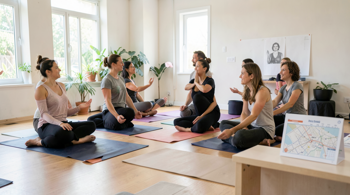
Other studios organize choices around the participant’s physical condition or preferred pace. A Troy, Michigan, studio categorizes gentle or restorative yoga as lower intensity, flow or vinyasa as moderate, and power or stronger flow as higher intensity. An Oakville, Ontario, studio emphasizes modifications, rest periods, comfortable clothing, water, and arriving 10 to 15 minutes early for a first class. 8 9
Checks before attending
Location and class title are not enough to establish suitability. Prospective participants should review age requirements, equipment instructions, accessibility information, registration rules, cancellation terms, and whether the session is suitable for beginners. Alexandria, Virginia, listings describe small classes of 10 or fewer students, a Friday evening yoga and sound meditation class, and a studio on the third floor without an elevator. 7
Instructor background is another relevant verification point. The research identifies Yoga Alliance as a registry connected with teacher standards and notes that certifications such as RYT-200 or RYT-500 may be considered when evaluating instruction. The American Council on Exercise is cited as a source for selecting qualified and safe fitness instruction. Neither credential replaces disclosure of injuries, medical conditions, or personal limitations to the instructor. 12 13
Practical limitations and schedule maintenance
Yoga information can become outdated quickly because classes move locations, fill capacity, pause for holidays, or change instructors. Brooklyn Bridge Park specifically warns that holiday weekends may be skipped and that events can change because of weather. London’s MoreYoga schedule illustrates another maintenance issue: one studio page may list numerous instructors, class categories, session lengths, and remaining spaces, but those details are tied to particular dates and should not be assumed to represent every week. 3 10
Search platforms also create market friction. A listing may omit accessibility details, show a recurring series without reflecting a cancellation, or send a virtual link only after enrollment. Some programs require waivers, age eligibility, specific equipment, or advance booking, while outdoor classes may lack guaranteed indoor alternatives. A sound comparison therefore records the official venue, date, format, requirements, instructor, and confirmation method rather than relying solely on a search-result summary.
What a reliable comparison should include
A practical local comparison can be organized around a few consistent fields: distance or neighborhood, class style, date and time, indoor or outdoor setting, beginner suitability, equipment, age range, accessibility, registration requirements, and the official host. This structure prevents a recurring park session from being compared directly with a paid studio membership or a multiweek hybrid course without acknowledging their different obligations.
The most dependable approach is layered verification. First identify possible venues through maps, directories, parks departments, studios, or aggregators. Then consult the host’s current page for the exact date, participation requirements, instructor, location, and status. Finally, consider whether the pace, physical demands, travel distance, and cancellation conditions match the participant’s needs. This process improves accuracy without assuming that any single platform contains every class in an area.
Sources
- Liquid Breathwork, “Find Yoga Near Me”
- NYC Parks, “Yoga”
- Brooklyn Bridge Park, “Morning Yoga”
- Waterloo Greenway Conservancy, “Yoga & Sound”
- Active, Bedford Hatha Yoga listing
- Charlotte Yoga, “Our Classes”
- A Touch of Serenity, Alexandria yoga information
- Reve Body, Troy yoga information
- iGita Yoga & Pilates, Oakville yoga information
- MoreYoga, Clapham Junction schedule
- Mindbody, Google Maps, YogaTrail, and ClassPass research references
- Yoga Alliance
- American Council on Exercise
Authored by MyTrendSpot team