Effective compression sleeves for ligament stability: An analysis of mechanical support and clinical utility
Compression sleeves are frequently utilized by athletes and individuals recovering from minor injuries to provide structural reinforcement for vulnerable joints 5. While these garments are common in fitness and clinical settings, their efficacy relies on specific design elements that address the complex requirements of ligament stabilization 5. This report analyzes the technical characteristics, biomechanical foundations, and practical considerations involved in selecting and utilizing these supports for long-term joint health.
Biomechanical Mechanisms of Joint Stabilization
Joint stability is maintained by a combination of passive structures, such as ligaments, and active structures, including tendons and muscles 5. When these systems face fatigue or previous injury, compression sleeves intervene by providing external support that augments the body's natural mechanics 5. By applying consistent pressure to the skin, these sleeves stimulate mechanoreceptors, which enhances proprioception-the sensory awareness of joint position-allowing the central nervous system to better control movement and load distribution 5. This enhanced feedback loop is a fundamental reason for the widespread use of compression gear in athletic environments 1.
Material Engineering and Graduated Compression
Professional-grade compression sleeves are often manufactured using specialized nylon and spandex blends that prioritize moisture-wicking and elasticity 1, 2. These materials are designed to facilitate prolonged daily use while maintaining structural integrity 8. Many high-quality sleeves utilize graduated compression, which improves venous return and helps manage post-injury swelling by reducing edema around the joint 2, 3. This physiological effect is distinct from static pressure and is critical for users managing recurring discomfort or soreness following high-intensity training 1, 6.
Structural Additions for Enhanced Support
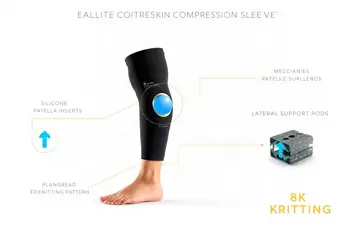
Standard elastic sleeves can be augmented with mechanical aids to improve stability beyond basic proprioceptive feedback. Integrated features like lateral rods and ergonomic silicone pads are commonly employed in orthopedic-grade designs to guide the knee joint and maintain natural positioning 1, 5. Furthermore, devices featuring malleable hinges allow for personalized adjustment, providing a middle ground between lightweight compression and rigid immobilization 3. These features are particularly useful for individuals managing mild to moderate strains of the ACL, MCL, LCL, or PCL 3.
| Feature Type | Mechanism of Support | Primary Indication |
|---|---|---|
| Graduated Compression | Improves circulation and reduces edema | General joint soreness, mild swelling |
| Silicone Inserts | Provides patellar tracking and massage | Patellar tracking, ligament irritation |
| Malleable Hinges | Limits lateral and rotational movement | Mild ligament tears, structural instability |
| Adjustable Straps | Provides customizable tension levels | Activity-specific support requirements |
Clinical Considerations and Proper Fitting
The efficacy of any compression sleeve is dependent on achieving a precise fit; a sleeve that is too loose will fail to provide the necessary resistance to movement, while one that is too tight can restrict blood flow and irritate the skin 4, 8. Users should measure their anatomy according to specific guidelines, often referencing the circumference of the thigh above the kneecap 3, 4. While sleeves are effective for proprioceptive enhancement and managing mild strains, clinical experts emphasize that they do not replace the structural integrity of a compromised ligament and should typically be used alongside physical therapy protocols 7, 8.
Maintenance and Long-Term Use
Maintaining the structural integrity of a compression garment is essential for its continued utility. Repeated stretching, heat from drying, and friction during activity can degrade the elasticity of the knit fabric over time 8. Users should monitor their gear for signs of wear, such as slipping during movement or loss of compression pressure, which often signal that the device no longer provides its original level of support 9. For those with sensitive skin, selecting breathable fabrics is crucial to mitigate potential dermatological irritation caused by extended wear during high-activity scenarios 8.
Categorization of Support Levels
The marketplace for compression supports spans from entry-level elastic garments to advanced, rigid-hinged braces. Understanding the distinction between these categories is vital for managing injury expectations. While soft compression sleeves offer benefits for neuromuscular control and swelling management, they do not provide the same mechanical blocking of abnormal motion as rigid, hinged braces 8. Athletes and patients should evaluate their specific activity demands-such as jumping, running, or heavy lifting-against the sleeve's design specifications to ensure the support matches the level of ligamentous risk 6, 10.
Sources
- Journal of Sport Rehabilitation: Proprioceptive feedback and joint stability.
- Cleveland Clinic: Compression therapy for joint injuries.
- Healthline: Benefits of graduated compression garments.
- WebMD: Importance of sizing in compression gear.
- Bauerfeind: Role of silicone buttress inserts in knee supports.
- PubMed: Dynamic stability and soft tissue compression mechanics.
- Verywell Health: Athletic use of compression for ligament strains.
- Mayo Clinic: Differences between rigid and soft bracing treatments.
- Runner's World: Performance compression gear and muscle fatigue mitigation.
- Physical Therapy Journal: Balancing tension for full range of motion.
Authored by MyTrendSpot team