Warning signs of Parkinson's disease: clinical context and early symptoms
Warning signs of Parkinson's disease can include more than the familiar tremor. Research and clinical references describe a gradual pattern involving sleep disturbances, reduced sense of smell, constipation, mood changes, handwriting changes, stiffness, slowed movement, and balance problems, although no single symptom confirms Parkinson's disease. 1
Early non-motor warning signs
Some symptoms may emerge during a prodromal phase, before the classic motor features become clear. Sleep disorders, loss of smell, constipation, depression, and anxiety have been reported as possible early indicators, sometimes occurring years before diagnosis. A University of Miami neurologist described non-motor symptoms appearing 10 to 15 years before movement symptoms in some people, while clinical reviews note that pathological changes may begin a decade or more before motor manifestations. 2 3
- Reduced or lost sense of smell without an obvious explanation.
- Persistent constipation or other autonomic changes.
- Depression, anxiety, or notable mood changes.
- Sleep disturbances, particularly acting out vivid dreams during REM sleep.
Sleep, smell, digestion, and mood
REM sleep behavior disorder, or RBD, is a particularly important research finding because it involves physically acting out dreams rather than remaining still during normal REM sleep. APDA reports that RBD has the strongest available data among potential pre-Parkinson's symptoms, and that more than half of people with RBD may later develop Parkinson's disease or a related disorder. Reduced smell, constipation, depression, and anxiety remain nonspecific, meaning they can occur for many reasons unrelated to Parkinson's. 1
- Sleep movements may include talking, shouting, or forceful actions during dreams.
- Loss of smell can be subtle and may involve difficulty identifying familiar odors.
- Constipation is relevant when it is persistent or represents a clear change from usual bowel habits.
- Mood symptoms should be considered alongside other neurological or physical changes.
Movement changes to monitor
Parkinson's motor symptoms commonly begin gradually and asymmetrically, affecting one side more than the other at first. A resting tremor may start in one hand, finger, thumb, chin, or lip, but not everyone with Parkinson's develops tremor. Bradykinesia, the clinical term for slowness of movement, can appear as difficulty initiating actions, reduced automatic movements, trouble rising from a chair, or progressively smaller handwriting. 3 4
- Shaking that is more noticeable when a limb is relaxed.
- Movements becoming slower, smaller, or harder to start.
- Small, cramped handwriting, sometimes called micrographia.
- Less frequent blinking, smiling, or other automatic movements.
Stiffness, posture, and walking
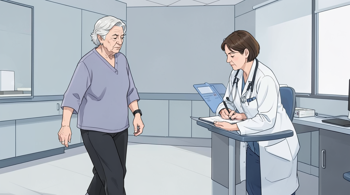
Rigidity can produce stiffness, reduced range of motion, or discomfort in the shoulder and neck, often more pronounced on one side. Walking and balance changes may include reduced arm swing, short steps, shuffling, freezing, difficulty turning, or a stooped posture. Postural instability is a recognized feature of Parkinson's disease, although balance problems can also result from medication effects, vision disorders, arthritis, inner-ear conditions, or other neurological disorders. 4 5
| Observed change | Possible Parkinson's-related pattern |
|---|---|
| Arm movement | Reduced swing on one side while walking |
| Stride | Shorter steps, shuffling, or difficulty turning |
| Posture | Progressive stooping or reduced ability to remain upright |
| Balance | Increasing instability or episodes of freezing |
Speech, facial expression, and swallowing
Changes involving communication and facial movement can be overlooked because they often develop slowly. Possible signs include a softer or lower voice, less expressive facial movement, reduced blinking, drooling, and difficulty swallowing. These findings can accompany the more recognizable motor symptoms, but they are not specific to Parkinson's disease. Speech or swallowing changes may also reflect other neurological, muscular, structural, or medication-related conditions, so their significance depends on the overall history and examination. 6 7
- Voice becoming quieter, less clear, or more monotone.
- Reduced facial expression or noticeably fewer spontaneous smiles.
- Drooling related to reduced swallowing frequency or motor control.
- Coughing, choking, or difficulty moving food and liquid safely.
What symptoms can and cannot establish
Parkinson's disease is diagnosed clinically through a medical history and neurological examination rather than by one warning sign alone. The National Institute of Neurological Disorders and Stroke describes the core pattern as tremor, rigidity, slowed movement, and postural instability, commonly beginning on one side. Similar symptoms may occur with other forms of parkinsonism, medication effects, stroke, essential tremor, sleep disorders, or unrelated age-associated conditions. Persistent, progressive, or one-sided changes merit assessment by a qualified healthcare professional. 8 9
- Record when symptoms began and whether they are worsening.
- Note whether changes affect one side more than the other.
- Describe medication use, sleep behavior, bowel changes, and family history during an evaluation.
- Seek prompt medical attention for sudden weakness, sudden speech difficulty, or abrupt loss of balance, which are not typical gradual warning signs.
How to interpret a changing symptom pattern
The most informative pattern is usually persistence or progression across several areas rather than an isolated complaint. For example, a new resting tremor combined with stiffness, smaller handwriting, reduced arm swing, or slowed movement is more concerning than occasional shaking alone. Likewise, constipation or loss of smell becomes more clinically relevant when paired with dream enactment, asymmetric motor changes, or reduced facial expression. The NHS and clinical references emphasize that early symptoms may initially affect only one side and develop slowly. 10
Evaluation does not automatically mean a Parkinson's diagnosis. A clinician may distinguish Parkinson's disease from related disorders by reviewing symptom timing, medication exposure, neurological findings, and response to treatment when appropriate. The condition is progressive and involves degeneration of dopamine-producing neurons, but the pace and combination of symptoms vary substantially. Early recognition can help identify other treatable causes of similar symptoms and establish appropriate monitoring without assuming that every warning sign represents Parkinson's disease. 3 5
Sources
- American Parkinson Disease Association, “Early Warning Signs of Parkinson’s Disease,” https://www.apdaparkinson.org/parkinsons-early-warning-signs-and-prevention/
- University of Miami Health System, “Early Parkinson’s Symptoms,” https://news.umiamihealth.org/en/early-parkinsons-symptoms-non-motor-warning-signs/
- NCBI Bookshelf, “Parkinson Disease: StatPearls,” https://www.ncbi.nlm.nih.gov/books/NBK470193/
- Merck Manual Professional Edition, “Parkinson Disease,” https://www.merckmanuals.com/professional/neurologic-disorders/movement-and-cerebellar-disorders/parkinson-disease
- Cold Spring Harbor Perspectives in Medicine, “Clinical Management of Parkinson’s Disease,” https://perspectivesinmedicine.cshlp.org/content/16/2/a041638.short
- MSD Manual Consumer Version, “Parkinson Disease,” https://www.msdmanuals.com/home/brain-spinal-cord-and-nerve-disorders/movement-disorders/parkinson-disease-pd
- Parkinson’s Foundation, “10 Signs of Parkinson’s Disease,” https://www.parkinson.org/understanding-parkinsons/10-signs
- National Institute of Neurological Disorders and Stroke, “Parkinson’s Disease,” https://www.ninds.nih.gov/health-information/disorders/parkinsons-disease
- Mayo Clinic, “Parkinson’s Disease: Symptoms and Causes,” https://www.mayoclinic.org/diseases-conditions/parkinsons-disease/symptoms-causes/syc-20376055
- National Health Service, “Parkinson’s Disease: Symptoms,” https://www.nhs.uk/conditions/parkinsons-disease/symptoms/
Authored by MyTrendSpot team