Best whale watching cruises from US Atlantic ports: A reported comparison of routes, seasons, and viewing conditions
Best whale watching cruises from US Atlantic ports vary substantially by geography, season, vessel type, and proximity to productive feeding grounds. The strongest documented options range from Massachusetts departures serving Stellwagen Bank National Marine Sanctuary to seasonal cruises from New York, New Jersey, Long Island, Maine, Rhode Island, Virginia, and North Carolina. Sightings remain wildlife encounters rather than guaranteed events, so route, timing, and conditions are central to evaluating each port.
Massachusetts ports and Stellwagen Bank
Boston, Gloucester, and Provincetown are among the most established whale-watching departure areas on the Atlantic coast because they provide access to Stellwagen Bank, a nutrient-rich feeding area between Cape Ann and Cape Cod. Humpback, fin, and minke whales are regularly reported there, along with dolphins and seabirds. Boston is the most convenient choice for travelers already visiting the city, while Gloucester places the cruise closer to open water. Provincetown is especially close to the sanctuary and has a whale-watching tradition extending more than 50 years. 1
Gloucester operators describe trips lasting approximately three to four hours, with offshore travel commonly taking 45 to 60 minutes each way and about 1.5 hours spent observing whales when animals are located. One Gloucester operator reports a sightings record above 99 percent, although the duration and distance can vary when whales are more than 25 miles offshore. Boston cruises operated in partnership with the New England Aquarium depart from Central Wharf, travel toward Stellwagen Bank, and include narration from Aquarium naturalists. 23
| Port | Documented characteristics |
|---|---|
| Boston | Urban access, Central Wharf departures, naturalist interpretation, approximately three-hour cruises. |
| Gloucester | Historic harbor, 45 to 60 minutes offshore, approximately 1.5 hours at feeding grounds. |
| Provincetown | Close position to Stellwagen Bank and a long-established whale-watching history. |
Maine and Cape Cod seasonality
Bar Harbor, Maine, is identified as a premier Gulf of Maine location for humpback, finback, and minke whales, with the principal viewing season generally running from June through October. Cape Cod offers another major concentration of cruises, particularly from Provincetown, where vessels can reach the Stellwagen Bank feeding habitat. These northern waters support multiple whale species because feeding conditions attract animals during the warmer months, but the exact composition of a trip changes with wildlife movement and ocean conditions. 4
Private Cape Cod charters represent a different format from large public vessels. Beth Ann Charters describes private trips of approximately 3.5 hours aboard a 38-foot boat, with panoramic viewing and capacity for small groups. Its published information identifies endangered right whales in spring and larger humpbacks and finbacks during the rest of the season. A private vessel can provide a more intimate setting, but a smaller boat may also expose passengers to more motion and offers fewer indoor facilities than a large cruise vessel. 5
New York, New Jersey, and Long Island departures
New York whale watching has experienced a resurgence as humpback whales have returned to feeding areas in the New York Bight. American Princess Cruises lists 2026 whale-watching and dolphin cruises from Pier 8 in Sheepshead Bay, Brooklyn, operating from April 11 through December 6. The operator describes a 17th year of service and a record of 95 or more mammal sightings, while listed passenger rates include adults, seniors, and children. Those figures describe the operator's published program, not a guarantee for every departure. 6
Long Island trips generally operate from late spring through fall, with many excursions concentrated between June and October. Montauk is the leading departure area because of its position near Montauk Point, Block Island Sound, and the open Atlantic. Private Susie E II charters from Montauk run for four hours and report opportunities to encounter humpback, minke, and finback whales, as well as dolphins. Belmar, New Jersey, offers an April through December season aboard the Jersey Girl, with possible sightings of humpbacks, dolphins, seabirds, and other marine life. 78
Rhode Island and other southern Atlantic ports
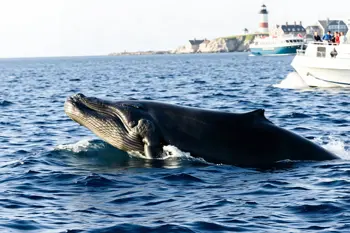
Newport, Rhode Island, has seasonal whale-watching excursions that use migration routes along the Atlantic coastline. The timing and species mix can differ from Massachusetts because boats may encounter animals traveling between feeding and other seasonal habitats rather than remaining around one fixed sanctuary. This makes Newport relevant for travelers based in Rhode Island, although the available research does not establish a single universal sightings rate or one consistently dominant species for every departure. 9
Virginia Beach is associated with winter whale watching, particularly sightings of endangered humpback whales between December and March. The Outer Banks of North Carolina also center much of their whale-watching interest on winter humpback migrations. These southern ports broaden the geographic range of Atlantic whale watching, but winter conditions can produce colder, rougher sea states and more weather-related variability. The available research supports seasonal opportunity, not a claim that whales will appear on every cruise. 10
How cruise formats differ
Large public cruises generally provide indoor and outdoor viewing areas, greater passenger capacity, and onboard naturalists who explain species identification, behavior, conservation, and marine ecology. The Boston experience combines those features with New England Aquarium interpretation, while Gloucester trips emphasize harbor history, protected-sanctuary context, and question-and-answer discussion during the return voyage. These characteristics make larger vessels practical for families and passengers who value facilities and educational narration.
Private charters from Montauk or Cape Cod offer smaller groups, closer control over departure style, and unobstructed viewing positions. The tradeoff is that smaller boats can have less cabin space and may respond more sharply to waves. Across all formats, trip length depends on where whales are located, and operators may travel substantially farther offshore when animals are not near the harbor. A responsible operator should explain marine-mammal viewing rules and maintain safe distances rather than pursuing animals aggressively. 2511
Limits, safety, and responsible expectations
Whale watching is inherently uncertain because whales move, feeding conditions change, and weather can affect navigation. Even a published high sightings record is a historical or operator-specific performance measure, not an individual-outing promise. Passengers should compare the stated season, approximate duration, offshore travel time, vessel facilities, cancellation policies, and whether naturalists are present. Reservations are commonly recommended in the available Long Island guidance, especially during the warmer months when demand and sailing frequency increase. 7
Marine conservation is part of the assessment, not an optional extra. Stellwagen Bank is recognized as critical whale habitat, and responsible viewing requires boats to avoid harmful approaches and maintain appropriate distances from marine mammals. Passengers should also account for seasickness, wind exposure, changing temperatures, and the possibility of a long return journey after limited activity. In practical terms, the most suitable port is usually the one that matches the travel location and season, rather than a universal ranking based solely on sightings claims. 1213
Sources
- DailyStoke, “Best Whale Watching in New England: Where and When to Go in 2026”
- 7 Seas Whale Watch, “Whale Watches in Gloucester, MA”
- New England Aquarium, “New England Aquarium Whale Watch in partnership with Boston Harbor City Cruises returns to Boston Harbor for 2026 season”
- Bar Harbor Whale Watch, operator information cited in the research brief
- Beth Ann Charters, “Private Whale Watch Tours”
- American Princess Cruises, “2026 Whale Watching and Dolphin Adventure Cruises”
- Long Island Guide, “Where can I whale watch?”
- Jersey Shore Whale Watch, “Belmar Whale Watching”
- Save The Bay, Newport seasonal whale-watching information cited in the research brief
- Virginia Aquarium and Outer Banks Visitors Bureau, seasonal whale-watching information cited in the research brief
- 7 Seas Whale Watch and Beth Ann Charters, vessel and trip-format information
- NOAA Stellwagen Bank National Marine Sanctuary, critical whale habitat information
- American Cetacean Society, responsible whale-watching guidance
Authored by MyTrendSpot team