Best glacier kayaking tours from Alaska cruise terminals: A neutral port-by-port guide
Best glacier kayaking tours from Alaska cruise terminals require matching the port, transfer time, water setting, and excursion length to the ship’s schedule. The main choices range from Juneau’s Mendenhall Glacier views and Seward’s tidewater-glacier paddling to Spencer Glacier iceberg kayaking from Anchorage and wildlife-focused routes in Ketchikan and Sitka. Each location offers a different balance of glacier proximity, wildlife, paddling time, and logistical complexity.
Juneau: Mendenhall Glacier views and longer wildlife routes
Juneau has the most clearly documented glacier-view kayaking options for cruise passengers. A small-group sea-kayaking trip meets at the main cruise ship dock beneath a blue tent near the Alaskan Public House, lasts about 3 hours 30 minutes, and limits participation to eight guests. The route crosses the Mendenhall Wetlands and estuarial waters, where the glacier can be viewed from approximately six miles away. Participants paddle individual kayaks, with double kayaks available by request, and receive dry suits and instruction. 1
The Juneau route is designed for beginners as well as experienced paddlers, but it is primarily a glacier-viewing and coastal-wildlife experience rather than a paddle directly to the ice face. Eagles, harbor seals, sea lions, and porpoises may appear along the route, although wildlife sightings remain uncertain. A separate six-hour Juneau excursion uses a small boat to reach a remote island in a humpback feeding area, followed by sea kayaking, a beach snack, and tide-pool exploration. Its downtown meeting point is near the Mt. Roberts Tramway and Taku Smokeries building. 2
Seward: Aialik Bay for tidewater-glacier paddling
Seward is a significant embarkation or disembarkation point rather than a standard mid-cruise port, and its strongest glacier-kayaking case is Kenai Fjords National Park. The Aialik Glacier day trip combines a boat journey with guided kayaking, assigning each group of six guests its own guide and using a 24-passenger water taxi to reach Aialik Bay. The trip also creates opportunities to observe whales, sea lions, otters, and puffins during the boat transfer. 3
Aialik Glacier is described by the operator as the park’s largest and most actively calving tidewater glacier, which makes it materially different from a route offering only a distant glacier panorama. Holgate Glacier is closer to Seward and may involve less travel, but it is smaller and calves less often according to the same comparison. Northwestern Fjord is another kayaking area, although the documented six-hour round-trip water journey makes it a demanding choice for a cruise schedule. The principal friction point is travel time: the most dramatic glacier setting requires substantial boat access before paddling begins. 3
Whittier and Anchorage: iceberg kayaking at Spencer Glacier
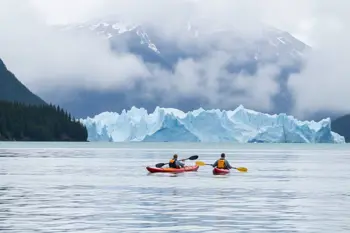
Whittier provides access to Prince William Sound, while Anchorage functions as the transportation base for several Spencer Glacier itineraries. The documented Spencer Glacier Iceberg Kayaking trip is a full-day summer activity lasting about seven to eight hours. It includes scenic stops along Turnagain Arm, travel on the Alaska Railroad’s Glacier Discovery train to Spencer Glacier Whistle Stop, shuttle transportation to the lake, and approximately 1 to 1.5 hours of kayaking among icebergs and smaller pieces of floating ice. 4
This format differs from sea kayaking beside a tidewater glacier because the paddling occurs on Spencer Glacier Lake, where the primary visual subject is floating glacier ice and the surrounding mountain landscape. The itinerary includes lunch, snacks, water, kayaking equipment, and professional guiding, with a maximum ratio of six adventurers per guide. The stated minimum age is 11 for the regular trip, while younger travelers are directed toward a private option. Anchorage hotel pickup is available, but private residences and vacation rentals are excluded from the stated pickup policy. 4
Sitka and Ketchikan: wildlife and rainforest alternatives
Sitka’s Siginaka Islands Cruise and Kayak Adventure is a three-hour excursion that begins at the lower promenade of the Sitka Sound Cruise Ship Terminal. A specialized sightseeing vessel carries participants to a private island paddle base, where two-person sea kayaks are used for a fully guided exploration. The itinerary identifies approximately 90 minutes of kayaking, along with instruction, outfitting, boat travel, and time at the paddle base. Marine-life possibilities include eagles, sea otters, porpoises, and colorful intertidal species. 5
Ketchikan’s four-hour kayak eco-tour travels to Clover Pass, about 15 miles north of town, with approximately 2 to 2.5 hours spent in kayaks. The route passes rainforest islands within the Tongass National Forest and is structured around protected coastal scenery rather than a close approach to a named glacier. Reported wildlife possibilities include Steller sea lions, seals, bald eagles, humpback whales, orcas, porpoises, salmon, deer, and occasionally black bears. Transportation is provided from downtown cruise docks and Ward Cove, and the stated guide-to-guest ratio is six to one. 6
How the tours compare
| Port or base | Main setting | Documented duration | Primary distinction |
|---|---|---|---|
| Juneau | Wetlands, coastline, Mendenhall Glacier views | 3.5 hours | Small groups and individual kayaks |
| Seward | Aialik Bay and Kenai Fjords | Day trip | Tidewater glacier and boat transfer |
| Whittier or Anchorage | Spencer Glacier Lake | 7 to 8 hours | Train journey and iceberg paddling |
| Sitka | Siginaka Islands | 3 hours | Island kayaking and intertidal wildlife |
| Ketchikan | Clover Pass and rainforest islands | 4 hours | Wildlife-focused protected waters |
For the closest documented match to glacier kayaking from a conventional cruise stop, Juneau provides direct Mendenhall Glacier views, while Seward offers the more substantial tidewater-glacier setting. Spencer Glacier is the strongest choice for iceberg-focused inland paddling, but its full-day structure creates more scheduling exposure. Sitka and Ketchikan are better understood as marine and wildlife kayaking alternatives, even though both can include glacially carved coastal scenery. 1 3 4
Scheduling, safety, and eligibility considerations
Alaska kayaking excursions operate in cold, changeable coastal conditions. Operators commonly provide dry suits, personal flotation devices, paddles, and other required equipment, while guides supply basic instruction for participants without prior kayaking experience. Basic physical fitness is generally expected, and travelers should evaluate the ability to enter and exit a kayak, paddle for the stated duration, tolerate cold conditions, and manage uneven shore terrain where hiking is included. 1 7
Weather is a central operational risk. High winds, heavy rain, rough water, poor visibility, or changing ice conditions can cause a route to be canceled, shortened, or redirected. The Mendenhall canoe, paddle, and hike itinerary lasts about 5 hours 30 minutes and includes Nugget Falls, Arctic tern nesting areas, glacier views, and a rocky hike, but it does not place visitors on the glacier itself. Cruise passengers also face transfer and return-time risk, so ship-sponsored excursions may provide more schedule coordination than independently arranged transportation, although no itinerary removes weather or port-operation uncertainty. 7 8
What to verify before selecting a port excursion
The most important comparison is not the word “glacier” in the tour title, but the actual relationship between the kayak and the ice. Mendenhall routes may provide broad glacier views, Spencer Glacier trips place kayakers among icebergs on a lake, and Aialik trips combine a long boat transfer with paddling near an actively calving tidewater glacier. Travelers should also verify the meeting location, total duration, transportation method, minimum age, kayak configuration, included clothing, and whether a hike or boat ride is part of the advertised schedule.
Wildlife descriptions should be treated as possibilities rather than promised outcomes. The documented tours mention whales, seals, sea lions, otters, eagles, porpoises, puffins, salmon, and other species, but sightings depend on season, weather, location, and animal behavior. Glacier activity also changes constantly, and calving areas require distance and guide oversight. The practical selection process therefore weighs glacier intimacy against transfer length, physical demands, weather exposure, and the consequences of a delayed return to the ship. 3 5 6
Sources
- Kayak Adventures Worldwide, “Glacier Kayaking Tours in Seward”
- Travel Network, “Juneau Small Group Sea Kayaking with Mendenhall Glacier Views”
- Kayak Adventures Worldwide, Aialik Glacier comparison and Kenai Fjords kayaking information
- Greatland Adventures, “Spencer Glacier Iceberg Kayaking”
- Travel Network, “Siginaka Islands Cruise and Kayak Adventure”
- Travel Network, “Ketchikan Kayak Eco-Tour”
- Travel Network, “Juneau Shore Excursion: Mendenhall Glacier Canoe, Paddle and Hike”
- GoNorth Alaska and Anchorage Activities, Spencer Glacier and Prince William Sound access information
Authored by MyTrendSpot team