The role of physical therapy in sciatica relief
The shooting, burning pain that travels from the lower back down through the buttocks and into the leg is one of the most recognized and debilitating symptoms in musculoskeletal medicine. Nearly 40% of people will experience sciatica at some point in their lives, making it one of the most common causes of leg pain seen in medical care. 1 Physical therapy has emerged as a consistently recommended first-line intervention, with a growing body of clinical research supporting its capacity to reduce nerve irritation, restore mobility, and lower the likelihood of surgical intervention.
What Sciatica Actually Is and Why It Matters for Treatment
Sciatica is not a standalone diagnosis but rather a symptom caused by irritation or compression of the sciatic nerve, the longest and widest nerve in the human body, which runs from the lower spine through the hips, buttocks, and down each leg. 2 The root of the sciatic nerve originates in the lower spine between the L4 and S3 vertebrae, and compression at any point along that pathway can produce pain, numbness, tingling, or muscle weakness. Common structural causes include herniated or bulging lumbar discs pressing on a nerve root, spinal stenosis (narrowing of the spinal canal), piriformis syndrome, degenerative disc disease, and facet joint inflammation. 3
Understanding the underlying cause is clinically significant because treatment selection depends on what is actually compressing or irritating the nerve. Exercises that relieve disc-related sciatica may worsen piriformis-related symptoms, and vice versa. This specificity is a core reason why structured physical therapy, which begins with a thorough diagnostic assessment, is preferred over generic self-treatment protocols. 4
Clinical Evidence Supporting Physical Therapy for Sciatica
The research base for physical therapy in sciatica management is substantial. A systematic review published in The Spine Journal found that physical therapy significantly reduced pain and disability in patients with lumbar radiculopathy, the clinical term for sciatica, with improvements that held at 12-month follow-up. 5 A separate analysis in the Journal of Orthopaedic and Sports Physical Therapy found that directional preference exercises, movements tailored to the specific behavior of a patient's nerve pain, outperformed general stretching for reducing leg pain intensity. 5
A landmark study from the New England Journal of Medicine compared outcomes for surgical discectomy against conservative care, including physical therapy, and found that results were similar at two-year follow-up for many patients. Surgery produced faster short-term relief, but physical therapy outcomes converged over time, and without the risks associated with an invasive procedure. 5 Additional data indicates that 85% of disc herniations resolve without surgery when managed with exercise and time, and that 96% of lumbar radiculopathy patients improved with conservative treatment alone. 6 Starting PT within 14 days of low back pain onset has also been associated with approximately $2,057 in savings per patient compared to delayed intervention. 6
Core Physical Therapy Interventions and Techniques
A structured PT program for sciatica typically unfolds across several phases rather than as a single uniform protocol. Early treatment focuses on calming acute nerve irritation through movement modification, positioning guidance, and carefully selected exercises. As symptoms stabilize, the program progresses toward strengthening, mobility restoration, and functional training for daily activities like sitting, standing, and lifting. 7 The McKenzie Method, also known as Mechanical Diagnosis and Therapy, is one of the most evidence-supported approaches for disc-related sciatica with a directional preference, using specific movements to centralize leg pain back toward the lower back as a marker of improvement. 8
Neural mobilization techniques, including slider and tensioner exercises that help the sciatic nerve move more freely through surrounding tissue, are another targeted intervention. A randomized controlled trial comparing neural mobilization techniques against conventional physical therapy in 60 participants with lumbar radiculopathy used the Visual Analogue Scale to measure pain intensity and the Oswestry Disability Index to track functional outcomes, finding meaningful differences between targeted and generalized approaches. 9 Manual therapy, including spinal joint mobilization and soft tissue work, improves range of motion, increases blood flow, and reduces nerve sensitivity. Therapeutic adjuncts such as ultrasound, electrical stimulation, and heat or cold therapy are frequently used alongside active exercise to manage acute inflammation. 10
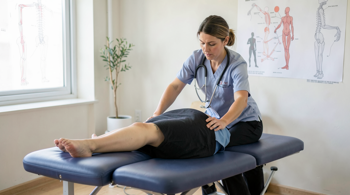
Specific Exercise Categories Used in Sciatica Rehabilitation
Physical therapists draw from several categories of exercise depending on patient presentation. Core stabilization exercises targeting the abdominals and lower back muscles help support the lumbar spine and reduce compressive load on intervertebral discs. Hip and glute strengthening reduces mechanical strain on the nerve pathway through the pelvis. Hamstring and piriformis stretching decreases the tension those muscles exert on the sciatic nerve. 11 Nerve gliding exercises help maintain or restore the normal mobility of the sciatic nerve through surrounding tissue, which can become restricted in chronic cases.
The sequence and selection of exercises matters considerably. Exercises that involve forward flexion of the lumbar spine may reduce symptoms in patients with spinal stenosis but worsen those with active disc herniation. Conversely, extension-based movements such as those emphasized in the McKenzie approach often benefit disc-related presentations but can increase symptoms in stenosis cases. 4 This is why generic exercise lists found outside of a supervised clinical assessment carry real risk of setback, particularly in the early stages of recovery.
Realistic Recovery Timelines, Limitations, and Risk Indicators
Most people with acute sciatica improve over several weeks of consistent conservative care, though timelines vary considerably based on cause, severity, and individual response. Many patients notice meaningful improvement within 2 to 6 weeks, with larger functional gains typically seen in the 6 to 12 week window when adherence to the home program is high. 12 Approximately 80 to 90% of acute sciatica episodes resolve within 6 to 12 weeks with structured non-surgical care. 8 Progress is often uneven, with better days mixed with temporary setbacks, and physical therapy rarely produces complete resolution after a single session.
There are clear red flags that indicate a need for urgent medical evaluation rather than outpatient physical therapy. Loss of bladder or bowel control, saddle anesthesia (numbness in the groin and inner thighs), or rapidly progressive bilateral leg weakness may indicate cauda equina syndrome, a surgical emergency. 8 Worsening neurological deficits, severe or rapidly escalating leg weakness, or symptoms that fail to respond to 6 to 12 weeks of structured conservative care also warrant escalation to a spine specialist for further imaging and evaluation. 3
Self-Management, Patient Education, and Long-Term Prevention
A core goal of physical therapy for sciatica is equipping patients with a repeatable self-management plan that reduces reliance on ongoing clinical appointments. This includes education on ergonomics, proper lifting mechanics, posture correction, and activity modification to avoid positions or movements that aggravate nerve irritation. 10 Patients who complete a structured PT program with directional preference exercises, neural mobilization, and core motor control training have demonstrated higher rates of long-term surgery avoidance compared to those who receive only passive treatments.
Physical therapy combined with activity modification and ergonomic adjustments consistently shows higher success rates than passive-only approaches such as bed rest or medication alone. 10 Extended bed rest is generally considered counterproductive, as it can decondition supporting musculature and sensitize the nervous system. Short walks, guided movement, and a structured home exercise program are broadly supported as more effective recovery strategies for the majority of sciatica cases. 3 Long-term outcomes depend heavily on patient engagement with home programs, lifestyle adjustments, and the accuracy of the initial assessment in identifying the specific mechanical driver of nerve irritation.
Sources
- Cleveland Clinic - Sciatica: What It Is, Causes, Symptoms, Treatment and Pain Relief (my.clevelandclinic.org)
- PT Solutions - Does Physical Therapy Work for Sciatica? (ptsolutions.com)
- Calibration PT - How Physical Therapy Treats Sciatica (calibrationptkc.com)
- Limitless Physical Therapy - Sciatica Exercises: What Physical Therapists Actually Recommend (limitlesspts.com)
- RPM Physical Therapy - Can Physical Therapy Help With Sciatica? What the Evidence Says (rpmwoodlandspt.com)
- Forward PT - Sciatica and Herniated Disc Physical Therapy: The Evidence (fwdptwi.com)
- Sciatica.pro - Physical Therapy for Sciatica: Cost and Results (sciatica.pro)
- Spectrum Therapeutics NJ - Sciatica Explained: Causes, Symptoms and Recovery Timeline (spectrumtherapynj.com)
- Allied Medical Research Journal - A Comparative Analysis of Neural Mobilization Techniques and Conventional Physical Therapy for Sciatica Pain Management in Lumbar Radiculopathy (ojs.amrj.net)
- ITNYCPT - Treatment for Sciatica: A Physical Therapy Approach (itnycpt.com)
- Hinge Health - Physical Therapy for Sciatica: Tips and Best Exercises (hingehealth.com)
- IHS Pain MD - Physical Therapy for Sciatica: A Symptom-Led Plan (ihspainmd.com)
Authored by MyTrendSpot team