Best red light therapy for skin healing: An evidence-based consumer guide
The phrase “Best red light therapy for skin healing” covers two different questions: which consumer devices may support skin appearance and recovery, and when light therapy belongs under medical supervision. Red and near-infrared photobiomodulation has plausible effects on inflammation, cellular activity, collagen production, and tissue repair, but results vary according to the condition, device parameters, treatment schedule, and wound type.
What red light therapy can and cannot do
Red light therapy, also called photobiomodulation or low-level light therapy, uses red or near-infrared light from LEDs or low-level lasers. Harvard Health reports that legitimate medical literature supports some dermatologic uses, while also noting that at-home masks, caps, and wands can cost several hundred dollars or more. The American Academy of Dermatology describes the likely improvements in signs of skin aging as modest and positions the treatment as complementary rather than a replacement for standard dermatologic care. 1
- Potential cosmetic targets include fine lines, firmness, texture, redness, and inflammation.
- Healing claims should be separated from treatment of open wounds, burns, infections, ulcers, or surgical incisions.
- Relaxation and ease of use do not establish clinical effectiveness.
Wavelengths associated with skin recovery
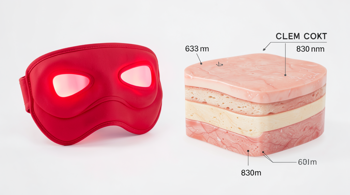
Consumer devices commonly focus on red wavelengths around 630 to 660 nanometers and near-infrared wavelengths around 810 to 850 nanometers. Product specifications in the supplied research include 633 nanometers and 830 nanometers for Omnilux Contour Face and CurrentBody, while LightStim describes a combination of red and near-infrared LEDs for localized facial treatment. These ranges are relevant to cosmetic skin concerns, but a wavelength number alone does not establish an effective dose or prove that a device treats a particular wound. 2
- Red light is generally positioned for more superficial skin effects.
- Near-infrared light is intended to reach deeper tissue than visible red light.
- Irradiance, exposure time, distance, and total energy also affect treatment delivery.
How device formats differ
Testing reported by Wirecutter covered 11 red-light devices over three months and identified three preferred formats: a rigid mask, a soft mask, and a wand. The reported testing emphasized comfort, convenience, and perceived firmness or fine-line benefits, while cautioning that the devices were most dependable as relaxing self-care tools rather than effortless substitutes for broader skin-care routines. Masks provide wider facial coverage, whereas handheld devices allow more localized positioning. 3
| Format | Typical use pattern | Important limitation |
|---|---|---|
| Rigid mask | Full-face treatment with fixed positioning | Fit and coverage may vary by face shape |
| Flexible mask | Closer contact with facial contours | Comfort and LED placement require assessment |
| Handheld wand | Targeted areas and localized treatment | Coverage depends on consistent repositioning |
What product claims actually establish
Manufacturers describe different intended uses and technical profiles. Dermalux Tri-Wave MD lists 415, 633, and 830 nanometers, adjustable power, cooling, and medically certified applications that include wound healing, but it is a professional platform rather than a typical home mask. Other supplied product pages describe features such as 660-nanometer red light, 470 micro-LEDs, or combinations including 630, 460, 610, and 850 nanometers. Those specifications document design claims, not independent proof that every advertised outcome will occur. 4
- FDA clearance applies to a specific intended use and does not validate every marketing statement.
- “Medical-grade,” “clinical,” and “full-spectrum” are not interchangeable evidence categories.
- Independent clinical studies should be distinguished from testimonials and manufacturer descriptions.
Safety and medical boundaries
Red-light therapy is generally considered low risk, but reported or plausible problems include temporary redness, irritation, headaches, and eye discomfort. The supplied research also identifies photosensitizing medicines and eye conditions as reasons to seek medical advice before treatment. At-home products marketed for wrinkles or acne should not be assumed to be appropriate for an open or slow-healing wound, diabetic ulcer, infection, burn, or post-surgical incision. Clinician-directed wound care takes priority in those situations. 5
- Follow the manufacturer’s exposure schedule rather than increasing sessions independently.
- Use supplied eye protection when the device design calls for it.
- Ask a clinician about medication-related light sensitivity or an existing eye condition.
How to evaluate a device before use
A practical assessment starts with verified wavelength output, published irradiance or dose information, and a clearly stated intended use. FDA clearance, where applicable, should be read as evidence of substantial equivalence for a defined purpose, not as a universal guarantee of healing. Coverage, fit, eye protection, warranty terms, and return policies affect whether a person can follow the treatment schedule consistently. Consistency matters because excessive exposure may increase irritation without improving results. 6
| Evaluation point | Question to ask |
|---|---|
| Wavelength | Are the red and near-infrared values clearly disclosed? |
| Dose | Are irradiance and session duration provided? |
| Regulatory status | What specific indication, if any, is cleared? |
| Safety design | Are eye protection and contraindications explained? |
| Practicality | Can the coverage, fit, and schedule be maintained? |
Evidence, expectations, and ongoing maintenance
Clinical and experimental literature provides biologic rationale for effects involving inflammation, cell proliferation, angiogenesis, and tissue repair, yet evidence differs by condition and protocol. Consumer reporting from Forbes involved nine panelists assessing seven masks, while CNN summarized dermatology commentary describing red-light therapy as supported by published studies but still dependent on appropriate device use. A reasonable expectation is gradual, variable cosmetic improvement rather than guaranteed wound closure, instant regeneration, or replacement of diagnosis and treatment. 7
- Results may require repeated sessions over an extended schedule.
- Skin type, condition severity, device output, and adherence can influence outcomes.
- Persistent redness, pain, drainage, spreading inflammation, or delayed healing warrants medical assessment.
Examples of marketed consumer configurations
The supplied market examples illustrate why comparison requires more than counting LEDs. Omnilux Contour Face and CurrentBody list 633- and 830-nanometer combinations, while LightStim is designed for localized facial use. INIA describes red, blue, yellow, and near-infrared modes, and Kivo lists red, near-infrared, blue, and yellow wavelengths. Blue or additional visible wavelengths may target different concerns, so a multi-light device should not automatically be treated as superior for skin healing. 8
- Red and near-infrared configurations are the most directly relevant to general cosmetic recovery claims.
- Blue-light modes are commonly associated with acne-focused positioning rather than wound care.
- More wavelengths can increase versatility but also complicate indication and safety assessment.
Bottom line for skin healing decisions
The most defensible choice is the device whose wavelength, dose information, intended use, eye-safety instructions, and regulatory status are clearly documented. Consumer masks may be reasonable for adjunctive cosmetic goals such as texture, mild redness, or the appearance of wrinkles, but evidence does not support treating every healing problem with an unsupervised home product. Manufacturer claims for scar softening, inflammation reduction, and recovery should be interpreted as claims requiring condition-specific evidence, not as universal outcomes. 9
For surgical recovery, chronic wounds, infections, burns, or suspected complications, assessment by a qualified clinician is more important than selecting a particular mask or wand. A 2026 review on near-infrared light and surgical wound healing reflects ongoing research, but the presence of research does not make every consumer device interchangeable with a supervised clinical protocol. The central decision is therefore not simply which product appears most powerful, but whether light therapy is appropriate for the specific skin problem at all. 10
Sources
- The New York Times Wirecutter, “The Best Red-Light Therapy Device”
- Forbes, “Best Red Light Therapy Masks 2026”
- Harvard Health, “Red light therapy for skin care”
- Dermalux, “Tri-Wave MD”
- FOREO, “FAQ 502 Full-Spectrum Red Light Therapy”
- The Piazza Center, “Lumara VISO LED Mask”
- INIA, “Red Light Therapy Set for Face, Neck, and Chest”
- CNN Underscored, “Red light therapy: What you need to know”
- Kivo Therapy, “Kivo Elite Face Mask”
- National Library of Medicine, “Effects of Near Infrared Light on Surgical Wound Healing”
Authored by MyTrendSpot team