Get your single-tooth dental implant in a single day: Clinical facts, eligibility, and treatment limits
Get your single-tooth dental implant in a single day is a treatment possibility rather than a universal guarantee. In suitable cases, a dentist may remove a failing tooth, place a titanium implant, and attach a temporary crown during one appointment, while the permanent crown is fitted after healing and bone integration. 1
What a single-day implant actually means
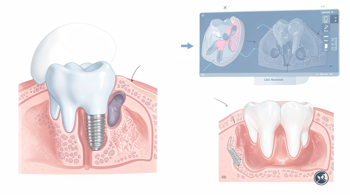
A single-tooth implant replaces the missing tooth root with a titanium post and restores the visible portion with a crown. Same-day treatment generally refers to immediate placement and a fixed temporary restoration, not completion of the entire treatment with a final permanent crown. The temporary tooth protects the area and supports appearance while the implant integrates with the jawbone. 2
When a failing tooth is removed, the implant may be placed into the fresh extraction socket if the surrounding anatomy allows adequate stability. Some clinical workflows can complete extraction, implant placement, and temporary crown delivery in one visit. Other cases require extraction first, healing, bone treatment, or a later implant procedure. 3
How clinicians assess eligibility
Eligibility depends on anatomy and oral health rather than the number of appointments a patient prefers. A clinical examination and three-dimensional CBCT scan can assess bone volume, nerve location, socket shape, and the planned implant position. Healthy gums, sufficient bone, and the absence of problematic infection are commonly cited requirements for immediate treatment. 4
Implant stability at placement is a central consideration. The implant must achieve enough initial fixation to support the temporary restoration without excessive movement during healing. Active gum disease, inadequate bone, unfavorable positioning, or a need for substantial grafting can make a staged approach more appropriate. Bruxism, meaning heavy or repetitive tooth grinding, may also increase mechanical risk. 5
The appointment and healing sequence
Planning often occurs before the surgical appointment and may include a CBCT scan, digital impressions, treatment design, and discussion of anesthesia or sedation options. Guided surgery and digital planning are used in some practices to improve positioning precision. The procedure itself commonly involves local anesthesia, with other sedation methods considered according to the patient and clinical setting. 6
After placement, the implant must integrate with the jawbone through osseointegration. Published clinical explanations commonly describe a healing period of several months before the final restoration is attached. One practice describes a typical integration period of three to four months, while other treatment guides describe approximately three to six months, showing why individual timelines vary. 7
Temporary tooth versus permanent crown
The tooth visible on the day of treatment is usually provisional. It is designed to provide appearance and limited function while the implant stabilizes, but it is not necessarily the final restoration in material, strength, fit, or cosmetic refinement. Patients may therefore leave with a complete-looking smile while still having an active healing process beneath the gum. 8
The permanent crown is normally produced and fitted after clinical checks confirm that the implant has integrated adequately. The final restoration may be custom designed to match neighboring teeth and establish an appropriate bite. Treating the provisional tooth as fully restored immediately can place unnecessary forces on the implant, particularly during the early healing phase. 9
Benefits and practical limitations
The main potential benefit of immediate treatment is consolidation of early treatment steps. A patient may avoid a prolonged visible gap and may undergo one surgical episode instead of separate extraction and implant appointments. Immediate placement can also help preserve the extraction-site architecture when the clinical conditions are favorable. These advantages must be weighed against the possibility that a same-day plan will be changed after examination or surgery. 10
Same-day treatment does not eliminate healing, follow-up, or dietary precautions. Hard or excessive chewing can place stress on the provisional restoration and the healing implant. Infection, insufficient stability, poor bone quality, gum disease, and uncontrolled grinding can increase the likelihood of complications. A staged procedure may involve more visits, but it can provide time for infection control, bone healing, or grafting before implant placement.
Questions to clarify before treatment
A careful consultation should establish whether the proposed restoration is temporary or permanent, what imaging has been performed, and whether extraction, grafting, or implant placement are all expected during one appointment. The clinician should also explain the alternative of delayed placement and identify the findings that would cause the plan to change. These details are important because “teeth in a day” describes a workflow, not a single standardized procedure.
Patients should also ask how implant stability will be evaluated, what foods and activities must be avoided, how follow-up visits will be scheduled, and when the final crown is expected. Long-term maintenance includes daily oral hygiene, professional monitoring, and attention to gum inflammation or excessive bite forces. The most reliable decision is therefore based on the CBCT findings, periodontal condition, bone anatomy, and restoration plan rather than speed alone.
Sources
- Cambridge Centre Dental Care, “Single Tooth Dental Implant Cambridge”
- Carolina Implants, “Huntersville NC Single Tooth Implants”
- Toothopia Dental, “Same-Day Tooth Extraction and Implant”
- Radiant Dental Care, “Same-Day Implants”
- Douglas Family Dental, “Single Tooth Implant”
- Landmark Dental, “Can Dental Implants Be Done in One Day?”
- Ponce Dental Studio, “Same-Day Dental Implants”
- ClearChoice, “Who Can Get One-Day Dental Implants?”
- Elite Dental Group, “Same-Day Dental Implants: Myth vs. Reality”
- WebMD, “Teeth in a Day”
Authored by MyTrendSpot team