How assisted living costs vary across the United States: A state-by-state analysis of prices, services, and coverage
National benchmarks provide context
National estimates differ because researchers use different surveys, dates, provider networks, and definitions of assisted living. Brevy Care reports a national median of about $6,200 per month, or $74,400 annually, based on CareScout 2025 survey information. 1 Stacker cites an average of $5,830 per month from A Place for Mom proprietary data, while an Investopedia report citing 2026 A Place for Mom data lists $5,419 monthly. 2 4
Older benchmarks remain substantially lower. The Assisted Living Authority identifies approximately $4,995 per month as the national median in the Genworth 2023 Cost of Care Survey. 8 These figures should therefore be treated as reference points rather than guaranteed provider rates. CareScout cautions that an individual community can differ significantly from a local median because location, services, and support requirements vary. 3
State-level differences are substantial
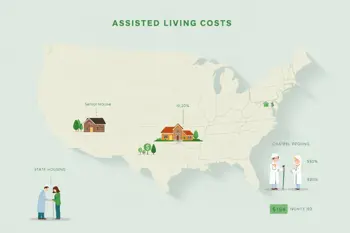
Published state data show a broad geographic spread. World Population Review lists annual median assisted living costs of $83,730 in the District of Columbia, $81,960 in Alaska, $81,915 in Rhode Island, $78,000 in Massachusetts, and $77,940 in New Jersey. 6 At the lower end, the same dataset lists $42,000 in Mississippi, $42,030 in Alabama, $42,420 in Georgia, $43,338 in South Carolina, and $44,979 in Louisiana. 6
Other research shows that rankings can change by methodology and year. Raya’s Paradise reports a national median of $6,200 per month from figures collected between July and November 2025, with a low of $4,369 in Mississippi and a high of $12,096 in Hawaii. 7 Newsweek, using a different A Place for Mom dataset, reports a median monthly cost of $8,960 in Washington, D.C., and $7,885 in Vermont. 9 These differences illustrate why survey definitions matter.
Local markets often matter more than state averages
A state median can conceal major differences between metropolitan, suburban, and rural markets. A Place for Mom identifies location, apartment size, amenities, and the amount of care required as major pricing factors. 2 Large metropolitan areas and sought-after destinations often have higher real-estate and labor costs, while local supply and demand can affect how communities set rates. 9
Labor is a central operating expense because assisted living depends on staff coverage throughout the day and night. CarePriced identifies local labor-market wages as the largest cost driver, alongside real estate, facility expenses, and services. 5 Regulatory requirements can also influence staffing models and facility operations. Since states use different licensing categories and definitions, a standard package in one state may include medication management or other assistance that is billed separately elsewhere. 8
Base rates do not always reflect the final bill
Assisted living commonly combines housing and personal support in a recurring monthly fee. Typical inclusions may involve a room or apartment, meals, housekeeping, laundry, transportation to medical appointments, social programming, staff oversight, and assistance with activities of daily living such as bathing, dressing, and medication management. 5 The exact bundle depends on the community and its state licensing framework.
Additional charges may apply for higher levels of personal assistance, medication management, memory-care services, physical or occupational therapy, premium transportation, and selected amenities. CarePriced reports that add-on charges can increase a base bill by approximately $500 to $1,500 per month. 5 Tiered or a la carte pricing also means that the monthly amount may rise after a resident’s care assessment changes. Apartment size, particularly the difference between a studio and a one-bedroom unit, can further alter the bill. 2
Licensing and public coverage differ by state
There is no single national label for assisted living. States may use terms such as residential care facility, personal care home, or assisted living community, with separate licensing agencies and rulebooks. 1 Those differences affect which residents a facility may serve, what services staff can provide, required oversight, and which costs appear in the standard rate. Comparing communities across state lines therefore requires reviewing services, staffing, and licensing terms rather than comparing monthly figures alone.
Medicare generally does not pay for long-term custodial care, including room, board, and routine assisted living stays, although it may cover separately billable medical services. 11 Medicaid is more state-specific. Federal policy does not allow Medicaid to pay for room and board in assisted living, but state programs and waivers may cover eligible care services for qualifying residents. 1 10 Eligibility, enrollment rules, covered services, and provider participation can differ substantially.
Financial planning includes several constraints
Families commonly combine personal income and assets with long-term-care insurance, home equity, veterans benefits, or Medicaid-covered services when eligible. 7 The Department of Veterans Affairs identifies Aid and Attendance as a potential benefit for qualifying veterans and survivors who need help with activities of daily living. 12 These resources have distinct eligibility standards, documentation requirements, exclusions, and payment limits, so they should not be treated as interchangeable sources of coverage.
The main planning risk is relying on a headline median without accounting for care progression, inflation, unit selection, move-in charges, and excluded services. Memory care generally costs more than standard assisted living because it requires enhanced supervision, secured environments, and specialized staffing. 4 Provider availability is another constraint: a state may show a moderate median while a particular county has limited supply or few communities able to meet complex needs. CareScout recommends using survey figures as a starting point, not as a prediction of an individual provider’s bill. 3
Sources
- Brevy Care, Assisted Living by State
- Stacker, How Much Does Assisted Living Cost?
- CareScout, Cost of Long Term Care by State
- Investopedia, What Assisted Living Costs Across the U.S.
- CarePriced, Assisted Living Cost in 2026
- World Population Review, Assisted Living Costs by State
- Raya’s Paradise, Assisted Living Cost Research
- Assisted Living Authority, Average Cost by State
- Newsweek, States With the Highest Senior Care Costs
- Medicaid.gov, Home and Community-Based Services
- Medicare.gov, Long-Term Care Coverage
- U.S. Department of Veterans Affairs, Aid and Attendance
Authored by MyTrendSpot team