Best pottery classes near me: An evidence-based guide to formats, costs, and studio policies
“Best pottery classes near me” can refer to very different experiences, including wheel throwing, handbuilding, pottery painting, one-time workshops, and multi-week instruction. The documented studio examples below show how class length, location, cost, age eligibility, materials, firing, and studio access can vary substantially, so proximity alone does not establish suitability.
How pottery classes differ by format
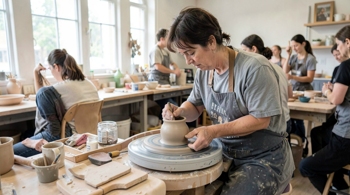
Pottery instruction generally centers on three areas: wheel throwing, handbuilding, and glazing or surface decoration. Wheel classes teach students to shape clay on a rotating wheel, while handbuilding uses pinch, coil, and slab methods. Some programs combine both approaches, as MudCity Clay’s eight-week series does, with glazing instruction using Cone 6 glazes. 1 KudoClay similarly describes beginner instruction in pinch, coil, slab construction, wheel techniques, and surface decoration. 10
One-time workshops are structured differently from continuing courses. Manna Pottery lists one-session “Try-It” classes lasting two and a half hours, while Lodi’s Meet the Maker describes a one-time wheel session for first-time participants and separate handbuilding instruction. 2 4 Multi-week formats allow projects to progress through forming, drying, glazing, and firing, but they require a recurring time commitment and may involve policies that do not apply to single-session events.
Documented class examples by location
The supplied examples cover several different markets rather than one local area. MudCity Clay is in Rochester, New Hampshire, and publishes an all-levels Wednesday afternoon series for adults and teens aged 14 and older. 1 Clay Creations serves adults who are new to clay in Pacifica, California, with introductory wheel classes scheduled on Monday, Wednesday, and Sunday options in the supplied listing. 3
Other examples illustrate regional variation. Manna Pottery is located in Sterling, Virginia, and offers wheel throwing, handbuilding, children’s programs, and one-session workshops. 2 Meet the Maker operates in Lodi, California, with classes for children, adults, and mixed child-adult participation. 4 A separate Washington, DC guide identifies studios and arts organizations offering beginner through advanced instruction, including wheel and handbuilding formats. 5
What published prices indicate
The research describes a typical United States single-session pottery workshop range of $60 to $120, depending on the studio and included materials. 11 Specific published examples fall within or near that range: Manna Pottery lists its one-session classes at $97, and Meet the Maker lists a one-time wheel class at $75. 2 4 Meet the Maker also lists a $35 handbuilding class and a $40 child-and-adult class, although those formats are not directly equivalent to a full wheel workshop.
Multi-week instruction carries a different cost structure. Clay Creations lists six-week introductory wheel sessions at $300, while the Memorial Art Gallery in Rochester, New York, lists a ten-week beginning class at $440. 3 7 Slip Studio lists an eight-week handbuilding session at $560, with additional firing charges calculated at eight cents per cubic inch. 8 These figures show why comparing a headline fee without checking duration and finishing charges can produce a misleading result.
Materials, firing, and studio access
Included materials differ by provider and class type. MudCity Clay states that materials and firing are included and that enrolled students may participate in Saturday open studio sessions. 1 KudoClay states that beginner enrollment includes tools, clay, glazes, and standard firings. 10 The Memorial Art Gallery includes a 25-pound bag of clay, glazes, and firing in its stated class cost. 7
Other studios separate some costs or access conditions. Slip Studio includes clay, underglazes, colored slips, commercial glazes, studio-made glazes, and studio equipment, but charges firing by cubic inch. 8 Clay Creations includes materials and provides open-studio access while a class is in session, according to its adult-class page. 3 Prospective students should therefore verify whether firing, glaze, tool use, missed-class access, and independent studio time are included or billed separately.
Eligibility and scheduling considerations
Age and experience requirements can narrow the relevant choices. MudCity Clay identifies its series as suitable for adults and teens aged 14 and older, while Trade Oak Cliff states that its pottery minimum is age 10 with a ticketed parent. 1 9 Clay Creations labels its listed introductory programs for adults, beginners, and intermediates, and KudoClay describes its foundation class as requiring no prior experience. 3 10
Scheduling also varies from one session to ten weeks. The Memorial Art Gallery example meets on Tuesdays for ten weeks, Clay Creations offers six-week sessions, and MudCity Clay publishes an eight-week Wednesday series. 7 3 1 Slip Studio allows missed classes to be made up during the scheduled session during specified afternoon hours, while its classes meet weekly and have a maximum of eight students. 8 These policies can matter as much as the class technique for people managing irregular schedules.
How to assess a nearby studio objectively
A useful comparison should record the studio’s exact address, class format, session length, skill level, age rules, class size, instructor support, and finishing process. The DC ceramics guide organizes studios by address, approximate price range, and skill level, illustrating a practical comparison framework rather than a universal ranking. 5 CourseHorse and ClassPass are identified as platforms that can help people compare local schedules, while Yelp is described as a source for reviews and studio availability information. 12 13 16
Potential friction points include separate firing charges, missed-class rules, membership waitlists, and changing schedules. Clay Creations requires prospective members to complete at least two sessions before membership consideration and gives priority to currently enrolled students. 3 The Memorial Art Gallery notes that programs with inadequate enrollment may be canceled before the first meeting and publishes registration and cancellation policies. 7 The supplied research does not identify a universal regulatory body overseeing pottery classes, so studio-specific safety, footwear, equipment, cancellation, and kiln policies require direct verification.
Sources
- MudCity Clay
- Manna Pottery
- Clay Creations
- Meet the Maker, Lodi Ceramics
- Not Bored in DC
- Kensington Pottery
- Memorial Art Gallery
- Slip Studio
- Trade Oak Cliff
- KudoClay Pottery Studios
- Craftsy
- CourseHorse
- ClassPass
- Ceramic Arts Network
- The Spruce Crafts
- Yelp
Authored by MyTrendSpot team