Police auction trailers by category: An analysis of government liquidation processes
Understanding Government Liquidation of Trailers
Government agencies at the federal, state, and local levels frequently manage surplus property by transitioning retired equipment into public auction channels. When investigating police auction trailers by category, it is essential to recognize that these items originate from diverse sources, including decommissioned agency vehicles, abandoned property from impound lots, and forfeited assets 1, 7. Because these items are classified as public assets, the liquidation process is subject to rigorous regulatory oversight, requiring transparent bidding, standardized payment terms, and clearly defined removal procedures for successful participants 2, 6.
Agencies typically use centralized platforms to aggregate these assets, often sorting them into specific buckets to help potential buyers identify equipment based on utility, weight class, or intended function 4, 5. Unlike private retail markets, police and government auctions are primarily designed for the efficient disposal of public property rather than profit maximization, meaning that inventory fluctuations depend entirely on the operational lifecycle of the department's fleet or the volume of seized property requiring processing at any given time 3, 6.
Common Categorization Standards for Auctioned Trailers
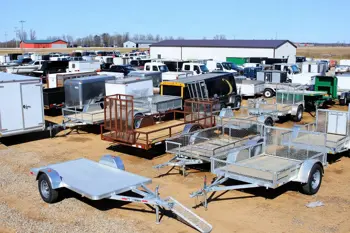
Auction houses and municipal agencies often group trailers into categories to streamline the inspection process for interested parties. Standardized classification systems typically include heavy-duty utility trailers, enclosed cargo units, flatbeds, and specialized equipment carriers such as boat trailers or livestock haulers 10. Furthermore, agencies may categorize these assets based on their Gross Vehicle Weight Rating (GVWR), which is critical for determining towing capabilities and registration requirements in accordance with local transportation regulations 10. Specialized items, such as decommissioned mobile command centers or evidence-processing units, are also occasionally listed, though these require specific mechanical knowledge due to their custom build-outs 10.
| Trailer Category | Primary Characteristics |
|---|---|
| Utility/Landscape | Open-bed designs, often used for grounds maintenance. |
| Enclosed Cargo | Protected storage for equipment or sensitive materials. |
| Flatbed/Hauling | Designed for heavy equipment and machinery transport. |
| Specialized Units | Mobile command centers or custom technical labs. |
The Role of Digital Platforms in Asset Disposal
Online platforms have largely replaced the need for in-person only bidding, significantly expanding the reach of surplus sales. Websites like GovDeals are frequently utilized by local law enforcement to host auctions for various assets, including trailers 2, 4. These systems provide centralized data points such as descriptions, photographic documentation, and sometimes 360-degree walkthroughs to assist remote bidders in assessing the condition of the lot before the auction closes 1. By centralizing the listing process, agencies ensure that records of the sale are maintained for auditability, which is a core component of public sector property management 6.
When searching through these platforms, users should note that the administrative burden of these auctions is handled through third-party services. This means that fees, such as buyer premiums and administrative costs, are often layered on top of the final bid price 1. Potential bidders must account for these additional costs when calculating their total acquisition expenditure, as these fees are standard across most government-contracted auction platforms and are non-negotiable at the point of payment 1.
Operational Realities and Condition Disclosures
A fundamental reality of participating in police-led trailer auctions is the 'as-is' status of the inventory. Government agencies provide documentation based on available records, but they rarely offer warranties or guarantees regarding the mechanical integrity or functional status of a trailer 2, 10. Some trailers might be decommissioned due to age or mileage, while others might be seized property with incomplete service histories 3, 9. Consequently, bidders are strongly encouraged to inspect the item, either in person or via the detailed disclosures provided by the agency, to understand the potential for future maintenance or repair requirements 1, 6.
Buyers should also be prepared for variations in title status. While some assets are sold with a clear, clean title, others-particularly those categorized as salvage or abandoned property-may carry specific restrictions 2, 8. In instances where documentation is limited to a bill of sale, the buyer assumes responsibility for obtaining the necessary registration or title from the local department of motor vehicles, a process that can involve significant administrative effort depending on the state of origin 2.
Compliance, Payment, and Removal Procedures
Participating in government surplus auctions necessitates strict adherence to established protocols regarding payment and asset retrieval. Payment timelines are generally tight, with many agencies requiring full settlement within five business days, often via wire transfer or cashier's check 10. Late payments or failure to collect items within the designated windows can result in the forfeiture of the lot or the application of significant daily storage fees, which can quickly erode the economic feasibility of the acquisition 1.
Safety and regulatory compliance also play a major role in the removal process. Because these auctions are often held on secured police or government lots, participants may be subject to restricted access, requirements to be over the age of 18, and prohibitions against bringing unauthorized items into the auction area 9. Successful bidders must often arrange for their own transportation of the trailer, ensuring that the towing vehicle is appropriately rated for the weight and type of the trailer being claimed, particularly for heavy-duty or specialized equipment 9, 10.
Market Risks and Due Diligence
Individuals exploring the purchase of trailers from law enforcement auctions should exercise caution regarding the condition and legal status of the items. It is advisable to run a check on the Personal Property Securities Register (PPSR) or equivalent local vehicle history databases, even if the auctioneer provides a general warranty, as rare encumbrances can exist on government-disposed assets 8. Furthermore, because many police auctions focus on the liquidation of equipment that has outlived its agency use, prospective buyers must evaluate the cost of potential refurbishment against the value of buying equipment through standard market channels 3.
The transparency provided by public notice requirements ensures that information regarding auctions is made available in advance, but the onus remains on the bidder to perform due diligence before submitting a bid. Recognizing that police departments are not commercial retailers, buyers should not anticipate the same level of post-purchase support or customer service found in the private sector. By maintaining a clear understanding of the risks associated with surplus property, buyers can effectively navigate these auctions while minimizing the potential for unforeseen legal or mechanical challenges 6, 8.
Sources
- https://bids.oaikc.com/auctions/45682-2026-03-03-kc-tow-lot
- https://www.jacksontwp.net/post/public-notice-police-fire-govdeals-auctions
- https://www.keizertimes.com/2025/10/16/keizer-police-auctioning-off-a-trailer-motorcycle-and-cars/
- https://www.govdeals.com/en/trailers/ohio
- https://ppms.gov/auctions/auctions-list?advanced=true&categoryCodes=200&status=active
- https://pugetpress.com/2026/06/08/jefferson-county-surplus-vehicle-auction/
- https://www.usa.gov/auctions-and-sales
- https://auctionfinder.com.au/c/upcoming-police-auctions-in-australia/
- https://ccpdblotter.com/2025/09/29/on-site-auction-and-live-online-webcast-4/
- https://www.govdeals.com
Authored by MyTrendSpot team