Warning signs of osteoporosis: clinical findings and when evaluation matters
Warning signs of osteoporosis are often absent in the early stages, which is why the condition is widely described as a silent disease. The first recognizable evidence may be a fracture after a minor fall, ordinary movement, or an activity that would not usually break a healthy bone. Later findings can include back pain, shrinking height, and a stooped posture. 1
Why osteoporosis can remain unnoticed
Osteoporosis develops when the body removes old bone faster than it replaces it, leaving bones thinner, less dense, and more fragile. Early bone loss usually does not produce a distinctive sensation, visible change, or daily symptom. A person may therefore have reduced bone strength without knowing it, even while continuing normal work, exercise, and household activities. 1
The absence of pain does not establish that bones are healthy. Many diagnoses occur only after a fracture or during a bone-density assessment performed because of age, menopause, family history, medication exposure, or another risk factor. This lack of early symptoms is clinically important because waiting for discomfort can mean waiting until substantial bone weakness has already developed. 2
Fractures after minor impact
A bone that breaks much more easily than expected is one of the clearest warning signs. Osteoporosis-related fractures commonly involve the hip, wrist, or spine, although weakened bone can fracture elsewhere. A fall from standing height or less, a small stumble, or routine activity followed by a fracture may indicate a fragility fracture rather than an unusually severe accident. 1
A previous fragility fracture is important even when the person feels recovered and even when bone density has not yet been measured. Cleveland Clinic describes osteoporosis as capable of causing breaks during routine activities or minor falls. Such an event warrants discussion with a healthcare professional about bone health, fracture risk, possible underlying causes, and whether formal testing is appropriate. 2
Back pain and spinal changes
Sudden, persistent, or unexplained back pain can reflect a vertebral compression fracture. These fractures may occur without a dramatic injury because weakened spinal bones can collapse under ordinary loads. Pain may be localized or may interfere with standing, movement, and everyday function. Back pain has many possible causes, so it cannot confirm osteoporosis by itself, but new pain in a person with risk factors merits medical assessment. 3
Repeated spinal fractures can alter the shape of the spine and gradually reduce mobility. A person may find it harder to stand upright, experience reduced range of movement, or develop discomfort while remaining in one position. Spinal fractures can also occur with limited outward warning, making changes in function or posture relevant even when no single fall explains them. 10
Height loss and a stooped posture
Losing height over time may signal compression of the vertebrae. Mayo Clinic identifies loss of height as a symptom that can appear after osteoporosis has weakened the spine, while other clinical sources describe a measurable reduction in stature as a reason to investigate bone health. A gradual change can be difficult to notice without comparison, so repeated measurements may provide useful information for a clinician. 1
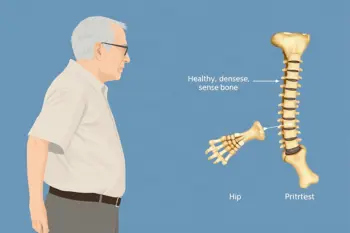
A forward curve of the upper back, known as kyphosis, may develop after multiple spinal fractures. It can appear as a hunched or stooped posture and may make standing straight uncomfortable. Kyphosis has causes other than osteoporosis, so posture alone is not diagnostic. In combination with height loss, back pain, or a low-impact fracture, however, it represents a stronger reason for evaluation. 6
Who has increased risk
Risk rises with age and is particularly significant for women after menopause, when hormonal changes can accelerate bone loss. Osteoporosis can also affect men, and it is not limited to one racial or ethnic group. A parent or sibling with osteoporosis, especially a parent who experienced a hip fracture, is an important family-history signal. Early menopause is another reason to discuss assessment. 1
Long-term corticosteroid use is a recognized risk factor, particularly when these medicines have been taken for several months. Other information relevant to assessment includes low body weight, smoking, and medical conditions or treatments that affect bone remodeling. These factors do not prove that osteoporosis is present, but they can influence eligibility for screening and the urgency of a clinical review. 7
Testing and clinical evaluation
A bone-density test can identify low bone mass before a fracture occurs. The most common test is dual-energy X-ray absorptiometry, often called DEXA, which typically assesses the lumbar spine, hip, and femoral neck. Harvard Health describes the procedure as brief and involving substantially less radiation than a standard chest X-ray. Results help clinicians estimate bone strength and fracture risk. 6
Screening recommendations depend on age, sex, menopausal status, and individual risk. The U.S. Preventive Services Task Force recommends bone measurement testing for women aged 65 years or older and for postmenopausal women younger than 65 who have increased risk. A healthcare professional may also consider testing after a low-impact fracture, notable height loss, unexplained spinal pain, early menopause, prolonged corticosteroid exposure, or a strong family history. 10
What the warning signs mean in practice
None of these findings should be interpreted in isolation as proof of osteoporosis. Back pain can result from several conditions, posture can change for reasons unrelated to bone density, and a fracture can occur without osteoporosis. The useful clinical pattern is the combination of an unexpectedly easy fracture, spinal symptoms, height reduction, posture change, or established risk factors. A structured assessment can distinguish osteoporosis from other explanations. 4
Evaluation matters because osteoporosis can affect mobility and daily activities after fractures, particularly when the hip or spine is involved. Bone health assessment may include medical history, medication review, physical examination, and bone-density testing. Treatment decisions are individualized and can involve exercise, nutrition, fall prevention, and medicines that slow bone loss or build bone, depending on the measured risk and clinical findings. 7
Sources
- Mayo Clinic, “Osteoporosis: Symptoms and causes”
- Cleveland Clinic, “Osteoporosis: Symptoms, Causes & Treatment”
- Penn Medicine, “Osteoporosis: Symptoms and Causes”
- GoodRx, “What Are the Early Signs of Osteoporosis?”
- AARP, “10 Osteoporosis Warning Signs and Bone Health Risks”
- Harvard Health Publishing, “How to know if your bones are thinning”
- Acibadem Hospitals Group, “Osteoporosis: Early Warning Signs, Risk Factors, and Bone Density Testing”
- Medscape, “Osteoporosis: A Bare-Bones Guide to Diagnosis and Management”
- Prevention, “5 Early Signs of Osteoporosis Doctors Say You Shouldn’t Ignore”
- U.S. Preventive Services Task Force, “Osteoporosis Screening”
Authored by MyTrendSpot team