Affordable riding lawn mowers near me: A Guide to Market Realities and Residential Selection
Understanding the Market for Residential Riding Mowers
For many property owners, the transition from push mowers to riding equipment is driven by the desire to reduce physical fatigue and decrease the time required for weekly lawn maintenance 1. The market for riding mowers is segmented by cutting deck size, engine power, and steering capability, with residential models typically ranging from 30 to 46 inches in cutting width 2. Identifying a machine that fits specific property needs requires balancing upfront expenditure against long-term maintenance requirements and operational efficiency 3.
Retailers including Home Depot, Lowe’s, Walmart, and other regional suppliers offer diverse catalogs that can be filtered by deck size, brand, and transmission type 4, 5. While online portals are useful for comparative analysis, actual costs can fluctuate based on local availability, assembly fees, and transportation costs 6. It is essential for consumers to verify regional pricing by checking the specific inventory assigned to their local store via postal code filters on retail websites 7.
Common Models and Specifications
Manufacturers offer a wide variety of entry-level lawn tractors designed for lawns up to 1.5 or 2 acres 8. The Troy-Bilt Bronco 46, for example, features a 547cc engine and a 46-inch twin-blade deck, often favored for its AutoDrive transmission that simplifies speed control for the operator 9. Similarly, the Murray MT100 utilizes a 13.5 HP, 500cc Briggs & Stratton engine, providing a balance of power and maneuverability for medium-sized residential properties 10.
Other popular entry-level options include the John Deere S100 series and the Cub Cadet XT1 LT42, both of which are common fixtures in residential lawn care 11. These machines generally utilize 42-inch cutting decks, which represent a standard balance between tight-space maneuverability and wider-path efficiency 12. When evaluating these models, users often look for features such as anti-scalp wheels, which minimize damage to uneven turf, and comfortable mid-back seating to reduce vibrations during operation 13.
Comparing Transmission and Performance Features
Transmission type is a significant factor in both ease of use and long-term machine value. Many entry-level riders utilize manual or foot-pedal operated automatic transmissions 14. While manual gear-driven transmissions may require more active shifting, hydrostatic or automatic foot-pedal systems offer a more intuitive experience for first-time riders, allowing for seamless changes in ground speed without stopping to shift gears 15. This is a critical consideration for properties with many trees, garden beds, or irregular obstacles.
| Feature | Purpose | Common Benefit |
|---|---|---|
| 42-inch Deck | Cutting width | Standard for average residential plots |
| 547cc Engine | Power output | Handles thick grass and minor overgrowth |
| AutoDrive | Transmission | Simplified, hands-free speed management |
| Anti-Scalp Wheels | Deck protection | Prevents turf damage on uneven ground |
The Role of Used Equipment in the Market
Purchasing pre-owned equipment is a common strategy for individuals seeking to minimize investment while maintaining utility 16. Older models, such as the MTD Yard Machine 638RL, are often available through private listings and can serve as functional, budget-conscious alternatives to new machinery 17. However, procuring a used mower requires careful inspection of the deck for corrosion, as rusted cutting decks are a primary indicator of structural degradation that can be expensive to remediate 18.
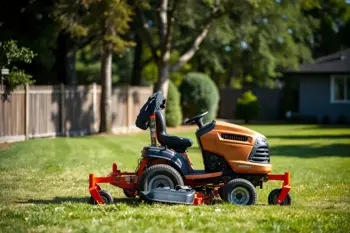
Beyond the deck, prospective buyers should verify the integrity of the drive belts, check for excessive smoke during engine operation, and assess the state of the battery and tires 19. Reviewing the hour meter is a common practice to gauge the engine’s total usage history. If service records are unavailable, buyers should factor the potential cost of immediate repairs, such as oil changes, carburetor cleaning, or blade replacement, into the total acquisition cost 20.
Battery-Powered Alternatives
The rise of battery-powered riding mowers has introduced a shift in residential maintenance expectations. These machines replace internal combustion engines with electric motors, effectively removing the need for fuel management, spark plug changes, and oil maintenance 21. While these units often come at a higher initial price point than gas-powered tractors, the potential reduction in ongoing engine service may appeal to owners seeking a simpler maintenance routine 22.
Buyers interested in electric models must account for total battery runtime compared to the size of their property. Charging times, charger compatibility, and the projected replacement cost of lithium-ion battery packs are critical long-term factors that should be weighed against the convenience of quiet, low-maintenance operation 23. Unlike gas engines, which can be refueled quickly, electric mowers are tethered to the constraints of their battery life and recharge cycles 24.
Navigating Maintenance and Operational Risks
All riding mowers carry inherent risks and maintenance obligations that are essential for long-term reliability. Regardless of brand or price point, operators should be familiar with the manufacturer’s service schedule, which typically includes routine belt tensioning, deck cleaning, and regular blade sharpening to ensure a high-quality cut 25. Ignoring these maintenance items can lead to increased engine strain and reduced longevity of the cutting deck assembly 26.
Safety remains paramount, and manufacturers emphasize that users should read the operator’s manual thoroughly before the first use. Key safety practices include clearing the lawn of debris such as rocks or thick branches, never operating on slopes exceeding the recommended incline, and ensuring that all guards are securely in place during operation 27. By adhering to these operational standards, property owners can optimize the safety and lifespan of their equipment investment 28.
Sources
- Popular Mechanics: The 8 Best Riding Lawn Mowers of 2026
- Lowe’s: Gas Riding Lawn Mowers and Shopping Filters
- Consumer Reports: Best Riding Lawn Mowers of 2026
- The Home Depot: Outdoor Power Equipment and Riding Mowers
- Lowe’s: Riding lawn mowers and shopping inventory
- Walmart: Retailer-specific pricing and local inventory access
- Tractor Supply Co.: Riding mower listings and product catalogs
- Menards: Riding mower and lawn tractor categories
- Walmart: Troy-Bilt Bronco 46-inch Riding Mower features
- The Lawn Market: Murray MT100 42-inch Performance and Specifications
- John Deere: S100 Series Entry-Level Lawn Tractors
- Cub Cadet: XT1 LT42 Residential Lawn Tractor Overview
- Husqvarna: TS 142 Compact Riding Mower Specifications
- Toro: Homeowner Riding Mower and Tractor Options
- Ariens: Residential Zero-Turn and Riding Equipment
- Ronmowers: MTD Yard Machine 638RL Used Equipment Evaluation
- Men’s Journal: Troy-Bilt Pony 42-inch Market Pricing Insights
- General Maintenance: Inspection guidelines for used lawn equipment
- General Maintenance: Engine and structural verification checklist
- General Maintenance: Long-term service considerations for riding mowers
- Technical Overview: Comparison of electric versus gas-powered propulsion
- Market Data: Maintenance cost comparisons for lawn equipment
- Battery Technology: Runtime and recharge factors for residential mowers
- Operations Guide: Factors influencing battery-powered mower selection
- Manufacturer Guidelines: Routine service schedules and deck maintenance
- Technical Data: Longevity and engine strain management
- Safety Standards: Operational precautions for lawn tractors
- Product Usage: Best practices for residential mower maintenance
Authored by MyTrendSpot team