Warning signs of Müllerian agenesis: A clinical guide to early recognition
Warning signs of Müllerian agenesis most often involve primary amenorrhea, meaning menstrual periods have not started by the expected teenage years, even though breast development and other pubertal changes appear typical. The condition is congenital and commonly involves absence or severe underdevelopment of the uterus and upper vagina, while ovarian function is usually preserved. 1
Primary amenorrhea is the clearest warning sign
The most common way Müllerian agenesis is recognized is when menstruation has not begun by age 15 or 16. Yale Medicine identifies failure to start periods during the teenage years as the typical first presentation of Mayer-Rokitansky-Küster-Hauser syndrome, or MRKH. The absence of menstrual bleeding is not itself a diagnosis, but it is a reason for structured medical evaluation because several conditions can cause primary amenorrhea. 1
Affected individuals usually experience typical puberty because the ovaries are generally present and functioning. Breast development, pubic hair growth, hormone production, and the external appearance of the genitals may therefore seem ordinary. This combination, normal secondary sexual characteristics with no first period, is an important clinical pattern that distinguishes Müllerian agenesis from some other causes of delayed puberty. 4
Vaginal symptoms may reveal an anatomical difference
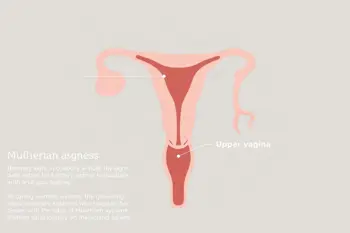
Müllerian agenesis can include absence or marked underdevelopment of the upper two-thirds of the vagina. The lower portion may still be present, but the canal can be shorter than expected or end in a blind pouch. As a result, some people report difficulty inserting tampons, inability to do so, or pain and difficulty with vaginal penetration. These symptoms may be noticed during adolescence or later during attempts at sexual activity. 4
Not everyone has vaginal symptoms, and some people remain unaware of the anatomical difference until an examination or imaging study is performed. Pain with intercourse and problems using tampons are also associated with other Müllerian anomalies, so they do not establish MRKH on their own. A careful assessment is needed to distinguish a shortened vaginal canal from conditions involving obstruction, inflammation, or other structural differences. 3
Pelvic pain requires particular attention
Pelvic pain is a recognized symptom across the broader group of Müllerian anomalies, although many people with these congenital differences have no symptoms. In Müllerian agenesis, cyclic pelvic pain can occur when a functioning rudimentary uterine structure or uterine remnant is present but has no effective outflow tract. Blood or secretions may collect behind the obstruction, producing pain that follows a monthly pattern even without visible menstrual bleeding. 2
Painful or difficult periods, pelvic pain, and problems with intercourse are common warning categories for Müllerian anomalies generally, but their meaning depends on the anatomy involved. Severe, recurrent, or unexplained pain should not be dismissed simply because periods are absent. Imaging can identify whether uterine remnants, obstructed structures, or another anatomical explanation is present. 2
Associated kidney and skeletal findings
Müllerian structures and the urinary system develop in close relationship before birth, so kidney differences can accompany MRKH, particularly in Type II disease and MURCS association. Reported findings include a missing kidney, a kidney located outside its usual position, or a horseshoe kidney. Yale Medicine also notes possible problems involving the spine, hearing, and heart, making a broader health history relevant when Müllerian agenesis is suspected. 1
Skeletal abnormalities may involve the vertebrae and cervical spine, while hearing impairment is a less common feature associated with the more complex Type II phenotype. These findings are not required for diagnosis, and their absence does not exclude Müllerian agenesis. However, a personal history of kidney disease, spinal differences, hearing problems, or congenital heart concerns can provide useful context for clinical evaluation. 4
Infertility and reproductive implications
Because the uterus is absent or severely underdeveloped in MRKH, carrying a pregnancy is generally not possible with the person’s own uterus. Ovarian function is usually preserved, however, so reproductive counseling may address the availability of eggs and different family-building pathways. Difficulty becoming pregnant can also be a sign of other Müllerian anomalies, including forms in which a uterus is present but shaped or divided abnormally. 1
Problems with vaginal intercourse may result from a shortened or absent upper vagina, but sexual health outcomes vary and should not be inferred from anatomy alone. Yale Medicine describes treatment planning as individualized, including shared decision-making about approaches to creating a functional vaginal canal when desired. Emotional support is also relevant because diagnosis may carry substantial physical and psychological effects. 1
How clinicians investigate warning signs
Evaluation commonly begins with medical history, pubertal development, and a physical examination, followed by imaging to assess the uterus, cervix, vagina, ovaries, and related structures. Pelvic ultrasound is often used initially, while magnetic resonance imaging can provide more detailed anatomical information when ultrasound findings are incomplete or complex. Imaging also helps identify associated renal or skeletal differences and distinguish Müllerian agenesis from other causes of primary amenorrhea. 1
Laboratory and genetic testing may be included because conditions with similar presentations must be separated clinically. Karyotype testing can help confirm a 46,XX pattern and distinguish MRKH from androgen insensitivity syndrome, which is associated with a 46,XY chromosome pattern. A diagnosis should therefore be based on the combined findings of development, examination, imaging, and appropriate testing rather than on one symptom alone. 4
When assessment is appropriate
A medical assessment is appropriate when menstruation has not started by age 15 or 16, particularly when breast development and pubic hair growth have occurred normally. Evaluation is also warranted for repeated cyclic pelvic pain without bleeding, difficulty inserting tampons, painful or difficult penetration, or a history suggesting kidney, spinal, hearing, or heart differences. These signs can reflect Müllerian agenesis or another condition requiring different care. 1
Müllerian anomalies are congenital, not caused by personal behavior, and some cases are discovered incidentally because they produce no symptoms. Earlier recognition can clarify the anatomy, identify associated health findings, and support informed decisions about treatment, sexual health, fertility, and emotional care. Specialist evaluation is particularly useful when the anatomy is complex or when symptoms are persistent. 2
Sources
- Yale Medicine, Mayer-Rokitansky-Küster-Hauser (MRKH) Syndrome: https://www.yalemedicine.org/conditions/mayer-rokitansky-kuster-hauser-mrkh-syndrome
- Yale Medicine, Müllerian Anomalies: https://www.yalemedicine.org/conditions/mullerian-anomalies
- University of Colorado Anschutz Medical Campus, Müllerian Anomalies: https://medschool.cuanschutz.edu/womens-health/clinics/health-info/mullerian-anomalies
- UniteRare, Mayer-Rokitansky-Küster-Hauser Syndrome: https://www.uniterare.org/diseases/mayer-rokitansky-kuster-hauser-syndrome
Authored by MyTrendSpot team