Signs you may have mild tendon strain: A Clinical Guide to Early Symptoms and Safe Next Steps
Signs you may have mild tendon strain often begin as localized discomfort near a joint after repeated activity, a sudden increase in exercise, or physically demanding movement. Early symptoms can include pain during motion, tenderness over the tendon, stiffness, minor swelling, and a mild reduction in strength. These signs can overlap with tendinopathy, muscle strain, or a more serious tear, so symptom patterns alone cannot establish a diagnosis. 1
Localized pain during movement
A mild tendon problem commonly produces pain in a specific area rather than a broad ache throughout the limb. Discomfort may become more noticeable when the affected tendon is loaded, stretched, or used against resistance. Tendinopathy is described as painful particularly when the tendon moves, while clinical assessment often focuses on pain during active or resisted motion. Pain that appears during an activity and eases after reducing the load is compatible with a minor overload pattern, but it does not prove that the injury is mild. 23
- Pain may be close to the shoulder, elbow, wrist, knee, ankle, or another joint.
- Repeated movement can make the discomfort more apparent.
- A sudden increase in running, lifting, sport, or repetitive work may precede symptoms.
Tenderness directly over the tendon
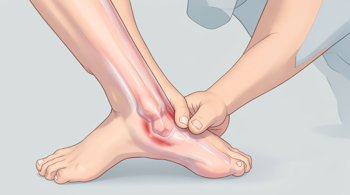
Tenderness to touch is another important sign. A clinician may palpate the painful area to determine whether sensitivity is centered over a tendon, at its attachment to bone, or within the thicker muscle belly. Tendon-related pain is often pinpointed near a joint, whereas muscle strain more commonly affects the fleshy portion of the muscle. A person can notice soreness when pressing the area, but self-palpation cannot reliably distinguish irritation from a partial tear, bursitis, or another condition. 45
- Localized sensitivity may be more obvious than visible swelling.
- Pain can increase when the nearby muscle contracts.
- Marked tenderness after a direct blow or sudden injury warrants closer evaluation.
Stiffness and minor swelling
Stiffness around the affected joint can accompany tendon irritation, particularly after rest or upon waking. Some tendon conditions also cause visible or palpable swelling, although swelling may be minimal in a mild injury. Achilles tendon symptoms, for example, can include morning stiffness and tenderness, with soreness sometimes improving after gentle activity. Stiffness that progressively restricts movement, swelling that continues to increase, or symptoms that persist at rest suggest that the problem may require professional assessment rather than continued self-management. 32
- Compare movement with the opposite side without forcing the joint.
- Do not treat the absence of swelling as proof that no tendon injury exists.
- Increasing warmth, redness, or swelling should be medically reviewed.
Mild weakness without complete loss of function
A mild tendon strain may create a dull ache or a feeling of weakness in the muscle connected to the tendon. However, minor injuries generally do not cause complete loss of function. Tendinopathy can reduce exercise tolerance and impair function, while more substantial tendon damage may produce a sudden loss of strength or inability to perform a familiar movement. Difficulty bearing weight, inability to raise or grip normally, or a sudden major change in function is not typical reassurance for a mild strain. 64
- Daily movement may remain possible but feel uncomfortable.
- Strength may feel reduced during lifting, pushing, pulling, gripping, or jumping.
- A sudden loss of function should be assessed promptly.
How symptoms may differ from a muscle strain
The location and timing of pain can provide clues, although only an examination can identify the injured structure reliably. Tendon pain is usually concentrated where muscle transitions into tendon or where the tendon attaches to bone. Muscle strain more often affects the muscle belly and may feel more spread across the limb. The mechanism also matters: tendon symptoms may follow repetitive loading or a sudden increase in activity, while an acute muscle injury may follow a forceful contraction or overstretch. 52
| Feature | Possible tendon pattern | Possible muscle pattern |
|---|---|---|
| Location | Pinpointed near a joint or attachment | More commonly within the muscle belly |
| Trigger | Repetitive loading or increased activity | Forceful contraction or overstretch |
| Function | Pain with resisted movement | Pain with muscle use or stretching |
Conservative care and warning signs
Initial management for a suspected mild strain generally centers on reducing or modifying the activity that provokes symptoms, protecting the area, and using rest, ice, compression, and elevation when appropriate. Mild injuries may improve over several days to a couple of weeks, but recovery time varies by tendon, workload, and underlying tissue condition. Persistent pain, weakness, swelling, or reduced function should not be attributed automatically to a mild strain. Assessment may involve a physical examination and, when the diagnosis is unclear or symptoms continue, imaging such as ultrasound or MRI. 17
- Stop or modify movements that clearly increase pain.
- Return to activity gradually rather than testing the tendon through worsening pain.
- Seek medical evaluation for a pop, sudden severe pain, major bruising, inability to bear weight, or sudden loss of movement.
- Arrange assessment when symptoms do not steadily improve after a period of rest and activity modification.
Sources
- MedicineNet, “How Do You Tell If a Tendon Is Torn or Strained?” https://www.medicinenet.com/how_do_you_tell_if_a_tendon_is_torn_or_strained/article.htm
- MSD Manual Consumer Version, “Tendinopathy.” https://www.msdmanuals.com/home/bone-joint-and-muscle-disorders/muscle-bursa-and-tendon-disorders/tendinopathy
- Mayo Clinic, “Achilles tendinitis: Symptoms and causes.” https://www.mayoclinic.org/diseases-conditions/achilles-tendinitis/symptoms-causes/syc-20369020
- MSD Manual Professional Edition, “Tendinopathy.” https://www.msdmanuals.com/professional/musculoskeletal-and-connective-tissue-disorders/bursa-muscle-and-tendon-disorders/tendinopathy
- MyPatientAdvice, “Physiotherapy Diagnosis: Tendonitis vs Muscle Strain.” https://mypatientadvice.co.uk/knowledge-base/how-can-a-physio-tell-if-i-have-tendonitis-rather-than-a-muscle-strain/
- Mount Sinai, “Sprains and strains.” https://www.mountsinai.org/health-library/injury/sprains-and-strains
- Acibadem International, “Tendon: Structure, Injuries, and Treatment.” https://acibademinternational.com/health-library/tendon-what-patients-need-to-know/
Authored by MyTrendSpot team