Signs you may have tendonitis: A Clinical Guide to Symptoms and Evaluation
Signs you may have tendonitis often begin as a localized ache near a joint that becomes more noticeable during repetitive movement. The condition may involve tendon irritation, but many cases are more accurately described as tendinopathy, a degenerative process associated with overuse and delayed healing rather than active inflammation. 1
Localized pain during movement
The most recognizable sign is pain centered over a tendon or near the joint it helps move. Discomfort may appear when the attached muscle contracts, when the joint moves, or when the tendon is placed under resistance. Shoulder, elbow, wrist, knee, and heel tendons are commonly affected locations. 1
Pain often becomes more noticeable during or after activity and may initially occur only with a particular motion. Repeated loading can make symptoms persist during ordinary actions, such as gripping, lifting, typing, walking, running, throwing, or reaching overhead. Pain with active or resisted movement is a feature clinicians consider when evaluating tendinopathy. 3
Tenderness, swelling, and skin changes
Tenderness directly over the affected tendon is another important clue. Pressing the area may reproduce the person’s usual pain, and the surrounding tissue can sometimes appear swollen. Tendons are often painful when moved and may be swollen, although the absence of visible swelling does not rule out a tendon problem. 2
Some reports describe warmth, redness, or a grating and crackling sensation as possible local findings. These signs are not specific to tendonitis, however, and can also occur with other musculoskeletal conditions. A lump or thickened area along a tendon may be more consistent with longer-standing tendon changes than with a brief episode of soreness. 5 10
Stiffness and reduced function
Stiffness may be most apparent after rest or when beginning an activity. Morning stiffness is frequently reported with tendon-related discomfort, while movement can remain painful until the tendon is warmed or the load is reduced. Reduced flexibility around the affected joint may develop when persistent tendon or tendon-sheath changes restrict normal motion. 6 2
Weakness, reduced exercise tolerance, or difficulty performing a familiar task can accompany continuing symptoms. These functional changes may involve an inability to lift, grip, climb, run, jump, or reach normally, depending on the tendon involved. Chronic tendon deterioration can weaken the tissue and increase the risk of a tear after a subsequent injury. 3 1
Symptoms linked to repetitive activity
Tendon symptoms often follow a change in physical demand rather than one obvious accident. Repetitive sports movements, physically demanding work, gripping tools, typing, throwing, jumping, and a sudden increase in exercise can repeatedly load a tendon before it has recovered. Tendinopathy can also occur without an identifiable cause. 8 2
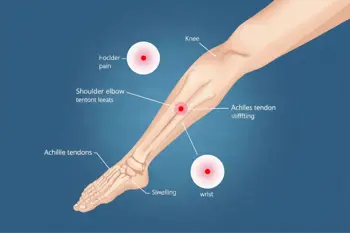
Commonly affected areas include the rotator cuff in the shoulder, the elbow tendons, the patellar tendon at the knee, the Achilles tendon at the ankle, and the thumb tendons. Runners and jumping-sport participants may develop symptoms in the knee or Achilles tendon, while overhead activity can stress the shoulder. Middle-aged and older adults are more susceptible as tendons become less resilient, although vigorous exercise can affect younger people as well. 1 2
How tendonitis is assessed
Diagnosis is usually based on the symptom history and a physical examination rather than imaging alone. A clinician may identify the painful tendon, test movement and strength, apply resistance, and assess tenderness. The pattern of pain, recent activity changes, and functional limitations helps distinguish tendon-related symptoms from other causes of pain around a joint. 1 9
X-rays, ultrasound, or magnetic resonance imaging may be considered when another injury or condition is suspected, or when symptoms remain unclear or persistent. Imaging is not automatically required for every suspected case. Because pain around a joint can have several causes, self-identifying tendonitis from symptoms alone cannot establish a definite diagnosis. 1 2
When symptoms need medical attention
Persistent pain that interferes with normal movement, work, exercise, or sleep warrants clinical assessment. Severe pain or an inability to move the affected joint may indicate a tendon rupture or another significant injury rather than uncomplicated tendonitis. Sudden loss of strength after an injury is especially important because chronic tendon deterioration can leave tissue more vulnerable to tearing. 11 1
Early management commonly involves modifying the activity that provokes symptoms, allowing recovery, and using rehabilitation guided by the affected tendon and the duration of symptoms. Ice, compression, stretching, physical therapy, supportive bracing, or short-term medication may be considered in appropriate cases. Rest alone may not address persistent tendon degeneration, so ongoing or recurring symptoms require an individualized evaluation rather than repeated return to the same load. 1 3
Sources
- American Orthopaedic Society for Sports Medicine, “Tendonitis”
- MSD Manual Consumer Version, “Tendinopathy”
- MSD Manual Professional Edition, “Tendinopathy”
- Mayo Clinic, “Tendinitis: Symptoms and causes”
- Cleveland Clinic, “Tendonitis”
- WebMD, “Understanding Tendonitis Symptoms”
- Johns Hopkins Medicine, “Tendonitis”
- MedlinePlus, “Tendonitis”
- Hospital for Special Surgery, “Tendonitis”
- American Academy of Orthopaedic Surgeons, “Tendinitis and Tendinosis”
- Stanford Health Care, “Tendonitis”
Authored by MyTrendSpot team