Municipal Surplus Trucks: Where to Find Listings and What to Check
Municipal surplus trucks enter the public market through a formal decommissioning process that cities, counties, school districts, transit agencies, and utility departments use to dispose of retired fleet assets. These vehicles range from standard half-ton pickups to dump trucks, bucket lift trucks, box trucks, and specialized service bodies, and they are sold almost universally on an as-is, where-is basis with no manufacturer or dealer warranty protections attached. 1 The variety is broader than many buyers expect, and the pricing dynamics are governed by platform fees, bidding competition, and title documentation requirements that can significantly alter the final cost of ownership.
Major Platforms Where Municipal Surplus Truck Listings Appear
The municipal surplus truck market is fragmented across multiple platforms, each serving a different tier of government. GovDeals, operated by Liquidity Services, functions as one of the largest online marketplaces for state and local fleet vehicles, connecting buyers with cities, counties, school districts, and utilities through a timed online bidding format with a 12.5% buyer's premium added to the winning bid. 2 Municibid serves smaller municipalities and is used by agencies in states including Pennsylvania, where the Pennsylvania Department of Transportation uses it as its primary platform for surplus fleet disposals ranging from sedans to specialized highway maintenance machinery. 3
Public Surplus, operated independently by The Public Group LLC since 1999, targets the same state and local seller category as GovDeals but maintains a smaller listing volume, typically 10 to 20 percent of GovDeals' daily inventory, which often results in less competitive bidding on individual lots. 4 GSA Auctions at gsaauctions.gov handles federal surplus property and carries no buyer's premium, while federal fleet vehicle sales specifically transitioned in January 2026 to weekly nationwide auctions operated through IAA, with roughly 30,000 to 40,000 federal fleet vehicles reaching the public each year. 5 Purple Wave and Ritchie Bros. cover farm, construction, and heavier equipment with buyer's premiums in the 10 to 15 percent range. 6
Categories of Municipal Trucks Commonly Available
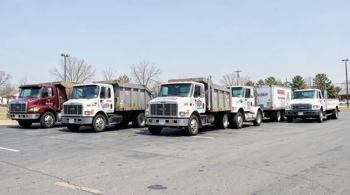
Government fleets use a wide range of truck configurations, and the surplus pipeline reflects that operational diversity. Pickup trucks including Ford F-150, F-250, F-350, Chevrolet Silverado, and RAM 2500 models represent the highest-volume category because forestry, agriculture, construction, and public works departments rely on them extensively. 7 Box trucks, stake-bed trucks, dump trucks, and service-body trucks retire from highway maintenance and public works departments at the state and county level on a regular schedule, often appearing in batch lots when an agency upgrades its entire fleet simultaneously. 8
Specialty vehicles including bucket lift trucks, fire apparatus, ambulances, and utility boom trucks also circulate through surplus channels, with over 8,000 fire trucks, ambulances, and related emergency equipment sold on GovDeals alone during 2025. 9 Real-world examples from recent auction activity illustrate the range: Floyd County, Georgia listed a fleet of diesel box trucks spanning 1995 to 2014 model years including Freightliner M2 and International units, while the Town of Kimball, Wisconsin sold a 1998 International single-axle dump truck alongside retired fire apparatus through a sealed-bid process. 10 Berwick Township in Pennsylvania listed a 1997 Ford Super Duty F-450 bucket truck with 86,754 miles through Municibid, and the Surgoinsville Utility District in Tennessee offered a 2005 Chevrolet Silverado 2500 with 182,844 miles and a rebuilt transmission. 11
Platform Fee Structures and True Cost Calculation
The hammer price at any government auction is rarely the final cost a buyer pays. Buyer's premiums, sales tax, title transfer fees, and transport expenses must all be factored into any budget analysis. The table below summarizes the primary platforms handling municipal surplus trucks and their documented fee structures.
| Platform | Primary Seller Type | Buyer's Premium | Bid Format |
|---|---|---|---|
| GovDeals | State and local agencies | 12.5% | Timed online |
| Municibid | Small-town and municipal government | None | Timed online |
| PublicSurplus | Municipal surplus, smaller lots | None | Timed online |
| GSA Auctions | Federal surplus | None | Sealed bid |
| Purple Wave | Farm and construction equipment | 10% | Timed online |
| Ritchie Bros. | Heavy equipment and fleet vehicles | 12-15% | Live and online |
Payment terms across these platforms typically require deposits or full payment within 24 to 48 hours of auction close, with vehicle pickup deadlines ranging from a few days to 30 days depending on the selling agency. 12 Buyers are also responsible for arranging and funding all transportation logistics, and some listings specify that loading assistance may not be available. The same physical truck listed across multiple platforms in the same week can carry a several-thousand-dollar difference in total out-of-pocket cost depending solely on which platform hosts the sale. 13
What to Check Before Bidding on a Municipal Surplus Truck
Every government auction listing carries some version of the as-is, where-is disclaimer, which removes the consumer protection recourse that applies to dealer sales. The person writing the listing may be a fleet coordinator who has not operated the vehicle recently, meaning condition descriptions can be incomplete without being intentionally misleading. 14 For municipal trucks specifically, the most informative contextual signal is the selling agency type: a public works department truck with documented service intervals represents a different risk profile than an impound lot seizure or an unclaimed vehicle with an unknown mechanical history.
Key inspection areas for municipal surplus trucks include engine start behavior both cold and warm, transmission engagement under load, hydraulic systems for vehicles with service bodies or lift equipment, rust at frame rails and cab corners, brake condition relative to stated mileage, and tire depth. For specialized units like bucket trucks, pump-hour readings on equipment components matter as much as chassis mileage. 15 Most sellers on GovDeals and similar platforms list inspection appointment contacts directly in the auction description, and in-person inspection is generally available by scheduling with the listed fleet contact before the auction closes. When sellers list a truck as condition unknown or not running, professional third-party inspection services can conduct an on-site assessment and report findings before a bid is placed.
Title Documentation and Registration Considerations
Title documentation for municipal surplus trucks varies meaningfully by selling agency type. State and local government sellers generally issue a standard state title, which processes through any DMV without complication. Federal agency sales, by contrast, issue a Standard Form 97 (SF-97), which is a Certificate of Release of a Motor Vehicle rather than a standard state title. 16 In many states, the SF-97 processes without issue, but in states including California, New York, New Jersey, Illinois, and Massachusetts, DMV staff unfamiliar with the form have historically classified these vehicles incorrectly, creating rebuilt-title complications that add inspection costs and time to the registration process even for vehicles that have no salvage history.
Buyers should confirm the title document type before bidding and verify their state's specific requirements for converting that document to a registered plate. Listings on GovDeals and Municibid typically specify the title type available, and contacting the selling agency's fleet department before bidding to confirm the exact paperwork in hand is a standard due diligence step. VIN history reports from services that access NMVTIS-connected databases provide additional verification of odometer readings, prior ownership categories, and any reported accident or flood events not mentioned in the listing description. 17
Risks, Realistic Expectations, and Market Context
Municipal surplus trucks offer access to fleet-grade vehicles at prices reflecting their age and usage, but the as-is sale structure places the entire burden of condition assessment and post-purchase repair on the buyer. Auction listings from real municipalities illustrate the spectrum: one Floyd County, Georgia Freightliner M2 box truck with 236,639 miles sold with a clear title but carried a noted requirement for a plug-in charge in cold weather; a 2009 International 4300 in the same fleet sale carried a salvage title despite reported good overall condition, which affects financing eligibility and future resale. 18 These are routine realities of the surplus market, not exceptional cases.
Government surplus trucks typically retire at 80,000 to 120,000 miles under standard fleet replacement schedules, which means the vehicles reaching auction are often mechanically serviceable but approaching major component service intervals. 19 Maintenance logs, when available, provide the most reliable insight into how service schedules were observed, but not all agencies retain or share complete records. Buyers bidding on specialty or high-value units without an in-person inspection, or without a third-party inspector's report, carry substantial financial risk that the auction platform itself provides no mechanism to recover. State surplus programs such as Virginia's Office of Surplus Property Management, South Carolina's Surplus Property Office, and state agencies in Texas, Florida, and California each operate under their own procedures and calendars, so buyers focused on a geographic area benefit from monitoring multiple platforms simultaneously rather than relying on any single aggregator. 20
Sources
- governmentauctions.org - How Government Truck Auctions Work for Buyers
- bidprowl.com - 10 Best Government Auction Sites, Ranked by Fees (2026)
- archynewsy.com - Pennsylvania Surplus Vehicles and Equipment to be Auctioned
- govauctions.app - Public Surplus FAQ (2026): The Underrated Government Auction Site
- govauctions.app - Government Car Auctions Near Me - How to Find and Buy (2026)
- bidprowl.com - 10 Best Government Auction Sites, Ranked by Fees (2026)
- govauctions.app - How to Buy a Government Surplus Vehicle (2026)
- governmentauctions.org - How Government Truck Auctions Work for Buyers
- blog.govdeals.com - How to Buy Fire Trucks and Emergency Vehicles on GovDeals
- dempseyauction.com - Surplus Commercial Box Truck Fleet, Floyd County GA; starbridge.ai - Kimball Surplus Vehicle Sale 2026
- starbridge.ai - Sale of Vehicle 1997 Ford Super Duty Bucket Truck; starbridge.ai - Surplus Property 2005 Chevrolet Silverado 2500
- 0taxtags.com - Government Surplus Vehicle Auction Sites Platform Guide
- 0taxtags.com - Government Surplus Vehicle Auction Sites Platform Guide
- bidprowl.com - How to Inspect Before You Bid at Auction (2026)
- blog.govdeals.com - Fire Truck Inspection Guide: What to Check Before Buying at an Emergency Vehicle Auction
- 0taxtags.com - Government Surplus Vehicle Buying Guide: Ex-Police and SF-97 Fix
- 0taxtags.com - Government Surplus Vehicle Buying Guide: Ex-Police and SF-97 Fix
- dempseyauction.com - Surplus Commercial Box Truck Fleet, Floyd County GA Online Auction
- govauctions.app - How to Buy a Government Surplus Vehicle (2026)
- dgs.virginia.gov - Surplus Public Auctions; admin.sc.gov - Surplus Property; gov.deal - State and Local Government Surplus
Authored by MyTrendSpot team