Understand ACL tear treatment options: A clinical guide to rehabilitation, reconstruction, and recovery
Understanding ACL tear treatment options starts with the central clinical question: whether a person can function safely without reconstruction or needs a procedure to restore stability. A torn ACL may be partial or complete, and treatment decisions depend on symptoms, activity demands, knee instability, age, and damage to structures such as the meniscus or cartilage. 1
How an ACL tear is identified
The anterior cruciate ligament connects the femur to the tibia and helps control forward movement and rotation of the shin. ACL injuries commonly occur during pivoting, sudden stopping, awkward landings, or twisting while the foot is planted. A pop, rapid swelling, difficulty bearing weight, restricted motion, and a feeling that the knee may give way are characteristic warning signs. 4
Diagnosis generally begins with the injury history and a physical examination. Clinicians may assess anterior translation and rotation using tests such as the Lachman, anterior drawer, and pivot-shift maneuvers. Magnetic resonance imaging can confirm the ACL injury and identify associated meniscus, cartilage, or ligament damage. Persistent locking, repeated giving way, inability to bear weight, or substantial swelling warrants medical assessment. 9
Initial care and prehabilitation
Early management focuses on reducing pain and swelling while restoring comfortable movement. Activity modification, cold therapy, compression, elevation, clinician-advised pain relief, and guided exercises are commonly used during the initial phase. The objective is not simply rest. Regaining knee extension, controlling swelling, and rebuilding basic function can improve movement and help clarify how stable the knee is during rehabilitation. 7
Prehabilitation, or rehabilitation before possible surgery, has two roles. It can identify people who function well enough to continue without reconstruction, and it can prepare surgical candidates by improving motion, strength, and knee function. Early rehabilitation is associated with faster recovery of symptoms, strength, and function, while structured education helps patients understand activity limits and longer-term risks. 5
Nonsurgical treatment and who may benefit
Nonsurgical care usually combines physical therapy, progressive strengthening, balance work, neuromuscular training, and activity modification. Strong quadriceps, hamstrings, gluteal muscles, and core muscles can help compensate for some loss of ligament control. Bracing may be considered in selected situations, but it does not replace rehabilitation or guarantee stability during pivoting movements. 8
Research and clinical experience describe three broad functional groups. About one-third of patients may cope well without an ACL and return to regular activities without giving way. Another third may adapt to daily life and straight-ahead activities such as running, biking, or swimming but remain unstable during cutting or pivoting. The remaining group may continue to experience instability that limits activity and increases concern about further injury. 1
When reconstruction is considered
ACL reconstruction is often considered for people who want to return to sports or work involving cutting, pivoting, sudden direction changes, jumping, or hard landings, particularly when the knee repeatedly gives way. Surgery may also be discussed when rehabilitation does not provide functional stability or when associated injuries require operative treatment. A complete tear does not automatically require surgery, because personal goals and demonstrated knee function remain important. 9
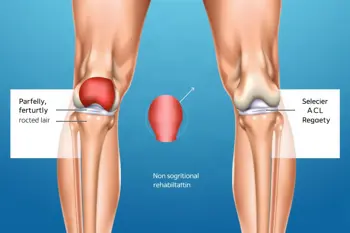
Reconstruction generally replaces the torn ligament with a graft rather than restoring the original ACL directly. Common autograft sources include the patellar tendon, hamstring tendon, and quadriceps tendon. Donor tissue, called an allograft, is another option, although graft selection involves balancing activity level, age, healing considerations, and donor-site effects. Allografts may have higher failure rates in young, active patients. 1116
Repair, reconstruction, and surgical realities
ACL repair is different from reconstruction. Repair reattaches suitable remaining ligament tissue to bone, often with suture anchors, instead of replacing the ligament with a graft. This approach is an emerging option for selected tears, especially some proximal tears near the ligament's attachment. It is not appropriate for every tear, and candidacy depends on tear location, tissue quality, knee stability, and the surgeon's assessment. 12
Arthroscopic techniques are commonly used for ACL reconstruction, but minimally invasive surgery does not remove the need for substantial rehabilitation. Potential concerns include reinjury, injury to the opposite knee, stiffness, complications involving the graft or donor site, and later osteoarthritis. The decision therefore involves more than choosing an operation. It requires discussion of expected stability, activity restrictions, associated injuries, and the possibility that symptoms may persist. 10
Rehabilitation and return to activity
Physical therapy is important whether treatment is surgical or nonsurgical. Programs typically progress from swelling control and range of motion to strength, balance, coordination, jumping, landing, and sport-specific movement. Rehabilitation aims to restore objective function rather than provide only short-term pain relief. A knee that feels better during straight-line activity may still lack the rotational control needed for cutting or pivoting. 13
Return to pivoting sports commonly takes many months after reconstruction, with 9 to 12 months often cited as a general range. Calendar time alone is not sufficient. Clinicians may evaluate strength symmetry, balance, movement quality, confidence, and functional performance before clearing higher-risk activity. Persistent instability, swelling, locking, or weakness should be reassessed rather than treated as a normal recovery milestone. 17
Comparing the main treatment paths
| Approach | Typical focus | Main consideration |
|---|---|---|
| Structured rehabilitation | Strength, balance, neuromuscular control, and activity adjustment | Most suitable for selected patients who remain functionally stable |
| ACL reconstruction | Graft replacement followed by staged rehabilitation | Often considered for persistent instability or pivoting-sport goals |
| ACL repair | Reattachment of suitable remaining ligament tissue | Limited to selected tear patterns and tissue quality |
The practical distinction between these approaches is stability under the demands a person intends to resume. Someone whose goals are walking, cycling, swimming, or other straight-ahead activities may function well with rehabilitation if the knee does not buckle. Someone who repeatedly pivots, lands, or changes direction may face greater instability without a functioning ACL and may discuss reconstruction with an orthopedic specialist. 2
There is no universal treatment pathway. A complete evaluation should consider the tear pattern, physical examination, MRI findings, symptoms, sport or work requirements, rehabilitation commitment, and injuries to the meniscus or other ligaments. Nonsurgical management is active treatment, not an absence of care, while surgery is not a substitute for restoring motion, strength, and neuromuscular control. 5
Sources
- University of Utah Health, “Tore Your ACL? Here Are Your Treatment Options”
- Mount Sinai Today, “If You Have Torn Your ACL, Here’s What to Do”
- Yale School of Medicine, “Understanding ACL Tears: From Injury to Reconstruction”
- Stony Brook Medicine, “ACL Injury: What to Know About Causes, Treatment and Recovery”
- Current Sports Medicine Reports, “Nonsurgical Treatment of Anterior Cruciate Ligament Tears: What Is the Evidence and Who Are the Candidates?”
- Acibadem Hospitals Group, “ACL Tear: Symptoms, Diagnosis, and Recovery Options”
- Acibadem Hospitals Group, “Treatment of Anterior Cruciate Ligament Injuries”
- Northwell Health, “Can You Recover From a Torn ACL Without Surgery?”
- American Orthopaedic Society for Sports Medicine, “The Injured ACL”
- Mayo Clinic, “ACL Injury: Diagnosis and Treatment”
- American Academy of Orthopaedic Surgeons, “ACL Injury: Does It Require Surgery?”
- Hospital for Special Surgery, “ACL Tear”
- National Institutes of Health, “Anterior Cruciate Ligament Injury”
- Journal of Orthopaedic & Sports Physical Therapy, return-to-sport guidance
- University of Rochester Medical Center, ACL reconstruction information
Authored by MyTrendSpot team