How location can affect access to specialty care: A geographic analysis of distance, infrastructure, and health outcomes
Distance as a barrier to specialty care
How location can affect access to specialty care is most apparent in the time and distance required to reach a specialist. In a Maine study of 12,014 children with indications for pediatric asthma referral, 47% lived in micropolitan or rural areas, 15% lived more than one hour from a specialist, and only 19% received specialty care within the following year. Greater driving time was associated with lower specialist use. 1
Geographic barriers also affect adults with complex conditions. A review of gastrointestinal care reported that more than two-thirds of the 3,149 U.S. counties lacked any GI specialist, leaving an estimated 49 to 50 million people more than 25 miles from this type of care. Wyoming and Arizona were reported to have more than 75% of residents living over 25 miles from GI services. 2
Rural and urban differences in provider distribution
Specialists are concentrated in metropolitan areas, academic medical centers, and larger hospital systems, while rural counties may have limited local coverage. Among cancer survivors in the All of Us dataset, people living in rural areas were less likely than urban survivors to report visits with specialists, primary-care clinicians, and mental-health professionals. Many associations persisted after adjustment for potential confounding factors. 3
The distribution problem is not limited to the United States. A geospatial study of medical college hospitals in India examined 36 states and union territories and 735 districts. It found that 71.76% of the population could reach a medical college hospital within 60 minutes by motorized transport, indicating that a substantial minority faced longer journeys to institutions providing specialized services. 4
Travel time, referrals, and continuity of care
Travel burden can influence whether a referral becomes an actual visit. Children in the Maine asthma cohort were less likely to use specialists when they lived in small towns, isolated small rural areas, or communities with lower Child Opportunity Index scores. The adjusted likelihood also declined as travel time increased, showing that distance interacted with local socioeconomic opportunity rather than operating as an isolated geographic factor. 1
Long journeys can create practical obstacles involving transportation, time away from work or school, lodging, and repeated appointments. These pressures are particularly important for specialty services that require ongoing monitoring. In gynecologic cancer care, patients were less commonly referred to outpatient specialty palliative care when they lived in rural or disadvantaged counties or farther from a National Cancer Institute-designated cancer center. 5
Clinical consequences of limited local access
Delayed or incomplete specialty access can affect conditions in which evaluation, treatment adjustment, or coordinated follow-up is important. The gastrointestinal-care review linked geographic shortages with broad access disparities and reported that states such as Alaska and North Dakota averaged only 1.8 gastroenterologists per 100,000 population. It also described lower treatment initiation among Medicaid patients with hepatitis C than among privately insured patients. 2
Evidence from multiple sclerosis illustrates how travel distance may relate to outcomes, although relationships can vary by disease subtype. A French cohort of 33,697 patients found that people with relapsing-onset MS who lived about 40 minutes from an expert center had the lowest excess death rates, while rates were higher among patients living farther away. The study found no corresponding accessibility effect for primary progressive MS. 6
Telehealth and the digital geography of care
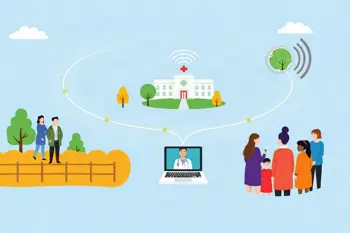
Telehealth can reduce the need for every specialty encounter to occur in person, but its usefulness depends on infrastructure and clinical suitability. A national cancer-care dataset combines oncologist locations, full-time-equivalent capacity, road travel times, fixed broadband, 5G coverage, and internet subscription measures. Its design reflects two distinct access questions: whether a patient can reach an oncologist physically and whether the patient has a reliable, sufficiently affordable digital connection. 7
Virtual care does not eliminate location-based disparities when broadband service, device access, digital skills, or privacy are limited. The dataset evaluates in-person accessibility through two-step floating catchment areas and telehealth-enabled accessibility through virtual catchment areas at 45- to 120-minute thresholds. These measures show why telehealth should be assessed alongside connectivity and provider capacity rather than treated as a universal replacement for in-person specialty care. 7
What patients and health systems must account for
Specialty access is shaped by more than the address of a clinic. Referral requirements, insurance coverage, transportation, appointment availability, specialist capacity, and the need for diagnostic testing can all affect whether care is completed. In the GI-care review, lack of insurance was associated with a 15 to 20 percentage-point gap in colorectal cancer screening uptake, while hepatitis C treatment initiation within one year was 35% among privately insured patients and 23% among Medicaid patients. 2
Potential responses include patient navigation, community health workers, mobile services, regional referral networks, and telemedicine supported by adequate broadband. In safety-net populations, patient navigation combined with mailed fecal immunochemical tests increased colorectal screening completion by 7.3 percentage points. Video-based inflammatory bowel disease management and other virtual models may expand reach, but they require continuing clinical oversight, appropriate privacy protections, reliable technology, and a clear process for in-person examination when necessary. 2
How access is measured and interpreted
Researchers measure geographic access using more than straight-line distance. Road travel time, public transportation, population distribution, provider capacity, referral thresholds, and the number of patients competing for appointments can produce different results. The India study used travel-time rasters, population data, median time to the nearest medical college hospital, and access-population coverage at 30-, 60-, 90-, and 120-minute thresholds. 4
These measures have limitations. A clinic may be geographically close but unable to accept new referrals, while a distant center may offer advanced services unavailable locally. Telehealth scores can also overstate practical access if internet subscriptions do not reflect affordability, device quality, or digital confidence. Geographic findings therefore describe population-level patterns, not a guarantee that any individual patient can obtain a particular appointment or procedure. 7
Sources
- Associations of rurality, child opportunity, and distance with use of pediatric asthma specialists, PubMed
- Disparities in Access to Gastrointestinal Care in the United States, Digestive Diseases and Sciences
- Health care utilization and self-reported health status among US cancer survivors by rurality and area deprivation, Med
- Geospatial modeling study assessing population level accessibility to medical college hospitals in India, Discover Public Health
- Compounding or confounding? Addressing context-specific disparities in access to outpatient specialty palliative care, Annals of Palliative Medicine
- Influence of geographical accessibility to specialist and primary care givers on excess mortality of multiple sclerosis patients in France, BMC Neurology
- Telehealth Infrastructure for Cancer Care in the United States, Scientific Data
Authored by MyTrendSpot team