Affordable full-mouth dental implants near me: A Consumer Cost and Care Analysis
Searching for affordable full-mouth dental implants near me usually means comparing permanent, full-arch options with dentures, while trying to understand the total financial and clinical commitment. Reported treatment prices vary substantially by location, materials, bone condition, extractions, temporary teeth, and whether one or both arches are treated.
What full-mouth implant treatment means
“Full-mouth implants” can describe more than one clinical approach. A fixed full arch, commonly called All-on-4 or All-on-6, uses four to six implants to support a non-removable bridge. An implant-supported denture uses fewer implants and remains removable for cleaning. These options differ in stability, maintenance, materials, surgical complexity, and cost, so a quoted price cannot be interpreted without identifying the restoration type. 1
- Fixed full-arch bridge: attached to implants and removed only by a dental professional.
- Implant-supported denture: clips onto implants and is taken out for cleaning.
- Individual implants: replaces selected teeth separately and may involve more implants.
Reported price ranges and local examples
General U.S. estimates place full-mouth dental implants at approximately $15,000 to $30,000 per arch. Published provider examples show why local research matters: South Bay Dentistry reports All-on-4 treatment beginning at $10,000 to $12,000 per arch, while an All-on-X provider in Paramus lists $12,995 for one arch and $25,990 for two arches. These figures are provider-reported starting prices, not universal market rates or guaranteed final totals. 2 3 4
| Treatment description | Reported figure | Important qualification |
|---|---|---|
| General U.S. estimate | $15,000 to $30,000 per arch | Broad estimate for full-mouth treatment |
| All-on-4 example | $10,000 to $12,000 per arch | Provider-reported starting range |
| All-on-X example | $12,995 single arch | Location-specific published figure |
| Both arches example | $28,000 starting figure | Qualification and treatment scope apply |
What can change the final treatment cost
Published treatment descriptions identify several cost variables that should appear in a written plan. These include extractions, the number of implants, bone support or grafting, temporary teeth, final restoration materials, and whether one or both arches are included. Zirconia and acrylic restorations represent different material choices, and the selected material can affect the overall amount. Geographic location also contributes to price variation, making comparisons between distant offices unreliable unless the scope is equivalent. 5 6
- Ask whether diagnostic imaging, extractions, grafting, temporary teeth, and follow-up visits are included.
- Identify whether the quoted restoration is acrylic, resin, ceramic, or zirconia.
- Confirm whether the figure covers one arch or both upper and lower arches.
- Check whether the final prosthesis is included or quoted separately.
Eligibility, imaging, and treatment expectations
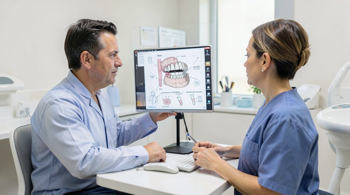
Suitability is determined through a clinical examination and imaging rather than age or advertising language alone. Providers describe the use of three-dimensional imaging to evaluate the mouth and jawbone, while the available bone influences whether four, five, or more implants are appropriate. Patients with failing teeth, severe tooth loss, loose dentures, or difficulty eating may be evaluated for full-arch treatment, but medical history, oral conditions, bone support, and restoration goals affect the plan. 7 8
Some practices describe attaching temporary fixed teeth on the day of implant placement. Those provisional teeth protect the healing implants while bone integration occurs, after which the final bridge is fitted. “Same-day teeth” therefore does not necessarily mean that the permanent restoration is completed that day. A consultation should clarify the surgical date, temporary phase, healing period, final restoration appointment, and the professional responsible for each stage.
Payment, insurance, and lower-cost pathways
Dental insurance may contribute to selected parts of treatment, such as extractions, implant-supported prosthetics, grafting, or postoperative care, although coverage depends on the plan and clinical circumstances. Some medical insurance plans may contribute when treatment is considered medically necessary. Flexible spending accounts, health savings accounts, and health reimbursement arrangements may also be usable for eligible dental procedures. Financing providers and in-house payment arrangements are additional options, but interest, term length, credit requirements, and deferred-interest conditions require careful review. 9
Dental schools and university clinics can provide implant procedures at substantially reduced rates compared with private practices, commonly reported at 30% to 50% less, although training-clinic scheduling and case acceptance criteria can limit availability. Community health centers may use sliding fees based on income, while Dental Lifeline Network serves certain vulnerable groups. Veterans should review Department of Veterans Affairs dental eligibility because coverage is limited to qualifying categories, and Medicaid adult dental benefits vary by state and rarely include full-mouth implants unless medical necessity rules apply. 10 11 12 13
Risks, maintenance, and comparison questions
Implant treatment is a major surgical and restorative process rather than a one-time cosmetic purchase. Potential friction points include healing complications, the need for bone support, changes to a temporary restoration, and future repair or replacement of prosthetic components. Fixed arches cannot be removed by the patient, so professional maintenance and careful cleaning around and beneath the restoration remain important. A low starting figure may be misleading if essential surgical, laboratory, diagnostic, or follow-up services are excluded.
- What credentials and surgical experience apply to the treating clinicians?
- Which complications are covered by the practice’s follow-up policy?
- How often are professional maintenance visits recommended?
- What is the expected service life of the temporary and final teeth?
- Does the written estimate show every included and excluded service?
- Are financing terms, interest, credit checks, and cancellation rules clearly stated?
How to compare nearby providers objectively
A useful comparison begins with matching like-for-like plans. Two prices should not be compared if one includes extractions, temporary fixed teeth, final zirconia, and both arches while the other covers only implant placement or a provisional appliance. Geographic convenience, emergency access, laboratory arrangements, clinician qualifications, imaging technology, and maintenance policies also affect practical value. A written treatment plan should identify the number of implants, restoration material, arch count, anticipated procedures, timeline, and total expected fee.
Independent sources can help frame the search, but provider webpages remain promotional materials and should be treated as starting evidence rather than clinical recommendations. Professional evaluation is necessary to determine candidacy, and a second opinion may be reasonable when treatment involves both arches, extensive surgery, or substantial financing. The most informative comparison is therefore not simply the lowest published number, but the completeness, transparency, clinical suitability, and long-term maintenance requirements of each plan.
Sources
- Affordable Dentures & Implants, “Dental Implants”
- South Bay Dentistry & Orthodontics, “Full Mouth Reconstruction”
- NJ Implant Dentist, “All-on-X Implants in Paramus”
- Healthline, “Full-Mouth Dental Implants”
- Spring Hope Family Dentistry, “All-on-X Full-Arch Implants”
- WebMD, “What Are Dental Implants?”
- Bishopville Dental, “Affordable Dental Implants in South Carolina”
- Sethi Virdi DDS, “All-on-4 Full-Mouth Dental Implants”
- All-on-4 Dental Implant Centers, “Affordability”
- American Dental Association, “Finding Low-Cost Dental Care”
- Find A Health Center, Health Resources and Services Administration
- U.S. Department of Veterans Affairs, “Dental Care”
- KFF, “Medicaid Adult Dental Benefits”
Authored by MyTrendSpot team