How to stretch tight hamstrings safely: A clinical guide to technique, timing, and warning signs
How to stretch tight hamstrings safely starts with slow, controlled movement rather than forceful toe-touching. A mild pulling sensation can be normal, but sharp pain, numbness, or tingling is a reason to stop and reassess. Regular moderate stretching, performed consistently, is generally more useful than occasional aggressive sessions. 1
Why hamstrings feel tight
The hamstrings are a group of muscles at the back of the thigh that bend the knee and extend the hip. They contribute to walking, stair climbing, running, jumping, squatting, and other daily movements. Tightness can follow prolonged sitting, inactivity, intense exercise, repetitive running or cycling, explosive movements, or a previous hamstring injury. 2
Long periods of sitting keep the hips flexed and knees bent, placing the hamstrings in a shortened position for much of the day. In active people, overuse from sprinting, lifting, hill work, leg curls, or deadlifts may instead create post-exercise stiffness. Tightness can also be influenced by the calves, hips, pelvis, or lower back, so the sensation does not always identify the only area involved. 3
Prepare the muscles before stretching
A brief warm-up helps the muscles respond more comfortably to stretching. Five to 10 minutes of light movement, such as walking or easy jogging, is commonly recommended before flexibility work. Before a workout, controlled dynamic movements such as gentle leg swings are generally more appropriate than prolonged static holds. Static stretches fit better after exercise or during a separate mobility session. 4
Warm-up movement should raise activity gradually rather than create fatigue. After walking or another easy activity, begin with a small range of motion and increase it only when the pulling sensation remains comfortable. Cold, stiff muscles are more vulnerable to irritation when pushed abruptly, while a gradual preparation period allows the stretch to be adjusted before discomfort becomes significant. 5
Controlled hamstring stretches
Several simple positions allow the intensity to be adjusted for different mobility levels. A supine stretch using a towel or strap is performed while lying on the back, raising one leg gradually while keeping the opposite leg comfortable. A doorway stretch uses the floor and a doorframe to support the raised leg. A standing heel-supported stretch uses a low chair or step, allowing the person to control how far the hips move forward.
- Supine towel or strap stretch: raise the leg slowly and stop before the pelvis twists.
- Seated stretch: extend one leg comfortably and hinge forward from the hips instead of collapsing the chest.
- Doorway stretch: keep the raised leg supported and avoid forcing the knee straight.
- Standing heel-supported stretch: use a low support and maintain balance while controlling the range.
These positions are widely used because they are easy to modify and do not require a deep forward fold. The practical goal is a steady stretch along the back of the thigh, not reaching the toes or matching another person’s range. 6
Protect the spine and knees
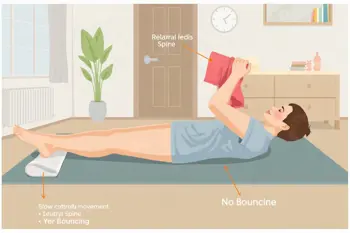
During a seated or standing stretch, a neutral spine and hip hinge help direct movement toward the hips and hamstrings. Bending from the waist and rounding the back can shift the sensation into the lower back. The knee should remain soft rather than locked or hyperextended, since forcing the joint straight can add unnecessary stress. A chair, wall, or strap can provide support and make the intensity easier to regulate.
Hold a static stretch for about 30 seconds, breathe steadily, and release gradually rather than snapping back to the starting position. Two or three 30-second holds, performed three to five days per week, are described as a practical consistency-based approach. Bouncing is discouraged because sudden movements can trigger protective muscle tightening and may irritate muscle or tendon tissue. 7
Distinguish muscle tension from nerve symptoms
Back-of-thigh tightness is not always caused by a shortened hamstring. The sciatic nerve travels from the lower spine through the hip and down the back of the leg, and irritation can feel similar to a strong muscle stretch. Symptoms that increase when the foot is pulled upward or the chin is brought toward the chest may suggest nerve involvement rather than ordinary muscle tension. 8
When stretching produces burning, electric, shooting, or tingling sensations, pushing farther is not a suitable progression. Persistent pain, numbness, weakness, or symptoms extending below the knee warrant assessment by a qualified healthcare professional. A clinician can evaluate whether the source is a hamstring strain, back problem, nerve irritation, joint restriction, or another condition that requires a different approach. 9
Build a sustainable flexibility routine
Flexibility changes are generally gradual, and consistency matters more than intensity. A routine can include a warm-up, one or two controlled hamstring positions, relaxed breathing, and a slow return from each hold. Stretching should not be used to force movement through acute soreness after a suspected injury. In that situation, the priority is appropriate evaluation and a plan suited to the injury stage.
Progress can be tracked through comfortable range of motion, easier sitting, improved hip hinging, or less restriction during ordinary activities rather than through a single toe-touch test. The central safety rules are straightforward: warm up, move slowly, avoid bouncing, keep the spine and knee controlled, accept mild pulling only, and stop for sharp or nerve-like symptoms. 10
Sources
- Acibadem International, “How To Stretch Hamstrings Safely”
- Men’s Health, “How to Stretch Hamstrings: Physical Therapists Share 8 Moves”
- Verywell Health, “Why Are My Hamstrings Tight and How Do I Stretch Them?”
- Popular Science, “7 Hamstring Stretches Recommended by a Physical Therapist”
- Rehab and Revive, “Is Your Hamstring Stretch Safe?”
- Best Exercise, “Hamstring Stretches: 7 of the Best Moves”
- HowStuffWorks, “A Simple Hamstring Stretch Can Ease Your Lower Back Pain”
- GMB, “How To Loosen Tight Hamstrings: 6 Tips That Actually Work”
- StretchingWorkout, “Hamstring Flexibility Guide”
- ScienceInsights, “How to Stretch Hamstrings With Sciatica Safely”
Authored by MyTrendSpot team