Cruise routes for northern lights viewing from US: A route and season analysis
Cruise routes for northern lights viewing from US generally involve crossing the North Atlantic to Iceland, Greenland, or northern Europe rather than using a conventional summer Alaska itinerary. The most relevant factors are darkness, latitude, cloud cover, solar activity, time spent above the Arctic Circle, and whether the ship remains at sea or makes late and overnight calls. 1
North Atlantic routes from US ports
Departures from Boston, New York, or Baltimore can connect North America with Iceland, Greenland, and Norway through transatlantic or Northern Europe itineraries. A Boston-to-Iceland pattern may include Reykjavík, Ísafjörður, and Akureyri, with some voyages continuing toward Greenland. New York routes can reach Iceland and Norway, although many are repositioning voyages rather than sailings designed specifically around aurora observation. 2
| Route pattern | Typical Arctic relevance | Primary limitation |
|---|---|---|
| Boston to Iceland | Reykjavík, Ísafjörður, Akureyri | Cloud cover and limited nighttime port hours |
| New York to Northern Europe | Iceland and Norway may be included | Often structured as a transatlantic repositioning voyage |
| North America to Greenland | Qaqortoq, Nuuk, or Ilulissat may appear | Sea ice and seasonal navigation conditions |
Norwegian Coastal Route
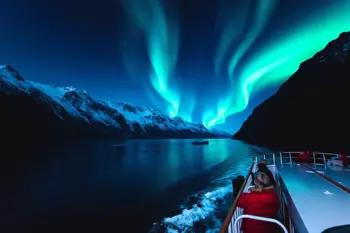
The Bergen to Kirkenes coastal corridor is the clearest dedicated cruise geography for northern-lights viewing. Hurtigruten and Havila operate along Norway’s coast, with potential calls at Tromsø, Alta, the Lofoten Islands, North Cape, and other Arctic fjords. The route combines movement through dark coastal waters with shore excursions, but individual sightings remain dependent on clear skies and geomagnetic activity. 3
Tromsø, Alta, and Honningsvåg are especially relevant because they lie inside or near the Arctic Circle and can provide extended darkness during the viewing season. Itineraries with several nights in northern Norway are more useful than a single brief port visit, since the aurora may appear for only a short interval and may be obscured by clouds at one location. 4
Iceland and Greenland itineraries
Iceland routes can operate as round trips from Reykjavík or as part of a longer North Atlantic voyage. A documented comparison describes a 10-night classic Iceland pattern covering Akureyri, Ísafjörður, and Stykkishólmur, while other routes range from seven to 14 nights. Iceland-focused voyages can provide observation opportunities from the deck and during evening port calls, but daylight, weather, and cloud cover remain unpredictable. 5
Greenland itineraries may include Qaqortoq, Nuuk, or Ilulissat and can add remote Arctic scenery to an Iceland crossing. Small-ship expedition routes emphasize dark anchorages, flexible routing, wildlife, and shore activities, while larger ships generally follow fixed port schedules. Sea ice and seasonal navigation conditions can affect Greenland routing, making the destination less predictable than a standard coastal itinerary. 6
Why Alaska cruises are usually a weak fit
Most mainstream Alaska cruises leave Seattle or Vancouver during the May-to-September operating season, when the region has long daylight hours and northern-lights viewing is generally limited. The aurora season extends from late August into mid-April, creating only a narrow overlap with the conventional cruise calendar. An autumn sailing can therefore offer an opportunity, but a typical midsummer Alaska cruise is poorly aligned with dark-sky viewing. 7
- Seattle and Vancouver departures are primarily associated with the warmer Alaska cruise season.
- Late-August or September voyages have more relevant darkness than May-to-July departures.
- High latitude alone does not overcome daylight, cloud cover, or weak solar activity.
Timing, darkness, and viewing conditions
The broad northern-lights cruise season runs from September through March, with the darkest conditions generally occurring around December through February. Arctic Norway is particularly suitable because northern destinations combine high latitude with long winter nights. The aurora is caused by solar activity and visibility depends on geomagnetic conditions as well as darkness, so no itinerary can guarantee a sighting. 8
Ship mobility can provide an advantage over a stationary urban viewpoint because captains may reposition away from cloud cover and passengers can observe from low-light areas at sea. That advantage is not absolute: rough seas, wind, ship lighting, precipitation, and limited deck access can reduce comfort or visibility. Onboard alerts, expert briefings, or wake-up calls may help passengers respond when activity appears. 9
How to assess an itinerary
Route design matters more than the departure port alone. An itinerary should be assessed by its number of nights in Arctic Norway or Iceland, the timing of port calls, the possibility of overnight stays, and the amount of open-water sailing away from city lights. A four-day period with 65 to 80 hours of combined darkness at sea and in port has been described for certain Arctic Norway voyages, illustrating why duration and scheduling affect opportunity. 10
- Prioritize multiple nights above or near the Arctic Circle.
- Look for late departures, overnight calls, or extended stays in Tromsø and Alta.
- Separate dedicated aurora itineraries from ordinary transatlantic repositioning routes.
- Evaluate sea-ice constraints, winter weather, and possible itinerary changes.
- Treat every sighting as weather-dependent rather than guaranteed.
Practical risks and trade-offs
Northern-lights cruises require tolerance for winter darkness, cold temperatures, variable seas, and schedule changes. A ship may pass through an aurora zone without a visible display because clouds block the sky or solar activity is insufficient. Conversely, an aurora may occur during daylight or while the ship is in a brightly lit port. The cruise format provides accommodation, transport, and multiple observation windows, but it cannot control atmospheric conditions. 11
Greenland and remote Arctic routes add navigation and access constraints, while Norway’s coastal route offers a more established pattern of Arctic ports and cultural excursions. Iceland provides a middle ground with Reykjavík access and several northern ports. Shore activities can include Sámi cultural experiences, reindeer encounters, wildlife observation, and guided aurora outings, giving the itinerary value even when the sky remains cloudy. 12
Sources
- Cruise on Earth, Northern Light Cruise Guide
- AAA Trip Canvas, Northern Lights Cruises Guide
- TravelPulse, Holland America Arctic Journey Voyages
- Celebrity Cruises, Northern Lights From a Cruise Ship in Alaska
- Travel Arbitrage, Iceland Aurora Cruise Complete Guide
- AdventureSmith Explorations, Northern Lights Cruises
- NOAA Space Weather Prediction Center, Aurora
- Visit Norway, Northern Lights
- Visit Iceland, The Northern Lights
- Holland America Line route information reported by CruiseToTravel
- Visit Alaska, Aurora
- Visit Greenland, Northern Lights
Authored by MyTrendSpot team