Military Surplus Construction Equipment: A 2026 Guide to Models, Costs, Inspection and Civilian Use
Key facts
- Military surplus inventories can include bulldozers, graders, cranes, excavators, generators, trailers and other industrial equipment. 1
- Government surplus equipment prices vary from a few dollars to six figures, depending on category, condition, completeness and demand. 2
- Public surplus machinery is commonly sold as-is, with short inspection periods and buyer responsibility for removal and hauling. 3
- Some military vehicles are designated off-road only, so title, registration and road-use rules require state-level verification. 4
Military surplus construction equipment refers to machinery formerly used by defense agencies or other government departments and later declared excess. The category can include earthmoving, grading, lifting, power-generation and transport assets, but availability is intermittent rather than a permanent retail inventory. Civilian buyers generally encounter these machines through public disposal programs, government auctions, specialist auction companies and equipment resellers.
What the category includes
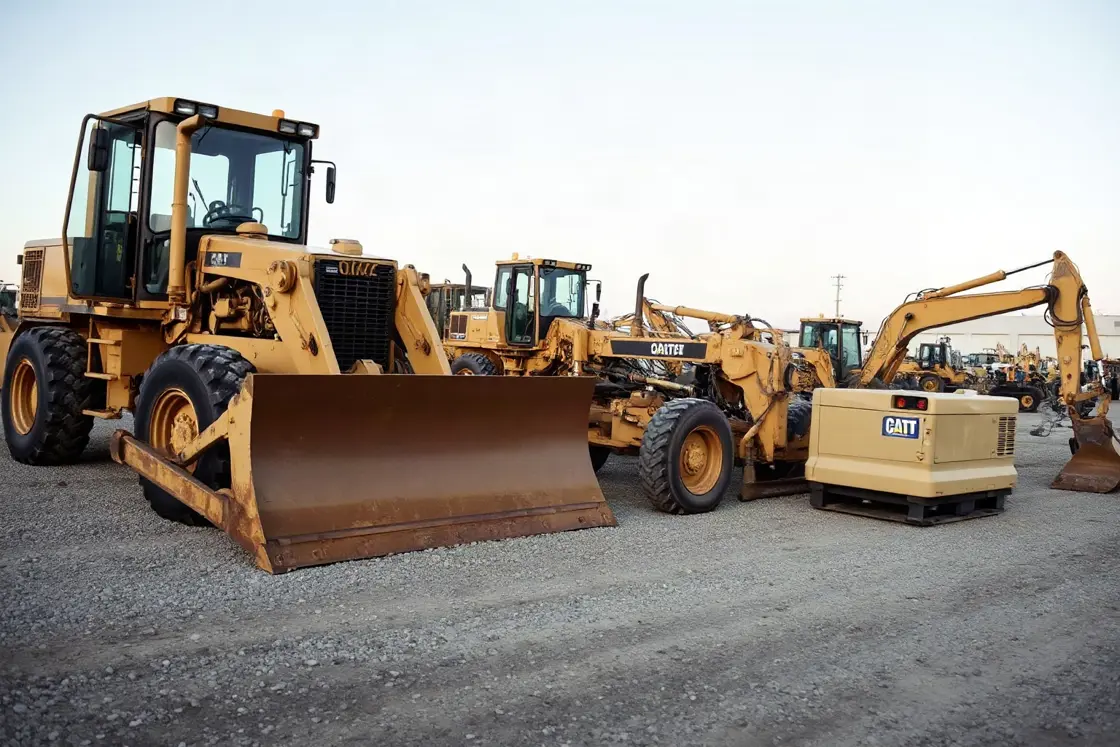
Common equipment types include bulldozers for pushing and spreading material, graders for shaping roads, excavators for digging and lifting, cranes for handling heavy loads, backhoes for mixed excavation work, loaders for moving aggregate, generators for field power and trailers for transporting attachments or supplies. Public-sector surplus sales can also include skid steers, wheel loaders, forklifts, dump trucks, trenchers, air compressors and jobsite tools. 1 3
The original military purpose is not always obvious from the machine itself. Some assets were built directly for engineering units, while others were ordinary commercial machines acquired for government projects. A unit may be released because of fleet replacement, changing mission needs, age, repair cost or excess inventory. Consequently, the phrase military surplus describes the ownership history and disposal route, not a guarantee of one uniform specification or condition.
Typical machines and civilian applications
Bulldozers and graders are most relevant to road formation, land clearing and site preparation, while excavators and backhoes suit trenching, drainage and foundation work. Cranes can support material handling, but their safe use depends heavily on rated capacity, boom condition, inspection records and correct setup. Generators may serve remote sites, although voltage, frequency, fuel type and load capacity must match the intended equipment.
Attachments can determine whether a machine is practically useful. Buckets, forks, hydraulic breakers, snowplows, brush cutters and pavement equipment are among the attachments found in broader surplus construction auctions. 3 Compatibility requires checking hydraulic flow, mounting geometry, electrical connections and lifting limits. A machine without its expected attachment may require additional fabrication, transport and testing before it can perform the intended job.
Military specification compared with commercial equipment
Military machinery is generally designed around durability, field repairability, modular components and operation in difficult environments. Those priorities can mean reinforced structures, accessible service points and systems intended to function away from established facilities. They do not automatically mean better productivity for a commercial contractor. Noise, fuel consumption, operator ergonomics, emissions equipment, controls and parts support may be less convenient than on newer commercial machinery.
Commercial equipment is usually developed around construction-site productivity, operator comfort, dealer support, emissions compliance and compatibility with widely available attachments. Military equipment may have unusual fasteners, electrical systems, tires, hydraulic components or engine configurations. Parts can be obtainable through specialist suppliers or used-equipment networks, but some components may no longer be manufactured. The relevant comparison is therefore the complete operating cost, not only the auction hammer price.
Inspection points before committing
Inspection should begin with identification records, engine hours, mileage, maintenance documentation, serial numbers, included attachments and any stated condition rating. The buyer should compare photographs with the machine in person where possible, looking for fluid leaks, cracked welds, bent frames, damaged cylinders, worn pins, loose bushings, tire deterioration and corrosion. Cold-start behavior, exhaust color, abnormal noise and hydraulic response can reveal problems that photographs do not show.
Under the machine, inspect the undercarriage, final drives, axles, brakes, steering and structural members. For lifting machinery, examine the boom, hooks, cables, outriggers and load charts. For earthmoving equipment, track or tire wear and hydraulic pressure are particularly important. Auction equipment may be sold as-is, inspection windows can be short and hauling is often the purchaser's responsibility, so an independent heavy-equipment mechanic can provide useful risk control. 3
Where surplus assets enter civilian markets
Federal disposal routes include the General Services Administration's surplus programs and Defense Logistics Agency Disposition Services. Government agencies may also use contracted auction companies or hold public sales connected with military installations. GSAXcess is associated with federal excess-property administration, while DLA Disposition Services handles transfer, donation and sale processes for property no longer required by defense organizations. 1 5
Named commercial auction examples include GovPlanet and IronPlanet, both of which are described in industry guides as platforms that can list government, military and industrial equipment. 1 They should be treated as marketplaces with changing inventories, not as evidence that a particular machine is currently available. Public auctions operated by municipalities, utilities, universities and other agencies can also contain construction equipment, even when the original owner was not a military branch. 3
2026 price context and total cost
Published 2026 guidance on government surplus equipment places the overall market from a few dollars to six figures, depending on equipment category, working condition, hours, records, attachments and demand. 2 That broad range is more defensible than assigning one typical price to every bulldozer, grader or excavator. Heavy construction machinery generally occupies the higher-value end of surplus markets, but a non-running unit, incomplete machine or specialized model can have a very different value from an operational counterpart.
| Cost factor | Why it changes the total |
|---|---|
| Winning bid | Reflects category, condition, hours, completeness and demand. |
| Buyer charges and taxes | May be added under the rules of the auction channel. |
| Transport | Oversize dimensions, weight, permits and distance can materially affect removal cost. |
| Repairs and parts | Deferred maintenance, obsolete components and specialist labor can exceed expectations. |
| Site preparation | Fuel, commissioning, safety checks and attachment compatibility affect readiness. |
Road use, worksite rules and practical risks
Military origin does not make a machine automatically street-legal or ready for a civilian construction site. Road registration depends on the equipment type, title documents, lighting, braking, dimensions, weight and the rules of the relevant state. A 2026 guide notes that many surplus HMMWVs are designated off-road only and that states differ on whether an SF97 document can be converted into a road title. 4 Similar checks are prudent for trucks, trailers and self-propelled machinery.
Worksite compliance also requires attention to guarding, rollover protection, seat belts, operator training, visibility, noise, exhaust emissions, lifting procedures and documented inspections. Military configurations may differ from current civilian expectations, including ROPS arrangements or control layouts. Transport planning is another major friction point because surplus equipment is commonly collected from depots or auction locations, and the purchaser may need heavy-haul equipment, permits, loading assistance and insurance before moving it to a jobsite.
Who should consider this equipment
Surplus machinery can fit experienced contractors, farms, land-management operations, mechanics and specialist users who can evaluate condition and support older systems. It is less suitable for an operation that needs predictable dealer servicing, modern emissions systems, low noise, rapid parts delivery or straightforward road registration. The machine's intended task, annual hours and distance from repair support matter as much as its purchase price.
A sound decision compares an inspected surplus unit with an equivalent used commercial machine on productivity, fuel, transport, repairs, operator safety, attachments and compliance. The strongest candidates have clear identity records, a documented inspection, usable service information, compatible parts and a realistic plan for hauling and commissioning. The central advantage is potential access to rugged industrial assets, while the central risk is accepting military history as a substitute for verified mechanical condition.
Sources
- A Guide to Military Surplus Construction Equipment - thinkstreamed.com: https://thinkstreamed.com/en/articles/a-guide-to-military-surplus-construction-equipment
- How Much Does Government Surplus Equipment Cost? - wondermapped.com: https://wondermapped.com/en/articles/how-much-does-government-surplus-equipment-cost
- Surplus Construction Equipment Auctions Explained – Government Auctions Blog: https://www.governmentauctions.org/blog/2026/08/05/surplus-construction-equipment-auctions-explained/
- GovPlanet FAQ: Humvee Titles, Fees, Inspections, Pickup (2026) | BidProwl: https://bidprowl.com/guides/govplanet-faq
- A Guide to Military Surplus Construction Equipment - curiositydive.com: https://curiositydive.com/en/articles/a-guide-to-military-surplus-construction-equipment-118eb3
Authored by MyTrendSpot team