Ways to manage neck pain at home: A clinically informed guide
Ways to manage neck pain at home generally focus on reducing strain while keeping the neck gently active. Common soreness related to posture, muscle tension, overuse, or an awkward sleeping position often improves with conservative care, but symptoms after trauma or alongside neurological changes require a different level of attention. 1
Understand the likely source of the pain
Neck pain can involve muscles, nerves, vertebrae, joints, discs, ligaments, or tendons. Everyday cases commonly develop from prolonged computer use, looking down at a phone, emotional stress, repetitive movement, or sleeping with inadequate support. A sudden muscle contraction may cause a “crick” or spasm, while irritated joints or discs can produce pain that extends toward the shoulder or arm. Identifying whether the discomfort is routine stiffness or a potential nerve-related problem helps determine whether home care is appropriate. 2
- Muscle strain may cause aching, tenderness, or tight knots in the neck and shoulders. 1
- Postural strain often builds gradually rather than beginning with one obvious event. 2
- Pain after a fall, collision, sports injury, or blow to the head should not be managed solely at home. 3
Keep the neck moving gently
For uncomplicated neck pain, prolonged bed rest or complete immobilization can be counterproductive. Gentle movement within a comfortable range may reduce stiffness and help maintain ordinary function. Slow turning, looking up and down, and controlled side-to-side motion can be attempted without forcing the neck into a stretch. Movement should remain mild and deliberate, particularly during the first several days, because aggressive stretching, repeated neck cracking, or exercises that reproduce sharp pain may aggravate irritated tissues. 4
- Change positions regularly instead of remaining seated or looking down for long periods. 2
- Stop an exercise if it increases pain, causes symptoms to travel into an arm, or produces numbness or weakness. 7
- Resume ordinary activity gradually, while limiting movements that clearly worsen symptoms. 5
Use heat or cold carefully
Heat and cold can provide short-term comfort, although the more useful option may depend on the timing and character of the symptoms. Cold packs are commonly used early after a new flare or minor strain, while warmth may relax tight muscles and ease stiffness. Either option should be wrapped in a cloth rather than placed directly against the skin. Sessions should be brief, and skin should be checked for excessive redness, numbness, or irritation. Temperature therapy is supportive care, not a way to diagnose the cause of pain. 6
| Approach | Potential role | Safety point |
|---|---|---|
| Cold pack | May calm discomfort during an early flare or minor strain | Wrap it and use it for short periods |
| Warm compress | May ease muscle tightness and stiffness | Avoid excessive heat or direct skin contact |
| Alternating methods | Can be considered according to which feels more comfortable | Stop if symptoms or skin irritation worsen |
Consider medication and activity limits
Over-the-counter pain relievers may offer temporary relief when used exactly as directed on the label and when medically appropriate. Options discussed in clinical guidance include acetaminophen and nonsteroidal anti-inflammatory drugs such as ibuprofen or naproxen. Medication suitability can vary with other medicines, pregnancy, kidney disease, stomach ulcers, cardiovascular conditions, liver disease, allergies, or age. A pharmacist or clinician can help assess risks, and taking more than the labeled amount does not make recovery faster. 4
- Read active ingredients carefully to avoid accidentally combining products with the same medicine. 6
- Use the shortest appropriate period rather than treating recurring pain indefinitely without assessment.
- Reduce activities that reliably trigger the pain, but avoid remaining inactive for extended periods. 7
Adjust posture, screens, and sleep
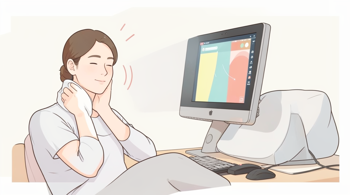
Small ergonomic changes can reduce repeated loading of the neck. A computer monitor positioned near eye level limits the need to bend or tilt the head, while a headset or hands-free phone setting avoids cradling a phone between the shoulder and ear. A tablet supported at an angle is generally less demanding than holding it flat in the lap. Frequent movement breaks are important because even a well-arranged workstation does not prevent strain if the same position is maintained for hours. 2
- Keep the head aligned over the shoulders as much as is comfortably possible.
- Use a supportive, comfortable pillow and avoid stacking too many pillows beneath the head. 2
- Update eyeglass prescriptions when vision problems cause repeated head tilting or leaning. 2
- Address stress and inadequate sleep, which can increase muscle tension and make pain harder to manage. 2
Know when home care is not enough
Most mild mechanical neck pain improves, but persistence, worsening symptoms, or repeated episodes may indicate a need for clinical assessment or physical therapy. Prompt evaluation is especially important after significant trauma or when pain occurs with numbness, tingling, weakness, balance problems, difficulty walking, or loss of hand coordination. Fever, severe headache, or a headache unlike previous headaches combined with neck stiffness can also signal a potentially serious condition. 8
- Seek urgent medical attention for progressive arm or hand weakness, trouble walking, or new coordination problems. 8
- Arrange medical review for pain that follows an accident, fall, or direct impact. 3
- Contact a clinician when symptoms last beyond about a week, continue to worsen, or repeatedly return. 3
- Do not use a home routine to delay evaluation of neurological symptoms or signs of infection.
Sources
- Harvard Health Publishing, “How to soothe a sore neck”
- Harvard Health Publishing, “6 ways to ease neck pain”
- Scripps Health, “Neck Pain Relief and Treatment Options”
- Mayo Clinic, “Neck pain: Diagnosis and treatment”
- NHS, “Neck pain and stiff neck”
- MedlinePlus, “Neck pain”
- American Academy of Orthopaedic Surgeons, “Neck Pain”
- American Association of Neurological Surgeons, “Neck Pain”
Authored by MyTrendSpot team