Best knee brace for knee pain: An Evidence-Based Guide to Choosing Support
How knee braces differ by purpose
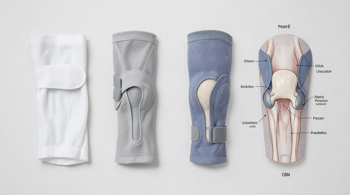
The best knee brace for knee pain is determined less by brand name than by the source and pattern of discomfort. Orthopedic guidance generally separates braces into compression sleeves, hinged stabilizers, unloader braces for osteoarthritis, and patellofemoral supports. Compression designs provide warmth, pressure, and sensory feedback, while hinged models are intended to limit unwanted side-to-side movement or hyperextension. Unloader braces apply a corrective force to shift weight away from a damaged knee compartment. 11
| Brace category | Typical design purpose | Relevant research examples |
|---|---|---|
| Compression sleeve | Warmth, compression, proprioception, and light support | Bauerfeind Sports Knee Support, GenuTrain |
| Hinged brace | Medial and lateral stability for ligament-related problems | Orthogears brace, Bauerfeind SofTec Genu |
| Unloader brace | Weight redistribution in one-compartment osteoarthritis | Breg Freestyle Plus OA |
| Patellofemoral support | Assistance with kneecap tracking and pressure distribution | DonJoy Reaction Web, Bauerfeind Sports support |
Options for osteoarthritis pain
Unloader braces are most relevant when osteoarthritis is concentrated in the medial or lateral compartment rather than evenly distributed throughout the knee. The Breg Freestyle Plus OA is described for mild to moderate unicompartmental osteoarthritis, meniscus injuries, and other conditions that may benefit from unicompartmental unloading. Its design includes medial or lateral configurations, a wrap-around structure, breathable BreatheFit material, contoured straps, and a tool-free thumbwheel intended to personalize unloading. 1
Fit and orientation are central to an unloader brace. Product information describes the hinge as being positioned opposite the painful compartment, outside the knee for medial pain and inside for lateral pain. The associated sizing information uses thigh and calf measurements, with listed sizes from small through 2XL and measurement ranges that vary by manufacturer. A clinician or orthotist can help identify whether pain is truly compartment-specific before an unloading design is selected. 3
Compression supports for daily activity and sport
Compression sleeves are generally less restrictive than rigid braces and are often used for activity-related discomfort, mild swelling, or a preference for warmth and low-profile support. Bauerfeind describes its Sports Knee Support as using anatomically contoured padding around the kneecap to redistribute pressure, while 3D AIRKNIT material is described as breathable, moisture-wicking, washable, and designed to permit freedom of movement. The manufacturer also states that compression can provide sensorimotor feedback, known as proprioception. 2
The Bauerfeind GenuTrain is another compression-oriented design, with a contoured knit structure, a pad intended to stimulate key areas around the knee, and fabric designed for breathability and moisture management. The product is offered in 13 sizes, including comfort sizes for more conical leg shapes, and requires upper and lower circumference measurements. These features may suit users who want support during walking, standing, or sport without the bulk of a rigid frame. 8
When hinged or ligament braces may be relevant
Hinged braces are intended for a different problem from a simple compression sleeve. They use side supports, hinges, straps, or spring elements to resist excessive rotation and provide medial or lateral stability. The Orthogears model described in the research includes a removable hinge, dual spring reinforcement, a patella gel pad, and anti-slip silicone. Such features are marketed for stability, but a suspected ACL, MCL, LCL, or meniscus injury requires assessment because the correct level of restriction depends on the diagnosis and stage of recovery. 6
For more substantial instability, the Bauerfeind SofTec Genu is described as using a four-point system, lateral aluminum sidebars, and a hinge system intended to limit incorrect movement. It is associated with ACL tears, ligament injuries, and complex instability, rather than routine mild knee soreness. A brace of this type can affect gait, range of motion, skin comfort, and rehabilitation, so postoperative or injury-related use should follow a professional fitting and treatment plan. 10
Patellar tracking and anterior knee discomfort
Some knee pain is felt around or behind the kneecap and may be associated with patellofemoral loading or tracking concerns. The DonJoy OA Reaction Web is described as a lightweight web-based orthosis for early to mild unicompartmental osteoarthritis and patellofemoral pain. Its silicone web is intended to distribute forces and influence patellar movement, while its undersleeve is described as breathable. The standard DonJoy Reaction description also identifies an elastomeric web, dual-axis hinges, and adjustable straps for shock absorption and stability. 4
Patellar supports should not be treated as interchangeable with ligament braces or osteoarthritis unloaders. A contoured pad may redistribute pressure, but it does not establish the cause of pain or correct every tracking problem. The Bauerfeind Sports support, for example, describes a pad surrounding the kneecap rather than a rigid frame designed to immobilize the joint. Persistent anterior knee pain, locking, recurrent swelling, or inability to bear weight warrants clinical evaluation instead of progressively tighter bracing. 2
Fit, maintenance, and possible drawbacks
Incorrect sizing can reduce support or create new symptoms. Several products specify measurements approximately 5.5 to 6 inches above the kneecap, while others also require a calf measurement below the knee. The Breg sizing chart lists thigh and calf ranges from XS through 2XL, whereas DonJoy sizing guidance notes that some wearers may find a measured size tight and may need a larger fit for comfort. Any brace should feel secure without causing numbness, tingling, sharp pain, skin irritation, or restricted circulation. 1
Braces also require ongoing care and realistic expectations. Knit supports may require washing and careful drying, straps can lose adjustment, and hinges or silicone elements may need inspection for wear. Medical guidance emphasizes that bracing is generally one part of a broader plan that can include strengthening and physical therapy, not a replacement for muscle conditioning. Long-term reliance without rehabilitation may contribute to reduced muscle use and functional weakness. Eligibility for insurance reimbursement varies, although some unloader and rigid orthoses carry PDAC-approved codes such as L1843, L1851, L1832, and L1833. 12
Safety and selection checklist
Selection should begin with the symptom pattern, activity demands, and diagnosis. A sleeve may be reasonable for mild activity-related discomfort, a patellar support for specific kneecap symptoms, a hinged brace for documented instability, and an unloader for confirmed single-compartment osteoarthritis. No brace can guarantee pain relief, prevent every injury, or replace medical evaluation. Red-flag symptoms include substantial swelling after trauma, deformity, inability to walk, repeated giving way, or mechanical locking. 13
- Identify whether pain is medial, lateral, anterior, or diffuse.
- Measure according to the exact manufacturer instructions.
- Match left or right leg and medial or lateral configuration where required.
- Check circulation, skin condition, comfort, and slippage during use.
- Pair bracing with clinician-directed strengthening or rehabilitation.
- Seek professional advice for surgery recovery, ligament injury, or persistent symptoms.
The main market friction is that similar-looking braces can serve fundamentally different mechanical purposes. A compression product may feel comfortable but offer limited instability control, while a rigid brace may be unnecessarily restrictive for ordinary soreness. Product descriptions also represent manufacturer or retailer claims, not independent proof that every user will experience the stated benefit. Comparing construction, fit, intended indication, and professional guidance provides a more reliable basis than choosing solely by appearance or advertised support level. 14
Sources
- Breg, Inc., Freestyle Plus OA Knee Brace
- Bauerfeind, Sports Knee Support
- BraceDirect, Breg Freestyle OA Unloader Knee Brace
- Medical Department Store, DonJoy OA Reaction Web Brace
- MedicalSupplies.co.uk, DonJoy Reaction Knee Brace
- Orthogears, Knee Brace for Pain Relief
- NEENCA, ACE-51 Knee Brace
- Bauerfeind UK, GenuTrain Knee Support
- BraceDirect, Bauerfeind Sports Compression Knee Support
- BraceDirect, Bauerfeind SofTec Genu Knee Brace
- American Academy of Orthopaedic Surgeons, Knee Braces: Types and Functions
- Cleveland Clinic, Knee Brace Guidance and Sizing
- Mayo Clinic, Knee Pain Diagnosis and Treatment
- Healthline, Knee Brace Selection Guidance
Authored by MyTrendSpot team