Early symptoms of osteoporosis you should know: Clinical signs, screening, and risk context
Why osteoporosis is difficult to detect early
Early osteoporosis is usually silent, meaning bone density can decline while a person feels normal and experiences no pain or visible change. Bone is living tissue that continually removes old material and replaces it, but osteoporosis develops when breakdown outpaces rebuilding. Because this process is gradual, many diagnoses occur only after a fracture or during a screening assessment. 1
- Osteoporosis most often affects the hips, wrists, and spine. 1
- Early bone loss may first be classified as osteopenia rather than osteoporosis. 2
- A lack of symptoms does not establish that bone strength is normal.
Fractures after minor impact
A broken bone after a minor fall, ordinary movement, or stress that would not usually cause injury is one of the clearest clinical warnings of fragile bones. These are often called fragility fractures. The wrist, hip, and spine are frequent sites, although fractures can also affect the shoulder, pelvis, ribs, and other bones. A fracture from low impact warrants medical assessment for possible underlying bone loss. 3
- Hip fractures can affect mobility and independence. 4
- Spinal fractures may occur without a clearly remembered accident.
- A fracture is not required before osteoporosis can be detected.
Height loss and posture changes
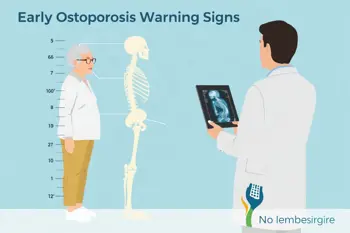
Gradual loss of height can signal compression of the vertebrae, the bones that form the spinal column. A reduction of about 1.5 inches or more is particularly concerning in clinical guidance, while smaller changes may still deserve attention when they occur progressively. Vertebral compression can also produce an increasingly rounded upper back, known as kyphosis, or a stooped posture. 5
- Measure height over time under consistent conditions.
- A new hunched appearance may reflect spinal bone collapse.
- Posture changes can have causes other than osteoporosis.
Back pain and possible spinal fractures
Persistent or sudden back pain without an obvious injury may be associated with a vertebral compression fracture. Some spinal fractures are painful, while others produce few immediate symptoms and become noticeable through height loss or posture changes. Pain that develops after lifting, bending, coughing, or a minor movement should not automatically be attributed to ordinary muscle strain, particularly when other signs of bone fragility are present. 6
- Spinal compression fractures can accumulate over time.
- Chronic pain may follow repeated vertebral injury.
- Severe or sudden back pain requires professional evaluation.
Dental and physical clues
Loose teeth, gum disease, or receding gums may reflect reduced bone support in the jaw, although these findings are not specific to osteoporosis and cannot diagnose it alone. Research summarized in the supplied clinical information also links weaker grip strength with lower bone mineral density in older adults. These clues are best understood as reasons to discuss broader bone health, not as substitutes for a formal assessment. 7
- Jawbone changes may occur alongside wider skeletal bone loss.
- Grip strength is a correlate, not a standalone diagnostic test.
- Dental symptoms also have common local causes.
Who may need evaluation without symptoms
Testing can be important even when no warning sign is present because osteoporosis often remains symptom-free until a break occurs. Risk rises with age and is especially significant for women after menopause, while men can also develop the condition. Family history, low body weight, smoking, and some medicines, including long-term corticosteroids, are additional factors associated with elevated risk. 8
- Women over 65 and men over 70 are identified as higher-risk groups in the supplied guidance. 9
- Previous low-impact fracture strengthens the case for evaluation.
- Bone-density testing can identify weak bones before a fracture.
How bone loss is confirmed
Symptoms alone cannot confirm osteoporosis because height loss, back pain, posture changes, dental problems, and reduced grip strength may have multiple explanations. A bone-density scan, commonly described as a DEXA scan, measures bone mineral density and can distinguish normal bone, osteopenia, and osteoporosis. The supplied research describes osteopenia as bone density below normal but not low enough for an osteoporosis diagnosis. 2
- Clinical history includes fractures, medicines, and relevant risk factors.
- Assessment may focus on the hip and spine.
- Treatment decisions depend on measured bone health and fracture risk.
When the signs deserve attention
A minor-impact fracture, unexplained back pain, measurable height loss, or a newly stooped posture should be discussed with a healthcare professional. These findings do not prove osteoporosis, but they can indicate vertebral injury or broader bone weakness. Evaluation is also relevant for people with major risk factors who have no symptoms, since waiting for pain or a fracture can mean that substantial bone loss has already occurred. 1
- Do not rely on symptoms alone to judge bone strength.
- Record changes in height and posture over time.
- Discuss screening when age, menopause, medication, or fracture history increases risk.
Sources
- Penn Medicine, Osteoporosis: Symptoms and Causes, https://www.pennmedicine.org/conditions/osteoporosis
- GoodRx, What Are the Early Signs of Osteoporosis?, https://www.goodrx.com/conditions/osteoporosis/what-are-the-early-signs-of-osteoporosis
- Acibadem Hospitals Group, Osteoporosis: Early Warning Signs, Risk Factors, and Bone Density Testing, https://acibademinternational.com/health-library/osteoporosis-early-warning-signs-risk-factors-and-bone-density-testing/
- Prevention, 5 Surprising Early Warning Signs of Osteoporosis, https://www.prevention.com/health/a69126494/early-warning-signs-of-osteoporosis/
- Florida Medical Clinic Orlando Health, How to Spot the Early Warning Signs of Osteoporosis, https://www.floridamedicalclinic.com/blog/early-warning-signs-of-osteoporosis/
- Medical Daily, Osteoporosis and Bone Density Loss, https://www.medicaldaily.com/osteoporosis-bone-density-loss-why-this-silent-bone-disease-often-missed-474528
- Sensorem, Osteoporosis Symptoms: How Do You Know You Have It?, https://www.sensorem.com/en/osteoporosis-symptoms/
- Baptist Health, Silent Bone Loss, https://baptisthealth.net/baptist-health-news/why-many-patients-do-not-know-they-have-osteoporosis-until-a-fracture
- National Osteoporosis Foundation, What Is Osteoporosis?, https://www.bonehealthandosteoporosis.org/patients/what-is-osteoporosis/
Authored by MyTrendSpot team