Best hospitals for Trauma Surgery: A Data-Based Guide to Level I Trauma Care
People researching the best hospitals for Trauma Surgery are generally comparing institutions that can manage severe, complex, and multiple injuries through coordinated emergency surgery, critical care, specialist treatment, and rehabilitation. Level I designation is an important reference point, but it does not by itself establish that one hospital is universally superior for every injury, age group, location, or clinical circumstance.
How trauma hospitals are evaluated
The American College of Surgeons evaluates trauma centers through a formal review of institutional resources, clinical capabilities, patient-care systems, and performance-improvement processes. The review concerns the hospital’s ability to deliver organized trauma care rather than a simple consumer ranking or reputation survey. 1
Level I centers are structured to provide comprehensive care for severe injuries, including access to trauma surgeons, surgical subspecialists, critical-care services, emergency operating capability, education, research, prevention, and rehabilitation. The practical meaning of a designation can vary by whether the program treats adults, children, or both, so those distinctions require close attention when comparing hospitals.
Hospitals with documented Level I capabilities
The supplied hospital information identifies multiple Level I programs across the United States. Penn Medicine operates designated Level I Trauma Centers at Penn Presbyterian Medical Center in Philadelphia and Lancaster General Hospital in Lancaster, while UVA Health University Medical Center has received repeated ACS verification as a Level I center. 2 3
| Hospital or system | Documented trauma-care characteristic |
|---|---|
| Penn Medicine | Level I centers in Philadelphia and Lancaster, with emergency surgery and surgical critical care |
| UVA Health University Medical Center | Level I adult and pediatric trauma care with multidisciplinary specialist support |
| Cedars-Sinai | Level I adult trauma center in Los Angeles County since 1984 |
| Tampa General Hospital | ACS-verified Level I center serving West Florida, in partnership with USF Health |
Cedars-Sinai reports that it has maintained Level I adult trauma designation since 1984 and remains one of four Level I adult trauma centers serving Los Angeles County. Tampa General Hospital reports that its renewed ACS verification extends through January 29, 2029, and that it is the only ACS-verified Level I trauma center in the West Florida region. 4 5
Regional hubs and emergency surgery systems
OU Health University of Oklahoma Medical Center is described as the central Level I trauma facility in Oklahoma’s statewide trauma system. The program treats patients of all ages, including children, and connects emergency medical services, community hospitals, air transport, and rehabilitation resources across the state and surrounding region. 6
UPMC Presbyterian combines trauma surgery, general surgery, and surgical critical care within a major academic program. Its emergency general surgery service is directed by Matthew D. Neal, MD, who is board-certified in general surgery and surgical critical care and directs the Pittsburgh Trauma and Transfusion Medicine Research Center. 7 These features illustrate why a hospital’s research, training, transfusion, and intensive-care infrastructure can matter alongside its formal designation.
Major referral centers by region
Harborview Medical Center in Seattle is identified as a Level I adult and pediatric trauma center serving Washington, Alaska, Montana, and Idaho. That broad referral role is relevant when a local hospital transfers a patient whose injuries require services unavailable at a smaller facility. 8
Grady Memorial Hospital in Atlanta provides Level I trauma services with emergency surgery, critical care, and trauma rehabilitation. 9
The R Adams Cowley Shock Trauma Center at the University of Maryland Medical Center serves as a specialized statewide referral center for critically injured adults. 10
Jackson Memorial Hospital in Miami operates a Level I trauma program for complex and life-threatening injuries in South Florida. 11
Parkland Memorial Hospital in Dallas provides Level I adult and pediatric trauma care, emergency surgery, and critical care. 12
Specialist coverage and injury complexity
Denver Health Medical Center is described as a Level I trauma center serving Colorado and the Rocky Mountain region, while Vanderbilt University Medical Center provides Level I trauma care through trauma, emergency general surgery, and surgical critical-care programs. 13 14 UCLA Health similarly describes multidisciplinary trauma treatment involving emergency, surgical, neurosurgical, and critical-care services. 15
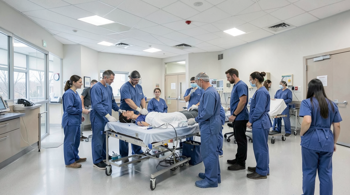
For musculoskeletal injuries, Penn Medicine reports comprehensive orthopaedic trauma and fracture care, including complex fractures and traumatic injuries, with access to resources at its Level I centers. University of Utah Health lists complex pelvic and acetabular trauma, polytrauma, deformity correction, malunions, and nonunions among the expertise associated with Thomas F. Higgins, MD. 2 16 These examples show that the most relevant hospital may depend on the specific injury rather than a general reputation.
What patients and families should verify
OHSU Hospital is identified as Oregon’s only Level I trauma center and a referral destination for complex injuries across the Pacific Northwest. 17 A hospital’s geographic role, pediatric capability, specialist availability, rehabilitation pathway, and transfer arrangements are therefore practical comparison criteria. Some programs focus on adults, while others explicitly include children, and that distinction can affect the appropriate destination.
Trauma care also involves operational limitations and clinical uncertainty. A designation confirms required capabilities, but it does not guarantee a particular outcome, eliminate complications, or mean that transfer is appropriate in every case. Penn Medicine states that transfers must be arranged by the patient’s doctor or care team, while Bellevue’s reported ACS recertification illustrates the continuing maintenance burden: its Level I adult program admitted 1,986 adults for trauma care in 2025 and its emergency department saw more than 100,000 adult patients. 2 18
Interpreting “best” in trauma surgery
There is no single evidence-based list in the supplied material that ranks these hospitals from first to last. A more defensible interpretation of “best” is the facility with the appropriate verified capability, specialist coverage, age-group expertise, referral access, and rehabilitation support for a particular injury. Local emergency systems may route patients according to travel time, injury severity, transport capacity, and the need for services that smaller hospitals cannot provide.
For a life-threatening injury, emergency medical services determine the safest destination and should be contacted rather than relying on independent hospital comparisons. For nonemergency follow-up, useful questions include whether the hospital treats the relevant injury, whether it has adult or pediatric Level I status, how transfers are coordinated, and how surgical critical care and rehabilitation are integrated. Those checks provide a more reliable basis for evaluating trauma hospitals than promotional language or generalized reputation.
Sources
- American College of Surgeons: Trauma Verification, Review, and Consultation Program
- Penn Medicine: Trauma Care and Emergency Surgery; Trauma and Fracture Care
- UVA Department of Surgery: UVA Health Earns Highest National Trauma Care Honor
- Cedars-Sinai: Advancements Over 40 Years of Trauma Care
- PR Newswire: Tampa General Hospital Level I Trauma Center Verification
- OU Health: Trauma and Injury Care
- UPMC Providers: Matthew D. Neal, MD
- UW Medicine: Harborview Medical Center Trauma
- Grady Health System: Trauma Center
- University of Maryland Medical Center: Shock Trauma
- Jackson Health System: Trauma
- Parkland Health: Trauma
- Denver Health: Trauma
- Vanderbilt University Medical Center: Trauma and Surgical Critical Care
- UCLA Health: Trauma
- University of Utah Health: Thomas F. Higgins, MD
- Oregon Health & Science University: Trauma
- NYC Health + Hospitals/Bellevue: Trauma Center Recertification
Authored by MyTrendSpot team