How inversion tables support back relief and core strength
People exploring non-surgical approaches to back pain management frequently encounter inversion tables as a gravity-based option for spinal decompression and muscle engagement. Understanding how inversion tables support back relief and core strength requires examining the underlying biomechanics, the specific muscle groups involved, the available clinical evidence, and the real limitations and health risks that accompany this therapy. The following sections provide an objective, data-grounded analysis of each dimension.
The Mechanics of Spinal Decompression During Inversion
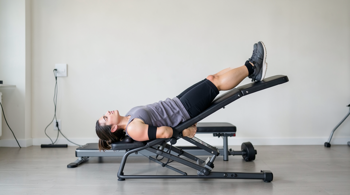
An inversion table is a padded, hinged board that rotates around a central pivot point, allowing a person secured at the ankles to tilt backward at angles ranging from approximately 20 degrees to a full 90-degree inversion. 1 Throughout a normal upright day, gravity continuously compresses the lumbar spine, squeezing the intervertebral discs and narrowing the spaces between vertebrae. When the body is inverted, that gravitational force reverses direction, pulling the upper body away from the lower body and creating a traction effect along the spinal column. 2 Biomechanical measurements show that meaningful spinal decompression begins at approximately 60 degrees of inversion, with studies recording measurable disc space increases of 3 to 5 millimeters under full traction conditions. 3
Most inversion tables achieve this through a rotating pivot system, ankle locking mechanisms, adjustable height settings, and an angle-limiter safety strap that allows the user to control how far the inversion progresses. 4 The decompression produced is temporary: the spine re-compresses when the user returns to an upright position. This temporary separation, however, is considered clinically meaningful for reducing nerve pressure and allowing intervertebral discs an opportunity to rehydrate by absorbing fluid and nutrients during the period of reduced compressive load. 5
Muscle Groups Targeted and Core Engagement
Inversion tables engage a broader range of muscles than passive decompression alone suggests. Primary muscles activated include the erector spinae, a group running along the spine that supports posture and back alignment, and the core stabilizers: the rectus abdominis, transverse abdominis, and obliques. 6 These core muscles are recruited automatically during inversion because the body must stabilize itself against an unfamiliar gravitational orientation. Secondary muscle groups that receive stretching and activation include the hamstrings, glutes, hip flexors, and calf muscles, all of which experience a decompression-assisted elongation as the body hangs inverted. 7
The following table summarizes the primary and secondary muscles engaged during inversion therapy sessions:
| Muscle Category | Specific Muscles | Primary Action |
|---|---|---|
| Core Stabilizers | Transverse abdominis, rectus abdominis, obliques | Stabilization and body control during inversion |
| Spinal Support | Erector spinae, multifidus | Postural alignment and spinal muscle relaxation |
| Posterior Chain | Hamstrings, glutes | Stretching and tension reduction |
| Hip Complex | Hip flexors | Gentle elongation, relief from sitting-related tightness |
Active inversion exercises amplify core engagement considerably. Inverted crunches, sit-ups, spinal twists, and back extensions performed at partial angles between 20 and 60 degrees can target the abdominals and obliques in ways that standard floor exercises cannot replicate, because gravity assists rather than compresses the spine during movement. 8 Research reviewing combined passive and active inversion routines found that pairing decompression with targeted exercises produces better long-term outcomes than either approach in isolation. 9
Clinical Evidence on Back Pain Relief
The clinical record on inversion therapy presents encouraging but context-dependent findings. A 2012 study conducted at Newcastle University found that patients with sciatica who practiced inversion therapy were significantly less likely to require surgery compared to control groups who did not use inversion. 10 A separate study published in the Journal of Physical Therapy Science, specifically examining Teeter-brand inversion tables for patients with lumbar disc disease and sciatica, reported that 74 percent of participants experienced reduced pain, 39 percent discontinued use of pain medication, and the group overall showed improved range of motion and reflexes. 11 That same research noted patients using inversion therapy were approximately 50 percent less likely to require surgical intervention. 11
An eight-week study examining 60-degree inversion found statistically significant reductions in reported back pain alongside measurable improvements in spinal flexibility. 12 Despite these results, clinical consensus consistently characterizes inversion therapy as a short-term symptomatic aid rather than a curative treatment. Long-term randomized controlled trials remain limited in number and sample size, and most expert guidance positions inversion as one component within a broader rehabilitation plan that includes physical therapy, corrective exercise, and medical oversight rather than a standalone solution. 13
Posture, Flexibility, and Long-Term Spinal Health
Beyond acute pain relief, inversion tables are associated with supporting spinal alignment and postural muscle conditioning over consistent use periods. Decompression-induced relaxation of tight back and hip muscles can allow the shoulders to drop into a more neutral position and reduce the chronic forward-head posture pattern associated with prolonged desk work. 14 The spinal muscle group known as the erector spinae benefits from the elongating effect of inversion, which can reduce chronic tension patterns that develop from repetitive loading in upright positions. 15
Flexibility outcomes associated with inversion therapy include increased spinal mobility, improved hip flexor range of motion, and greater hamstring extensibility. These effects are mechanically driven by the gravity-assisted stretch applied to the posterior chain during inverted positioning. Clinical observations note that inversion also temporarily improves circulation to spinal structures, promoting oxygen and nutrient delivery to tissues that are otherwise poorly perfused under sustained compressive load. 16 For individuals combining inversion with a structured exercise program targeting the core, erector spinae, glutes, and hip flexors, spinal stability improvements are more durable than those achieved through passive inversion alone. 9
Recommended Usage Protocols and Angle Guidance
Clinical and physical therapy guidance consistently recommends graduated progression for inversion table use. Beginners are advised to start at mild angles between 15 and 25 degrees for sessions of one to three minutes, allowing the cardiovascular and vestibular systems to acclimate to inverted positioning before advancing to deeper angles. 17 The optimal angle for disc decompression, according to reported clinical consensus, is approximately 60 degrees rather than a full 90-degree inversion, as this angle produces significant disc space increase without maximizing the cardiovascular stress associated with full inversion. 3
Best results in terms of pain management and spinal health maintenance are generally observed with consistent use of two to three sessions daily at the 60-degree angle for three to five minutes per session, combined with supportive exercises targeting the core and posterior chain. 18 Users should follow manufacturer-specific instructions for height adjustment, typically setting the table approximately one inch taller than the user's height to achieve a balanced center of gravity for smooth inversion control. 8 Inversion should always be paired with slow, controlled return to upright positioning to avoid sudden blood pressure changes.
Contraindications, Risks, and Populations Who Should Avoid Inversion
Inversion therapy carries documented risks that make it inappropriate for a significant portion of the population without explicit medical clearance. The inverted position increases blood pressure and intraocular pressure, making glaucoma a firm contraindication. 19 Individuals with uncontrolled hypertension, heart disease, circulatory disorders, retinal detachment, inner ear conditions, or active bone fractures are similarly advised to avoid inversion. 20 Pregnant individuals and those with osteoporosis should also consult a healthcare professional before considering inversion therapy, as the mechanical forces involved may pose elevated risk in these populations. 19
Even among eligible users, incorrect setup or excessive session duration can produce adverse outcomes including dizziness, increased muscle soreness, or joint strain at the ankles from the locking mechanism. The distinction between inversion table therapy and professionally supervised spinal decompression therapy is also medically relevant: clinical decompression uses computer-controlled traction that targets specific discs and can create negative pressure to retract disc material, achieving reported success rates of 71 to 89 percent for disc conditions, whereas inversion tables produce a general gravity-based stretch across the entire spine with no disc-specific targeting capability. 21 Medical consultation before beginning inversion therapy is not optional advice but a necessary first step for safety evaluation.
Sources
- Matriya.com - Best Inversion Tables of 2026
- Regenerative Spine and Joint - Understanding Inversion Tables
- YouBoost.com - Inversion Therapy: Benefits, Dosage and Evidence
- InversionExpert.com - How Inversion Tables Work
- Doctronic.ai - Inversion Tables for Back Pain: Do They Work?
- CyVigor.com - Inversion Table Benefits: Targeted Muscles and Decompression Explained
- CyVigor.com - Inversion Table Benefits: Muscle Relief, Strength, and Flexibility Explained
- ChiroHer.com - Beyond the Hang: Top Inversion Table Exercises for Back Pain Relief
- BestInversionTables.org - Lower Back Exercises Using an Inversion Table
- Teeter.com - Inversion Therapy Benefits: How It Relieves Back Pain Safely
- BackMuscleSolutions.com - Does Inversion Therapy Work for Back Pain?
- ChiroHer.com - Beyond the Hang: Top Inversion Table Exercises for Back Pain Relief
- T7FIT.com - Are Inversion Tables Effective For Back Pain
- T7FIT.com - Can Inversion Tables Improve Posture
- BestInversionTables.org - Back Strengthening Exercises and Health Benefits
- T7FIT.com - Can Inversion Tables Increase Flexibility
- BestCheapBuy.com - How Inversion Tables Work: Complete Guide
- BestCheapBuy.com - How Inversion Tables Work: Complete Guide
- Cleveland Clinic - Inversion Tables Might Flip the Script on Back Pain
- Health.com - How To Use an Inversion Table Safely for Back Pain
- SynergyPainRelief.com - Spinal Decompression vs Inversion Table
Authored by MyTrendSpot team