Police impound boats and trailers: A factual guide to seizures, storage, and recovery
Why police impound boats and trailers
Boat and trailer impoundments can follow a safety violation, a criminal investigation, an abandonment finding, or a municipal parking enforcement action. In Sudbury, Ontario, police responded to a suspected impaired driver after a boat fell from a trailer and landed in the roadway near John Street and Paris Street. Officers later located the pickup truck, arrested the driver, and charged him with impaired driving, dangerous driving, and hauling an insecure load. The vehicle and boat were reported as impounded. 1
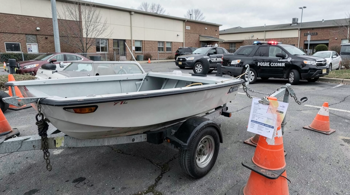
Other cases involve property status rather than driving conduct. Leader RCMP seized a white and light-blue fibreglass runabout with a Mariner 80 horsepower motor on a red single-axle trailer near Shackleton, Saskatchewan, after an investigation indicated it might be stolen. Police sought the owner and requested dashcam or surveillance footage. These examples show that impoundment may protect public safety, preserve evidence, or help identify property connected with a theft investigation. 4
Impaired operation and unsafe loads
An insecure load can create an immediate roadway hazard because a boat may detach, slide, or obstruct traffic. The Sudbury incident began with a report of a suspected impaired boater at the Ramsey Lake launch. Police said the individual left in a pickup towing a trailer, but the boat had not been properly secured and fell into the middle of the road. Breath testing later showed blood alcohol concentrations well above the Canadian legal limit of 80, according to the police account. 2
Comparable risks appeared in East Naples, Florida, where a boat fell from a trailer and slid along Bayshore Drive. Collier County deputies reported that the driver attempted to flee and was arrested after displaying signs that included slurred speech, glassy eyes, and imbalance. The incident was treated as a DUI case. A separate North Carolina traffic stop involved a pickup towing a trailer loaded in a hazardous manner, with items falling onto the roadway before deputies recovered stolen trailers and a stolen boat during the broader investigation. 6
Registration, parking, and abandonment issues
Registration and title requirements can apply separately to a boat and its trailer, although the exact rules depend on the jurisdiction. The research materials identify state boating agencies as authorities for registration requirements and note that trailers commonly require their own title or registration. A missing, expired, or mismatched registration can complicate a traffic stop, ownership inquiry, or recovery process. Owners also face local rules governing boat ramps, public roads, private property, and storage areas. 7
Portland documented a 1989 Searay with expired Oregon registration and a trailer with an expired plate after the vessel was seized for illegal parking. The city classified it as an abandoned vessel under Oregon law and stated that the owner had to establish ownership, register the boat, and pay accrued salvage, towing, and storage costs to prevent disposal. The notice also said the vessel could vest in the city if it was not reclaimed by the stated deadline. 3
Evidence, stolen property, and police custody
A boat or trailer may remain in police custody when investigators believe it was stolen or connected to another offense. In Saskatchewan, Leader RCMP asked people who had lost a boat or trailer matching the description to contact police, while also requesting video from the area on August 6. The seizure therefore served both an investigative purpose and a possible property-recovery purpose. Until ownership is established, the vessel may not be treated as an ordinary abandoned item. 5
The RCMP also investigated the theft of an orange, 14-foot Dunlop inflatable vessel and a 2002 Remeq trailer from a cabin property in Charleston, Newfoundland and Labrador. The trailer bore license plate TWM026, and the boat had no motor attached when it was reportedly stolen. This type of identifying detail, including color, hull style, plate information, and motor description, can be important when police compare seized property with theft reports. 8
What recovery usually involves
Recovery procedures vary by state, province, municipality, and the reason for the seizure. A person generally must demonstrate ownership or lawful authority, resolve any registration issue, and comply with the releasing agency's instructions. Research on impounded vehicles identifies towing, storage, administrative charges, documentation, and release requirements as recurring elements. A vessel held as evidence or in a criminal case may follow a different timetable from a boat towed for parking or abandonment. 9
Owners should distinguish between a police evidence hold, a roadside or municipal tow, and an abandonment proceeding. Each category can involve different notice rules and appeal or hearing procedures. In the Portland notice, the city stated that proof of ownership and payment of salvage, towing, and storage costs were required for reclamation. The notice also required registration before pickup, demonstrating how administrative compliance can be part of the release process. 3
Deadlines, disposal, and risk management
Unclaimed boats may eventually be sold, transferred, demolished, or otherwise disposed of under applicable law. Abandoned and derelict vessel programs address the environmental and navigational risks created when boats remain on public waterways, roads, or land. The research materials identify statutory notification periods and auctions as possible outcomes for unclaimed impounded property, but the actual deadline and disposal method are jurisdiction-specific. 10
Preventive compliance centers on secure loading, current boat and trailer records, lawful parking, and preserving ownership documents. The Sudbury case demonstrates how a loading failure can combine with impaired driving allegations and produce criminal, traffic, licensing, and impoundment consequences. Theft investigations show another risk: a legitimate owner may need photographs, serial or hull information, registration records, and a police report to distinguish a recovered vessel from an unrelated boat or trailer. 2
Sources
- CTV News, Sudbury sees boat slide off trailer onto the road
- Sudbury Star, Boat tumbles into roadway, leading to impaired driving charges
- City of Portland, Notice of Seizure of a red and white Searay boat OR 872RU
- Clark's Crossing Gazette, Leader RCMP looking for owner of boat found on patrol
- 98COOL, Leader RCMP seek owner of boat found on side of Highway 32
- WBBH, Man arrested after boat slides down Bayshore Drive in East Naples
- Florida Fish and Wildlife Conservation Commission, Boating Regulations
- Royal Canadian Mounted Police, Clarenville RCMP investigating theft of boat and trailer
- City of New York, Procedures for retrieving impounded vehicles and trailers
- National Oceanic and Atmospheric Administration, Abandoned and Derelict Vessels
Authored by MyTrendSpot team