Questions about rehabilitation after spine surgery: Evidence, timelines, and safety considerations
“Can I Drive? Can I Shower? When Can I Lift My Kid?” These practical questions often arise after returning home from spine surgery, alongside concerns about bending, dressing, sleeping, sex, and accidental movements. Recovery instructions from the surgical team take priority because restrictions depend on the operation and the individual patient. 1
Why rehabilitation plans differ
Rehabilitation after spine surgery is individualized according to the procedure, spinal level, number of treated segments, neurological status, medical conditions, baseline fitness, and the surgeon’s restrictions. Decompression surgery and spinal fusion are not interchangeable: fusion generally involves additional protection while bone heals around implanted hardware, whereas decompression protocols may emphasize earlier functional progression. 3
Postoperative advice also varies among clinicians. A systematic review found limited evidence that activity restrictions improve outcomes after lumbar surgery and no evidence supporting restrictions after cervical surgery, with low certainty across analyzed outcomes. A 2026 survey of 239 French spine surgeons likewise reported substantial variation in imaging, immobilization, sports recommendations, and physiotherapy timing. 46
Walking and mobility in the early phase
Walking is commonly introduced soon after surgery, often with assistance and safety monitoring. The early-mobilization evidence synthesis for lumbar fusion identified five practice domains: multidisciplinary planning, patient education, pre-ambulation assessment, activity progression, and risk mitigation. The appropriate distance and frequency depend on pain, balance, strength, dizziness, wound status, and neurological findings rather than on a universal schedule. 2
Activity usually progresses in small increments as tolerance improves. Safe transfers, upright posture, short walks, and avoidance of falls may be emphasized before endurance work. A retrospective cohort of 223 lumbar-surgery patients compared rehabilitation beginning from one day before surgery through the day of surgery, three to seven days afterward, or eight to fourteen days afterward; the early group reported lower pain at one and six months and lower disability at six months, although the study design cannot establish that timing alone caused the differences. 7
Driving, showering, lifting, and daily tasks
Driving should be addressed directly with the surgical team because it involves sitting tolerance, trunk or neck movement, reaction time, medication effects, and the ability to brake safely. Showering and wound care depend on the incision, dressings, drainage, and the instructions supplied at discharge. The same practical guide emphasizes that everyday questions should supplement, not replace, individualized discharge instructions. 1
Lifting children, carrying objects, bending, twisting, and sexual activity are also procedure-specific decisions. Fusion patients may receive restrictions for several months while the fusion develops, while decompression patients may have a different progression. A single accidental bend or movement does not automatically indicate surgical failure, but new or worsening pain, weakness, numbness, drainage, or another concerning change should be reported rather than interpreted independently. 13
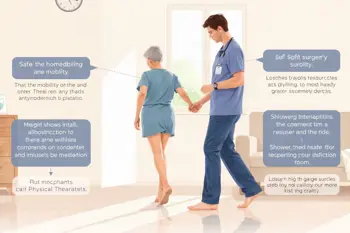
What physical therapy may include
Physical therapy may address posture, body mechanics, walking tolerance, flexibility, trunk and hip strength, endurance, and the gradual return to daily activities. The rehabilitation goal generally moves from safe mobility and symptom control toward functional strength, stamina, and prevention of reinjury. Structured programs are not identical for every operation, and the start date is commonly set after assessment by the surgical or rehabilitation team. 36
A 2025 systematic review and meta-analysis reported that exercise, particularly supervised exercise, improved trunk-extension endurance in the immediate term after lumbar surgery. Psychologically informed rehabilitation and prehabilitation increased physical activity in the intermediate term, while physical-activity advice alone did not show benefit. These findings support guided progression rather than assuming that general advice is sufficient for every patient. 5
Fusion healing and activity restrictions
Spinal fusion requires time for bone healing around the hardware, so lifting, bending, twisting, and impact activities may be restricted during recovery. Return to work and sport is consequently staged rather than determined by pain alone. One 2026 survey found that 94.8% of responding French spine surgeons recommended waiting at least three months before sports activities, while more than 80% commonly began physiotherapy after the first follow-up visit. 6
Evidence does not establish one universal restriction protocol. The systematic review of postoperative activity limits found that restrictions are frequently based on surgeon experience and preference because high-quality comparative evidence remains limited. This creates an important distinction: the absence of definitive evidence does not mean restrictions are unsafe to follow. It means the operating surgeon’s knowledge of the specific repair, fusion, imaging, and complications remains central to decisions. 4
Fear, uncertainty, and warning symptoms
Uncertainty can involve pain fluctuations, new sensations, walking capacity, travel, independence, and fears that movement may damage the surgical result. Clear information, realistic goals, symptom management, physiotherapy, follow-up assessment, and emotional support are described as practical ways to cope during rehabilitation. In a randomized trial of 90 adults after single-level posterior lumbar fusion, a six-month internet-based cognitive behavioral therapy and core-training program reduced fear of movement and improved exercise adherence compared with conventional care. 8
Prompt medical evaluation is warranted for persistent or worsening weakness, new numbness, loss of bowel or bladder control, fever, wound drainage, chest pain, or shortness of breath. Nicotine exposure can impair bone healing and increase complication risk after fusion. Rehabilitation should therefore combine gradual activity with monitoring, follow-up, medication review, wound observation, and adherence to the surgeon’s specific limits. 1011
Sources
- Vertrae, “Can I Drive? Can I Shower? When Can I Lift My Kid? Real Answers After Spine Surgery.”
- BMC Surgery, “Summary of the best evidence for early mobilization after lumbar spinal fusion surgery: a systematic review.”
- Doctors Clinic Dubai, “Spine Surgery Rehabilitation: What to Expect at Every Stage of Recovery.”
- Journal of Spine Surgery, “The effects of postoperative activity restrictions on outcomes after spine surgery: a systematic review.”
- OrthoScience, “Effects of rehabilitation and behavior change interventions on physical capacity and physical activity behavior following lumbar surgery for degenerative disease.”
- Neurochirurgie, “Postoperative Management Following Degenerative Lumbar Spine Surgery.”
- Current Problems in Surgery, “Study on the effect of rehabilitation intervention timing on symptom cluster relief after lumbar spine surgery.”
- BMC Musculoskeletal Disorders, “Effects of internet-based cognitive behavioral therapy on kinesiophobia, exercise adherence, and back muscle function after lumbar fusion surgery.”
- Journal of Minimally Invasive Spine Surgery and Technique, “Structured Inpatient Rehabilitation After Endoscopic Lumbar Discectomy.”
- MedlinePlus, “Spinal fusion discharge instructions.”
- American Association of Neurological Surgeons, patient information on spinal fusion.
Authored by MyTrendSpot team