Police seized jewelry auction catalogs: A factual guide to sources, records, and buyer risks
Police seized jewelry auction catalogs are not maintained in one nationwide public archive. Catalog information is instead distributed among federal asset-forfeiture programs, local government auction portals, police contractors, and independent auctioneers, so the originating agency and terms of each listing require separate verification.
Why no single national catalog exists
The U.S. Marshals Service handles forfeited assets for federal agencies and disposes of property through auctions and other authorized methods, but it does not function as a universal catalog for every local police department. The Department of Justice Asset Forfeiture Program provides the federal framework for seizure, forfeiture, and disposition, while state and municipal agencies follow their own procedures and publish information through different channels. 1 2
A catalog may therefore appear as a formal auction booklet, an online lot page, a government notice, or an auctioneer announcement. Some records identify the agency, case status, lot number, and closing terms; others provide only a short description and photographs. AuctionZip aggregates auction events and auctioneer listings, but an aggregation page does not by itself establish that jewelry was seized by police or that the seller holds valid authority to dispose of it. 10
Federal sources and asset-forfeiture channels
Federal jewelry may be connected to forfeiture actions handled through the U.S. Marshals Service, the Department of Justice, the Treasury Department, or another federal agency. Treasury-related auctions can include property seized or forfeited under Treasury authority, while the Marshals Service handles many assets connected to federal criminal cases after the applicable legal process. Inventory and catalog format vary by auction. 3
GSA Auctions is another federal marketplace, but its listings represent government-owned excess property and should not automatically be described as police-seized jewelry. The distinction matters because surplus property can originate from ordinary government operations, while forfeited property is connected to a legal seizure and disposition process. The FBI also publishes information about forfeited assets, although that information is not equivalent to a complete, continuously updated jewelry catalog. 4 5
Police contractors and online catalog formats
PropertyRoom.com is an online marketplace used by law-enforcement agencies and municipalities to process recovered, seized, unclaimed, and surplus property. Its reported categories include jewelry, watches, coins, electronics, bicycles, fashion, and other personal property. The company describes a workflow involving pickup, inspection, imaging, sorting, cataloging, condition assessment, and, for selected categories, authentication review. 6
A separate auctioneer may also maintain extensive historical catalogs. Seized Assets Auctioneers, based in Camarillo, California, describes its inventory as including jewelry, currency, art, fashion, vehicles, and memorabilia, and its LiveAuctioneers profile records 4,934 past catalogs. That history demonstrates how catalog archives can be held by the auctioneer rather than by the police agency, but an archive alone does not prove the origin, ownership status, or authenticity of any individual lot. 11
- PropertyRoom.com: law-enforcement and municipal property listings.
- GovDeals: government and public-organization auctions, including various surplus categories. 7
- Public Surplus: listings published by participating public agencies. 8
- Municibid: municipal and public-entity surplus auctions. 9
What jewelry catalog entries typically disclose
Jewelry catalog descriptions can identify an item by material, apparent gemstone, brand, design, weight, dimensions, markings, and visible condition. Terms such as “yellow metal,” “untested,” or “stone unknown” signal that the description may be limited and should not be treated as a laboratory finding. Photographs can document appearance, but they do not independently establish karat, stone identity, treatment, replacement parts, or market value.
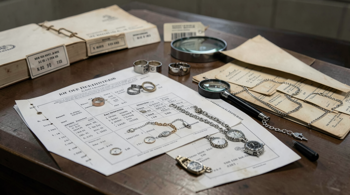
PropertyRoom states that jewelry and watches may be evaluated by gemologists and industry professionals, while its auction materials also emphasize standardized descriptions and photography. Such processing can provide useful information, but the precise scope of examination remains listing-specific. Catalog readers should distinguish between an agency statement, an auctioneer’s observation, a professional appraisal, and a bidder’s assumption. 6
Legal status, ownership, and buyer responsibilities
Police-held jewelry can come from several sources, including property seized in a criminal case, forfeited assets, recovered property that was not claimed, and ordinary agency surplus. Those categories do not carry identical documentation or legal histories. A forfeiture auction generally follows a formal disposition process, whereas unclaimed property may be sold after a holding period established by the responsible jurisdiction. The catalog should identify the seller or consigning agency where available.
Federal asset-forfeiture programs exist within statutory and regulatory frameworks, and the U.S. Marshals Service manages property after the relevant legal proceedings and custodial requirements. Buyers should not assume that an auction listing provides a transferable title, warranty, return right, or complete chain of custody unless the published terms expressly say so. Questions about disputed ownership, redemption rights, or restricted property require attention to the jurisdiction and auction contract. 1 2
Fees, inspection limits, and catalog verification
Online police-property auctions commonly impose conditions beyond the winning bid, including buyer premiums, shipping charges, taxes, payment deadlines, and pickup requirements. One comparison of PropertyRoom and GovDeals identifies a typical 16.5 percent PropertyRoom buyer premium and a 7.5 to 12.5 percent GovDeals range, while warning that actual terms vary by seller and listing. These figures are examples of published platform conditions, not universal auction standards. 7
Inspection rules also vary. Some catalogs permit scheduled inspection or local pickup, while shipped items may be sold based only on photographs and written descriptions. A responsible review should check the seller identity, agency relationship, forfeiture or unclaimed-property status, metal and gemstone disclosures, condition language, authentication limitations, premium, shipping, taxes, and dispute procedure. These checks address the main friction points before any bid is submitted.
- Confirm the originating agency or authorized auctioneer.
- Read the complete lot description and all condition disclaimers.
- Separate stated testing from visual claims or catalog estimates.
- Calculate the total obligation using the listed premium, shipping, and taxes.
- Preserve the catalog page, invoice, and terms for the transaction record.
How to interpret an archived catalog responsibly
An archived catalog is evidence that an auction event or lot description existed at a particular time, not proof that the item remains available or that the same terms apply today. Catalogs can be useful for studying recurring categories, agency participation, terminology, and auction practices. They should not be treated as live inventory, current pricing, or confirmation that a jewelry item is still legally available.
The strongest record links the lot to an identifiable public agency or authorized contractor, states the disposition category, supplies clear condition information, and preserves the governing terms. When those elements are absent, the catalog should be regarded as incomplete documentation. Federal sources, municipal portals, contracted platforms, and auctioneer archives each cover different parts of the market, making cross-checking essential for accurate identification and compliance-aware research.
Sources
- U.S. Marshals Service, https://www.usmarshals.gov/what-we-do/asset-forfeiture
- U.S. Department of Justice Asset Forfeiture Program, https://www.justice.gov/afp
- U.S. Department of the Treasury Auctions, https://www.treasury.gov/auctions/Pages/auction-lp.aspx
- General Services Administration, https://www.gsa.gov/buying-selling/government-property-for-sale-or-disposal
- Federal Bureau of Investigation, https://www.fbi.gov/how-we-can-help-you/need-an-fbi-service-or-more-information/forfeited-assets
- PropertyRoom.com, https://www.propertyroom.com/
- GovDeals, https://www.govdeals.com/
- Public Surplus, https://www.publicsurplus.com/
- Municibid, https://municibid.com/
- AuctionZip, https://www.auctionzip.com/
- Seized Assets Auctioneers, LiveAuctioneers, https://www.liveauctioneers.com/auctioneer/989/seized-assets-auctioneers/
Authored by MyTrendSpot team