How sleep habits can affect daytime fatigue: A research-based analysis
How sleep habits can affect daytime fatigue is best understood by examining both sleep quantity and sleep quality. Evidence from clinical guidance and recent observational studies shows that irregular schedules, interrupted sleep, late stimulants, naps, and insufficient restorative sleep can all influence how alert or exhausted a person feels during waking hours. 1
Sleep duration and next-day energy
Adults generally need seven to nine hours of sleep, but time in bed alone does not guarantee restoration. Harvard Health describes deep, slow-wave sleep as a period associated with physical repair and energy production, while recent research in Japanese working adults found that longer subjective and objectively measured total sleep time was associated with greater restorative sleep and less morning sleepiness. 4 6
A 2026 study of 37 healthy workers also found that a greater proportion of deep sleep was associated with reduced morning sleepiness. The finding does not mean that increasing sleep duration will resolve every case of fatigue, because depressive symptoms were independently associated with greater morning sleepiness in the same study. Sleep quantity and psychological health therefore need to be considered together when interpreting daytime exhaustion. 6
Why sleep continuity matters
Sleep fragmentation can leave a person tired even when the total time asleep appears adequate. Cleveland Clinic explains that sleep apnea may cause repeated breathing-related awakenings that the sleeper does not remember, repeatedly shifting the brain into lighter sleep and interfering with deep, restorative stages. Insomnia, restless legs syndrome, and narcolepsy are additional sleep-related conditions that may contribute to daytime fatigue or sleepiness. 2
Clinical references distinguish excessive daytime sleepiness from ordinary tiredness. Excessive daytime sleepiness involves an unusual tendency to fall asleep during normal waking hours, whereas insomnia includes difficulty falling asleep, staying asleep, early awakening, or unrefreshing sleep. These symptoms can impair concentration, work, and safe driving, making persistent or severe daytime sleepiness a medical concern rather than merely a lifestyle inconvenience. 3 5
Timing, routine, and sleep hygiene
Sleep habits during the evening can alter both sleep onset and continuity. Merck Manual identifies caffeine or other stimulants near bedtime, late-evening excitement or exercise, and irregular sleep-wake schedules as behaviors that can impair sleep. Sleeping late or compensating with naps after a poor night may further fragment nighttime sleep, especially when those responses create an inconsistent daily pattern. 3
A 14-day study of 74 undergraduate students examined 32 sleep-hygiene behaviors using objective sleep measures. More frequent napping was associated with more nighttime awakenings and greater wake time after sleep onset. Falling asleep with music or television on, eating too much before bed, and alcohol use were each associated with more awakenings, while unpleasant conversations and poor ventilation were associated with more time awake after sleep began. 5
Sleep stages and daytime performance
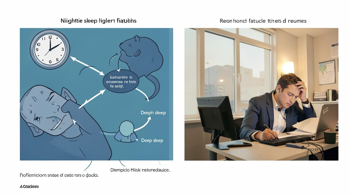
Sleep stages may affect daytime functioning in different ways. Harvard Health reports that non-REM sleep includes light, deeper, and deep stages, with deep sleep linked to tissue repair and the body’s energy molecule, ATP. In a three-week study of 26 call-centre employees, nightly REM sleep was positively related to the following day’s number of calls and total customer talk time. 4 8
The same workplace study found that total sleep time was positively related to the number of calls made the following day, while time in deep NREM sleep was not significantly related to the measured task outcomes. These results suggest that sleep duration and individual sleep stages may relate differently to performance, and that a single measure such as hours slept cannot fully describe next-day functioning. 8
Naps, screens, and perceived fatigue
Naps can provide compensation for lost nighttime sleep, but their effects depend on how they interact with the overall sleep schedule. The objective study of university students linked more frequent napping with additional nighttime awakenings and more wakefulness after sleep onset. This association does not establish that every nap causes fatigue, but it indicates that repeated daytime sleep may coincide with less consolidated nighttime sleep. 5
Perception also matters when daytime fatigue is assessed. A study of 63 people with insomnia symptoms found that fatigue was strongly related to dysfunctional beliefs about sleep and subjectively assessed insomnia, while one-night objective measures such as sleep-onset latency, wake after sleep onset, total sleep time, and sleep efficiency were mostly not significantly related. The subjective-only model explained 27.5% of fatigue variance. 9
When fatigue warrants further evaluation
Persistent fatigue despite apparently sufficient sleep can indicate a sleep disorder, a mental health concern, or another health issue rather than a simple scheduling problem. Cleveland Clinic specifically identifies sleep apnea as a possible explanation for daytime fogginess and exhaustion, while Merck Manual notes that excessive daytime sleepiness is a symptom of multiple sleep-related disorders. Repeated unrefreshing sleep, unintended daytime dozing, or impaired concentration should be evaluated clinically. 2 3
Recent questionnaire research provides another perspective on risk assessment. Among more than 750 adult sleep-clinic patients, an Atlantic Sleep Hygiene Questionnaire score of eight or higher, indicating detrimental sleep habits in that study, was significantly associated with abnormal sleepiness and abnormal fatigue. The score also correlated with lower perceived sleep quality, but it should be treated as a research and assessment measure, not as a diagnosis by itself. 7
Sources
- Cedars-Sinai, “Why Am I Still Tired After Sleeping?”
- Cleveland Clinic, “Why Do I Always Wake Up Tired?”
- Merck Manual Professional Edition, “Insomnia and Excessive Daytime Sleepiness.”
- Harvard Health, “How Sleep Boosts Your Energy.”
- Journal of Behavioral Medicine, “Associations between sleep hygiene and secondary objective sleep parameters.”
- Scientific Reports, “Daily associations of subjective and objective sleep parameters with restorative sleep and morning sleepiness.”
- Sleep Science and Practice, “Atlantic Sleep Hygiene Questionnaire.”
- Occupational Health Science, “Nightly Sleep and Daily Task Performance.”
- SLEEP, “Fatigue is Attributable to Beliefs and Perceptions Rather than Objective Sleep Quality.”
Authored by MyTrendSpot team