Salary variations for dental hygienists: A state-by-state analysis: What the wage data shows
National baseline for dental hygienist pay
Salary variations for dental hygienists are substantial from state to state. The Bureau of Labor Statistics reported a national median annual wage of $87,530, equivalent to $42.08 per hour, in its May 2023 Occupational Employment and Wage Statistics release. The same data set counted approximately 223,900 dental hygienists nationally and included private dental offices, outpatient care centers, physician offices, and government facilities. 1
Published figures can differ because they may describe different years, statistical measures, or collection methods. One 2024 summary lists a median of $94,260, or $45.32 per hour, while another analysis identifies the May 2023 national median as $87,530. A mean, median, hourly estimate, and aggregated job-posting figure should not be treated as interchangeable measures of typical pay. 2 4
Highest and lowest reported state examples
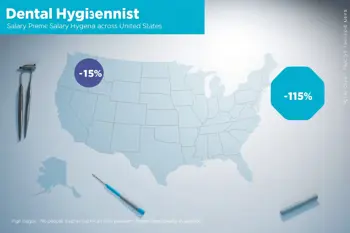
Available state-level reporting places Alaska at the top of the May 2023 comparison, with an approximate mean annual wage of $114,320. Alabama appears near the lower end at approximately $56,630 in the same analysis. These figures represent a difference of roughly $57,690 before taxes and living costs, demonstrating why a national average can obscure local labor-market conditions. 2
More recent state profiles show the same broad spread, although the reported measures are not identical. Arizona is listed with a 2024 median annual salary of $97,530, while Alabama is listed at $59,840 and North Dakota at $83,010. The Arizona profile reports a 90th-percentile wage of $102,170, compared with $68,640 in Alabama and $94,910 in North Dakota, indicating meaningful differences across both typical and experienced-worker earnings. 7 8 9
| Location or benchmark | Reported annual figure | Measure and data year |
|---|---|---|
| United States | $87,530 | Median, May 2023 |
| Alaska | Approximately $114,320 | Mean, May 2023 |
| Arizona | $97,530 | Median, 2024 |
| North Dakota | $83,010 | Median, 2024 |
| Alabama | $59,840 | Median, 2024 |
Regional patterns in the wage data
Northeastern and Pacific states generally appear above the national benchmark, while Southern and Midwestern states more often report lower nominal wages. California, Alaska, and Washington are frequently identified among the strongest compensation markets, reflecting localized demand and professional labor conditions. However, a higher nominal salary does not automatically produce greater purchasing power because housing, transportation, taxes, and other living expenses vary considerably by state. 1
Washington illustrates the distinction between nominal pay and broader market context. Homebase identified dental hygienists as the highest-paying hourly occupation in 14 states and reported an hourly wage of $58.69 for Washington and $57.06 for California. Those figures were compared with a national dental hygienist hourly average of $45.14 in that analysis, but the underlying data came from internal hourly-job records rather than the same BLS table used for state occupational estimates. 5
Why state salaries vary
Labor demand is one factor behind geographic variation. Preventive dental care, an aging population, and dentists’ reliance on hygienists all support continued employment needs. Becker’s Dental Review reported that California had the largest dental hygienist employment level among states and that 17% of hygienists had changed jobs during the preceding year. It also reported that 27% were considering a job change, with pay, benefits, and workplace conditions among the leading considerations. 3
Regulation also affects the market. State dental practice acts define supervision, permitted services, licensure pathways, and the extent of independent practice. Becker’s reported legislation in New York permitting hygienists to practice without dentist supervision and described broader national interest in a Dentist and Dental Hygienist Compact. Such changes may affect staffing models and the range of settings in which hygienists can work, although the salary effect depends on implementation and employer demand. 3 6
Experience, setting, and qualification effects
State averages combine workers at different experience levels and in different settings, so they should not be interpreted as guaranteed starting salaries. The Arizona profile lists $84,190 at the 10th percentile, $93,900 at the 25th percentile, $97,530 at the median, and $98,860 at the 75th percentile. In Alabama, the corresponding figures are $47,280, $51,920, $59,840, and $62,440. These percentile differences show how location and experience interact. 7 8
Education and licensing requirements create another comparison point. The state profiles identify graduation from a Commission on Dental Accreditation-accredited dental hygiene program, passage of the National Board Dental Hygiene Examination, and completion of a regional clinical examination as core requirements in Arizona, Alabama, and North Dakota. Jurisprudence exams, background checks, CPR certification, continuing education, renewal rules, and application fees vary by jurisdiction. 7 8 9
How to interpret a state-by-state comparison
A reliable comparison should first separate median from mean wages and should identify the BLS release year. It should then distinguish annual compensation from hourly pay, because schedules may be part time, variable, or organized around days worked rather than a conventional full-time year. Employer type also matters because private practices, outpatient centers, physician offices, public health programs, and government facilities may use different pay structures and benefit packages. 1
Cost-of-living comparisons are essential when evaluating relocation or career planning. A lower-wage state may offer different housing and transportation conditions than a high-wage coastal market, while a high nominal salary may be accompanied by greater expenses. Regulatory eligibility is another potential constraint: a hygienist moving between states may need credential review, examinations, jurisprudence requirements, background checks, or continuing education before practicing. 6 7 8
Outlook and limitations of the evidence
The national outlook remains comparatively strong. The supplied research describes projected dental hygienist employment growth of 7% from 2023 to 2033, while another summary cites 11% growth for 2020 to 2030. These percentages refer to different projection periods and should not be combined. Workforce shortages, preventive-care demand, and job movement may strengthen bargaining power in some markets, but results will vary by local employment volume and practice structure. 1 4
The principal limitation is that wage sources do not measure exactly the same population. BLS estimates are occupational statistics, state profiles present selected 2024 estimates, and staffing or hourly-job analyses use different samples and definitions. The most defensible conclusion is therefore directional rather than absolute: Alaska, Washington, California, and several Northeastern or Pacific markets tend to report higher nominal compensation, while Alabama and other Southern or Midwestern markets often report lower figures. 1 2 5
Sources
- Bureau of Labor Statistics, Occupational Employment and Wage Statistics
- Dentx, Dental Hygienist Salary by State
- Becker’s Dental Review, Dental Hygiene Workforce and Salary Updates
- Kwikly Dental Staffing, Hygienist Salary Guide
- Homebase, Each State’s Highest-Paying Hourly Jobs
- American Dental Hygienists’ Association, Dental Hygiene Practice Act Overview
- CertOutlook, Arizona Dental Hygienist Profile
- CertOutlook, Alabama Dental Hygienist Profile
- CertOutlook, North Dakota Dental Hygienist Profile
Authored by MyTrendSpot team