Repossessed sailboats for sale: A U.S. buyer's guide to prices, paperwork and risk
Key facts
- Used cruising sailboats typically range from about $4,499 for 20 to 25 feet to $17,500 for 30 to 35 feet in 2026. 1
- Catalina 30 asking prices had a $15,950 median in an August 2026 market analysis, while Catalina 36 examples had a $48,500 median. 2
- Small used sailboats under 20 feet typically range from $3,000 to $15,000, depending on condition, equipment and construction. 3
- A repossessed boat may be sold as-is, making title verification, inspection and repair budgeting central to the purchase decision. 4
Repossessed sailboats for sale usually means vessels recovered after a previous owner failed to meet an ownership or contractual obligation, then transferred to an authorized party for resale, auction or another disposition process. The label does not by itself confirm condition, clean ownership records, current availability or a favorable total cost. A careful comparison with ordinary used sailboats should cover the boat's history, documentation, inspection access, likely repairs and delivery responsibilities.
What repossession means and where boats enter the market
A repossessed sailboat can come from a private recovery process, a court-supervised sale, an authorized marine auction, a brokered transaction or an institutional surplus channel. These routes differ in how ownership is transferred and what information accompanies the vessel. Some boats are sold after routine maintenance was interrupted, while others may have experienced water intrusion, storm exposure, grounding, long-term storage or unauthorized use. A short auction description should therefore be treated as a starting point rather than a condition report.
Marine auctions and online auction platforms may use sealed bids, timed bidding or open auctions. Brokers and specialist marine sales businesses generally provide more opportunity for questions and scheduled inspections, although terms vary. Auction conditions can require deposits, impose short payment deadlines, restrict testing, and assign removal, transport and storage to the buyer. The sale may be strictly as-is, with limited remedies after completion, so the written terms and seller's authority deserve review before any bid.
Boat types, models and typical 2026 prices
The suitable comparison depends on intended use. Trailerable daysailers and pocket cruisers are easier to store and transport, but usually have limited accommodation. Thirty-foot production cruisers commonly add standing headroom, an enclosed head, a galley and an inboard engine. Heavier cutters and larger multihulls can provide more offshore comfort, but their standing rigging, systems, haul-out requirements and refit budgets are more demanding. Age and maintenance often influence value as much as length.
| Category or model | Typical market reference | Useful comparison |
|---|---|---|
| Used cruising sailboat, 20 to 25 feet | $4,499 median asking price in 2026 | Compact accommodation and lower storage burden |
| Used cruising sailboat, 25 to 30 feet | $8,200 median asking price in 2026 | More cabin space and coastal-cruising utility |
| Used cruising sailboat, 30 to 35 feet | $17,500 median asking price in 2026 | Greater systems complexity and ownership cost |
| Catalina 30 | $15,950 median asking price in 2026 | Large owner community and conventional cruiser layout |
| Catalina 36 | $48,500 median asking price in 2026 | Standing headroom, aft cabin and broader cruising space |
| Tayana 37 | $36,950 median asking price in 2026 | Heavy cutter design associated with offshore capability |
These figures are typical asking-price indicators, not auction guarantees or purchase offers. A 2026 market guide placed under-20-foot used sailboats at roughly $3,000 to $15,000, while a small-boat guide described serviceable boats below 25 feet as sometimes under $5,000 and better-maintained examples around $18,000. 5 3 The same model can vary substantially with engine condition, sails, electronics, trailer, interior moisture and documentation.
Title, registration and ownership checks
Before bidding, the hull identification number, title or registration, bills of sale and ownership history should tell a consistent story. The seller should be able to demonstrate authority to transfer the boat and provide documentation showing how that authority arose. Any discrepancy in the hull number, vessel name, state registration, ownership chain or recorded security interest can delay registration or create a dispute after payment.
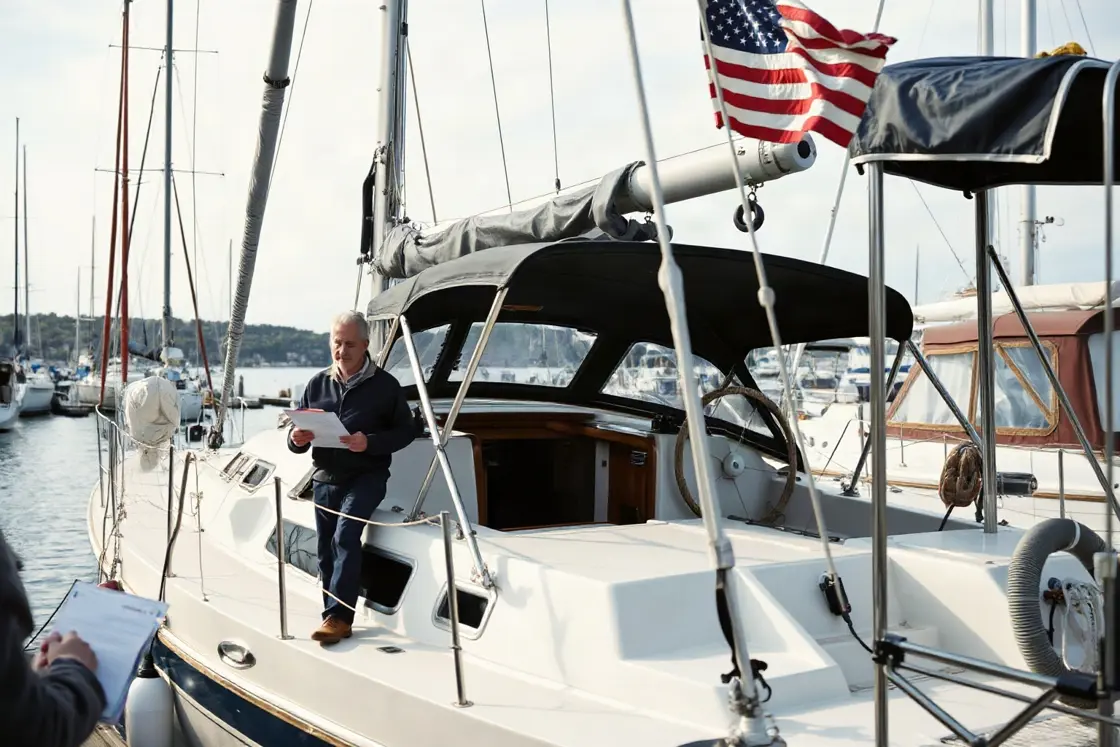
A marine survey evaluates physical condition, systems and safety concerns, but it is not a substitute for a legal ownership search. Buyers should ask whether recorded claims, unpaid marina charges, repair claims, salvage interests or court proceedings could affect transfer. Court-supervised sales may follow different procedures from private auctions, and the wording of the final bill of sale matters. A clean-looking boat with incomplete paperwork can be more difficult to register, insure or resell than a visibly older boat with a well-documented history.
Inspection points before a bid or offer
The hull and deck require close attention to cracks, blistering, soft areas, repairs, delamination, keel movement, rudder damage and signs of grounding. On deck, inspect chainplates, stanchions, hatches and deck fittings for leaks or movement. The mast, boom, standing rigging, running rigging and sails can represent a major replacement expense, particularly when corrosion or ultraviolet damage has been hidden by storage covers.
Below deck, an inspection should include the engine, fuel system, battery banks, wiring, charging equipment, steering, plumbing, tanks, bilge pumps, through-hulls, seacocks and safety equipment. Moisture readings and an out-of-water inspection can reveal problems photographs cannot show. An independent marine surveyor can organize these findings into a condition report, but the buyer may still need separate mechanical, electrical or engine specialists. Sea trials may be unavailable at auction, making preventive assumptions especially risky.
Costs beyond the purchase price
The acquisition figure is only one part of the ownership calculation. Common additions include a survey, haul-out, registration, documentation work, transport, crane or loading charges, storage, slip or mooring fees, replacement sails, rigging, batteries, safety equipment and initial maintenance. A trailerable boat can reduce marina exposure, while a larger cruiser may require recurring haul-outs, bottom maintenance and specialized labor.
Published 2026 guidance estimated annual maintenance for a small sailboat at about $300 to $2,000, with trailer and towing equipment commonly around $1,000 to $5,000. 3 Another market guide estimated that a slip-kept boat can require roughly 10% to 20% of its value annually for ongoing ownership, although actual spending varies widely by age, location, labor and refit condition. 1 A repair reserve should be based on survey findings rather than a fixed percentage alone.
When an ordinary used boat may be safer
A repossession auction may suit an experienced buyer who can interpret survey findings, verify documents, arrange transport and absorb uncertain repairs. It is less suitable when inspection access is restricted, the title chain is incomplete, the vessel has been stored unattended, or the buyer needs predictable delivery and immediate sailing capability. Apparent savings can disappear through engine work, rig replacement, storage, legal documentation and deferred maintenance.
A conventional used-boat transaction may offer clearer disclosures, more time for negotiation, better inspection access and a more established process for correcting paperwork, although it does not eliminate defects or ownership risks. The central comparison is therefore not simply auction price against ordinary asking price. It is the documented total cost, usable condition, legal transferability, inspection rights, support after closing and suitability for the intended sailing area. Repossession status should be one factor in that assessment, not a conclusion about value.
Sources
- How Much Does a Sailboat Cost? (2026 Data) | Keel Index: https://keelindex.com/articles/how-much-does-a-sailboat-cost
- What 8,665 Sailboat Listings Tell Us About Used Boat Prices | Keel Index: https://keelindex.com/articles/used-sailboat-prices
- Cost of Small Sailboats in the U.S. 2026 – LatestCost – Real-Time Price Insights: https://latestcost.com/cost-small-sailboats-u-s/
- Buying a Repossessed Yacht: Risks, Rewards, and How to Do It Right — RN MARINE | Yacht Sales & Consulting: https://rnmarine.com/news/buyarepoyacht
- How Much Does a Small Sailboat Cost? (Under 25 Feet): https://bluelifecharters.com/how-much-does-a-small-sailboat-cost/
Authored by MyTrendSpot team