Nursing salaries by state: how they differ across the United States: A 2026 Comprehensive Geographic and Cost-of-Living Analysis
Nursing salaries by state: how they differ across the United States is a critical point of analysis for healthcare professionals mapping out their long-term career strategies. The financial rewards of nursing are heavily dependent on geographic location, as state labor markets operate under highly localized supply and demand metrics. Understanding these regional variations allows registered nurses to optimize their real earning potential rather than relying solely on nominal salary figures.
The National Compensation Landscape for Registered Nurses
The national baseline for nursing compensation demonstrates a stable and highly competitive career field, though the headline numbers can be misleading due to regional outliers. According to official data from the U.S. Bureau of Labor Statistics, the national mean annual wage for registered nurses has reached $101,420, while the national median stands at $97,550 1. Other wage surveys place the national average closer to $98,430 annually, reflecting a median of $93,600 across approximately 3.3 million practicing registered nurses 2.
This discrepancy between mean and median figures is primarily driven by exceptionally high wages in several coastal states, which skew the national average upward. Indeed, roughly half of all registered nurses in the United States earn less than the median of $93,600, making geography the single most influential factor in determining individual earning potential 3. Within the overall nurse workforce, the lowest 10th percentile of earners commands around $66,030, whereas the top 90th percentile of high earners makes upwards of $135,320 per year 3.
The Pacific Coast Wage Premium and Top-Paying States
Registered nurses practicing on the West Coast benefit from what economists refer to as a Pacific premium, where salaries are consistently among the highest in the country 4. This regional cluster is led by California, where registered nurses earn an average annual salary of $150,280 1. Other Pacific states follow closely behind, with Hawaii reporting an average annual wage of $136,320, Oregon at $123,140, Washington at $121,540, and Alaska at $114,870, showing a solid coastal distribution of high earnings 1.
The drivers behind this Pacific Coast premium are multifaceted, combining high local cost-of-living metrics with structural workplace protections. For instance, California and Massachusetts are known for maintaining strict, legally mandated nurse-to-patient staffing ratios that increase demand for qualified clinical staff 5. Furthermore, strong union representation in these regions creates significant wage pressure, as union-represented registered nurses across the entire country earn an average of 18.8% more than their non-union counterparts in other healthcare systems 3.
The Southern and Midwestern Paradox
In stark contrast to the high-paying coastal regions, many Southern and Midwestern states feature nominal nursing salaries that rank near the bottom of the national scale 6. Alabama reports some of the lowest average annual compensation for registered nurses at $77,020 1. Similarly, Mississippi offers an average RN salary of $70,790, and South Dakota reports a baseline average salary of $67,030, presenting a substantial geographic contrast across the nationwide market 2.
This regional pay gap creates a paradox where states with a substantial demand for healthcare services pay their nursing staff the least. South Dakota, for example, ranks last or near the bottom in nominal nursing pay, yet boasts the highest concentration of registered nurses per capita in the nation, with 16 RNs for every 1,000 residents 4. This indicates that localized labor density does not necessarily translate into higher wage benchmarks, as local healthcare infrastructure and funding play a massive role in setting base rates.
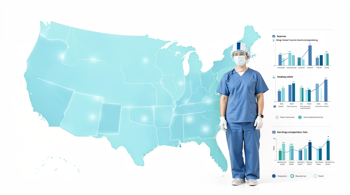
Factoring in Cost of Living: Real vs. Nominal Salaries
While a six-figure salary in a major metropolitan area is highly attractive, the gross salary on an employment offer is arguably the least reliable metric for long-term financial planning 7. Analysts emphasize Purchasing Power Parity, which measures how far a nurse's paycheck actually stretches after accounting for local taxes, rent, and the cost of essential goods 8. A nurse in Boston paying $2,800 in monthly rent requires a gross salary of $96,450 to maintain the same basic standard of living as a nurse in Mississippi earning $57,840, where average monthly rent is only $950 5.
When nominal wages are adjusted against the regional Cost of Living Index, the national ranking of best-paying states changes dramatically, allowing states with lower raw salaries to emerge as highly lucrative options 7. This adjustment reveals that raw numbers do not reflect actual disposable income.
| Rank | State | Mean Gross Salary | Cost of Living Index | Adjusted Real Salary |
|---|---|---|---|---|
| 1 | Texas | $88,400 | 92.5 | $95,567 |
| 2 | Nevada | $96,200 | 101.3 | $94,965 |
| 3 | Georgia | $84,500 | 89.2 | $94,730 |
| 4 | Tennessee | $81,300 | 88.7 | $91,657 |
| 5 | California | $136,000 | 149.9 | $90,727 |
Salary Variations Across Nursing Roles and Credentials
Beyond geographic location, the specific educational credentials, specialties, and clinical roles of a nurse heavily dictate overall earning power. The nursing profession maintains a steep career ladder, with the wage gap between entry-level roles and advanced practice credentials reaching up to 482% 9. While Certified Nursing Assistants earn a baseline median wage of $35,000 and Licensed Practical Nurses earn a median of $55,000, registered nurses with an Associate Degree in Nursing earn a national median of $80,000 10.
Obtaining a Bachelor of Science in Nursing typically yields an additional premium of $6,000 to $10,000 annually over an associate degree program 11. Advanced Practice Registered Nurses command the highest tier of national clinical compensation, with Nurse Practitioners earning a median salary of $125,000, while Certified Registered Nurse Anesthetists lead the entire clinical profession with a median annual salary of $205,000 10.
Market Friction Points and Systemic Challenges
While geographic relocation offers a viable path for registered nurses to maximize their real income, the process is accompanied by significant market friction points and strict regulatory oversight. Nurses wishing to practice in a new state must navigate distinct state board licensing requirements, transfer fees, and varying continuing education mandates 12. These administrative barriers, alongside the rising cost of physical relocation, can deter nurses from pursuing opportunities in higher-paying regions.
Furthermore, the entire United States healthcare infrastructure is currently grappling with a projected 8% registered nurse shortage, representing approximately 263,870 clinical vacancies nationwide 3. While this nationwide shortage maintains strong upward pressure on gross wages, it also leads to severe systemic challenges, including increased nurse burnout, heavier shift workloads, and demanding clinical environments that impact overall job satisfaction across all fifty states.
Sources
- Mappr.co
- Diversity Nursing
- Salario
- SmartAsset
- Nurse Salary Data
- Cornerstonelex
- GoodNurse
- Nurseonestop
- The Nursing Directory
- Wealthvieu
- NurseSalaryIntel
- RenewRN
Authored by MyTrendSpot team