Questions to ask about pulmonary rehabilitation care: A clinical guide to evaluating programs
Questions to ask about pulmonary rehabilitation care become especially important after a COPD flare, hospital discharge, or worsening breathlessness. A useful discussion should clarify what the program includes, how safety is monitored, who provides care, how progress is measured, and what support continues after the structured course ends.
Is pulmonary rehabilitation appropriate for the diagnosis?
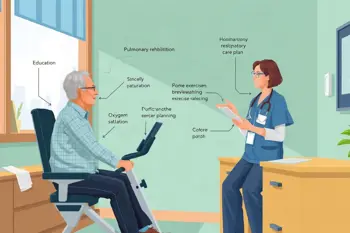
Pulmonary rehabilitation is a structured service for people with chronic respiratory disorders. It combines supervised exercise, education, support, and behavior-focused interventions to improve functional capacity and quality of life. Evidence summarized by the MSD Manual links rehabilitation with reduced breathlessness and better exercise tolerance, while rehabilitation started within three months after COPD hospitalization has been associated with lower one-year mortality and fewer rehospitalizations. 1 Ask the referring clinician:
- Is the program suitable for COPD, pulmonary fibrosis, bronchiectasis, asthma, post-COVID symptoms, or another diagnosis?
- What symptoms or functional limitations make participation appropriate?
- Are there medical conditions that require stabilization or additional assessment first?
- What goals should be prioritized, such as walking, household tasks, or managing breathlessness?
What happens during the initial assessment?
Assessment should be broader than a simple walking test. Pulmonary rehabilitation commonly begins with a review of medical history, respiratory symptoms, exercise capacity, oxygen needs, medications, nutrition, and emotional well-being. The British Thoracic Society quality standard describes a multi-system assessment for eligible participants, reflecting the need to consider the physical and psychological effects of chronic respiratory disease. 3 Questions to ask include:
- Which exercise or functional tests will be performed?
- How will oxygen saturation, heart rate, breathlessness, and recovery be recorded?
- Will inhaler use, oxygen equipment, nutrition, anxiety, or depression be assessed?
- How will the assessment findings be converted into an individualized care plan?
Who supervises care and how is exercise adjusted?
Exercise training is a core component of pulmonary rehabilitation, but the intensity should be individualized and reviewed as tolerance changes. Programs may involve respiratory and exercise professionals, with education, nutritional guidance, and psychosocial support included according to patient needs. 2 The safety discussion should address how staff respond to low oxygen readings, chest symptoms, dizziness, severe breathlessness, or delayed recovery. Important questions include:
- Which professionals are present during exercise sessions?
- How frequently are vital signs and symptoms checked?
- How is exercise progressed, reduced, or paused?
- What emergency procedures and medical support are available?
- How are oxygen prescriptions and portable oxygen devices handled during activity?
What education and self-management training are provided?
Rehabilitation is not limited to supervised exercise. Programs generally include education on lung disease, breathing strategies, medication use, activity planning, and managing symptoms. The available clinical guidance describes pulmonary rehabilitation as a combination of exercise, education, and behavior change rather than a single treatment session. 2 A patient or family member can ask whether the curriculum covers:
- Correct inhaler technique and medication schedules.
- Pursed-lip or other breathing strategies for breathlessness.
- Airway-clearance techniques when relevant to the diagnosis.
- Recognizing flare-ups and knowing when to contact a clinician.
- Oxygen safety, nutrition, sleep, emotional health, and daily activity planning.
What delivery options and access barriers should be discussed?
Programs are commonly delivered in hospitals or clinics, but home-based, internet-based, and virtual models also exist. The MSD Manual notes that virtual rehabilitation has shown improvements in functional capacity, quality of life, and adherence in some evidence, while the British Thoracic Society standard says people who decline centre-based care should be offered an alternative. 1 Access questions should cover:
- How often sessions occur and how long the course lasts.
- Whether centre-based, home-based, or virtual care is clinically appropriate.
- How transportation, mobility limitations, work, caregiving, or technology access will be addressed.
- Whether family caregivers can participate in education or home planning.
- How quickly referral, assessment, and enrollment can occur after discharge.
How will progress, coverage, and long-term maintenance be handled?
Progress should be measured against the initial assessment rather than judged only by attendance. The care team should explain how exercise capacity, breathlessness, daily function, quality of life, and self-management skills will be reviewed. The British Thoracic Society standard calls for ongoing exercise maintenance after completion, while a systematic review of home-based rehabilitation identified adherence barriers involving capability, opportunity, and motivation among patients, professionals, and caregivers. 3 Ask:
- Which outcomes will be reassessed at the end of the program?
- Will a written home-exercise and flare-up management plan be provided?
- What follow-up, maintenance classes, or clinical review are available?
- What attendance requirements, referral rules, and diagnostic criteria apply?
- What insurance coverage, deductibles, copayments, or authorization rules may apply?
Coverage depends on the health system and individual eligibility. In the United States, the supplied Medicare summary describes Part B coverage for eligible people with moderate to very severe COPD and certain persistent post-COVID respiratory symptoms, with physician referral and program requirements. 8 Coverage should therefore be confirmed with the insurer, referring clinician, and rehabilitation service rather than assumed from the diagnosis alone.
Why referral and participation can be difficult
Strong evidence of benefit has not translated into consistent access. A CHEST Physician report states that fewer than 5% of Medicare beneficiaries hospitalized with COPD enroll in pulmonary rehabilitation, and more than half of US counties lack a hospital-based outpatient program. 6 A 2026 review also reported that only 40% of eligible patients in the United Kingdom are referred, illustrating a persistent gap between clinical evidence and service use. 5 Questions can help identify whether barriers involve:
- Referral processes or limited clinician awareness.
- Distance, transportation, scheduling, or technology.
- Unclear expectations about exercise and breathlessness.
- Fear, low confidence, fatigue, or competing health problems.
- Insufficient follow-up after the structured program ends.
A 2026 co-design study found that patients often expected only brief information at referral and identified referral acknowledgment, focused end-of-rehabilitation feedback, and professional education as possible improvements. 4 Asking for written explanations, clear goals, progress feedback, and a maintenance plan can make the referral process more understandable without treating rehabilitation as a substitute for prescribed medical care.
Sources
- MSD Manual Professional Edition, Pulmonary Rehabilitation
- Liv Hospital, How to Start Pulmonary Rehab for COPD
- British Thoracic Society, New Quality Standard for Pulmonary Rehabilitation
- npj Primary Care Respiratory Medicine, Supporting Referral to Pulmonary Rehabilitation
- Dove Medical Press, Referral to and Engagement with Pulmonary Rehabilitation
- CHEST Physician, Closing the Gap in Pulmonary Rehabilitation
- BMC Nursing, Barriers and Facilitators to Adherence to Home-Based Pulmonary Rehabilitation
- LegalClarity, Medicare Coverage for Pulmonary Rehabilitation
Authored by MyTrendSpot team