High-quality dental bridges: a fast and accessible solution: An Evidence-Based Consumer Guide
High-quality dental bridges can be a fast and accessible solution for replacing missing teeth, but the appropriate design depends on oral health, supporting teeth, bone, bite alignment, and treatment goals. Bridges may restore chewing and speech while helping keep neighboring teeth from moving into the gap. 1
What a dental bridge does
A dental bridge is a fixed restoration that replaces one or more missing teeth. In a traditional design, an artificial tooth, called a pontic, is connected to crowns fitted over the natural teeth beside the gap. Those supporting teeth are called abutments. Implant-supported bridges use implants instead of natural teeth as anchors, while Maryland bridges use a bonded metal or ceramic framework. 2
Filling a gap can restore more than appearance. Dental bridges may improve chewing and speech, support a more balanced bite, and reduce the tendency of remaining teeth to drift into the open space. However, a bridge does not automatically suit every missing-tooth case. A dentist must assess the gums, supporting teeth, bone, bite, and cause of tooth loss before selecting a design. 4
Types and supporting structures
Traditional fixed bridges are commonly used when healthy teeth are present on both sides of the gap. The abutment teeth are prepared to receive crowns, which hold the pontic in place. A cantilever bridge may be considered when support is available on only one side, while a Maryland bridge generally bonds to adjacent teeth with a framework and may require less preparation. 2
Implant-supported bridges can replace several adjacent missing teeth without placing crowns on neighboring natural teeth. They require surgical implant placement and sufficient bone and gum support, followed by a healing period before the final restoration is attached. This makes the implant route generally longer than many conventional tooth-supported bridges. 8 9
How fast treatment can be
A conventional bridge can often involve two dental visits. The first appointment commonly includes examination, preparation of supporting teeth, and impressions or digital scans. A temporary restoration may be used while a laboratory makes the permanent bridge, and a later visit is used for fitting and cementation. The exact schedule depends on laboratory work, tooth preparation, and the patient’s oral health. 2 3
Some dental offices use in-office digital scanning and milling systems to produce crowns or bridges during a single appointment for qualifying patients. Reported examples include CEREC systems and digital workflows using intraoral scanners and milling equipment. Same-day availability is therefore a technology and eligibility issue, not a universal expectation. Complex cases, implant treatment, infection, gum disease, or uncertain support can extend the timeline. 1 2
Quality, materials, and durability
Bridge quality depends on accurate planning, the health of the abutment teeth and gums, the design, the material, bite forces, and daily hygiene. Common material categories described in clinical sources include porcelain-fused-to-metal, all-porcelain, and zirconia. Tooth-colored ceramic materials can be designed to blend with surrounding teeth, while material selection must also account for strength and the location of the restoration. 2 7
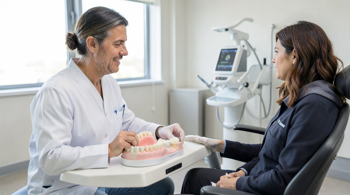
Dental bridge longevity varies rather than following a fixed guarantee. Cleveland Clinic information places a commonly cited lifespan at approximately five to 15 years, depending on care and other clinical factors. Some dental practices report longer service periods for particular materials and cases, but those figures should not be treated as universal outcomes. Supporting-tooth decay, gum disease, fracture, heavy bite forces, and poor cleaning can shorten service life. 7
Maintenance and clinical limitations
A bridge is fixed in place, but it still requires daily cleaning. Plaque can collect around the crowns, gums, and underside of the pontic, where an ordinary toothbrush may not reach effectively. Floss threaders, interdental brushes, or other cleaning aids can help remove plaque beneath the artificial tooth. Regular dental examinations remain important because decay or gum disease in an abutment can threaten the entire restoration. 6
Bridges are not risk-free. Preparing otherwise healthy neighboring teeth for a conventional bridge can alter those teeth, and an abutment may later develop decay or structural problems. A bridge also replaces the visible tooth portion but does not recreate a natural tooth root. Patients with unhealthy gums, inadequate support, uncontrolled bite forces, or insufficient bone may require stabilization or another treatment approach before restoration. 5 8
Costs, alternatives, and decision factors
The cost of a bridge varies with the number of teeth involved, bridge type, materials, laboratory fees, location, and dental insurance provisions. Insurance coverage differs by plan and treatment circumstances, so a quoted fee should identify examinations, imaging, temporary restorations, laboratory work, and follow-up care. A financially accessible option in one case may not be the least costly over time if supporting teeth later require treatment. 10 11
Removable partial dentures may have a lower initial cost but require removal and different cleaning routines. Implants can provide a more independent replacement and avoid preparing adjacent teeth, but they involve surgery, bone and gum assessment, and a longer healing process. A clinically sound decision weighs support, durability, appearance, timeline, maintenance, medical factors, and patient preferences rather than treating speed alone as the definition of quality. 8 9 10
Sources
- American Dental Association, MouthHealthy, “Bridges”
- Cleveland Clinic, “Dental Bridges”
- NHS, “Dental bridges and dentures”
- Healthdirect Australia, “Dental bridges”
- Johns Hopkins Medicine, “Dental Bridges”
- MedlinePlus, “Dental Bridges”
- Cleveland Clinic, bridge lifespan information
- American College of Prosthodontists, “Dental Implants”
- Mayo Clinic, “Dental implants”
- American Dental Association, dental benefits information
- CareCredit, “How Much Do Dental Bridges Cost?”
Authored by MyTrendSpot team