Police surplus property auction guide: A practical analysis of public sales, risks, and buyer procedures
A police surplus property auction guide is useful because police auctions are not one nationwide marketplace with uniform procedures. City police departments, county sheriffs, state agencies, impound contractors, and federal agencies may use different auction companies, schedules, registration systems, payment rules, and property-disposal requirements. The central preparation steps are identifying the responsible agency, reading the sale terms, inspecting available information, and establishing a total spending limit before bidding begins. 1
What police surplus auctions include
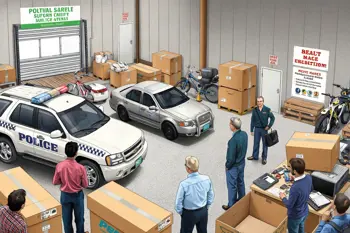
Police surplus auctions generally combine several legally distinct property streams. Impound sales may involve vehicles that were towed and not reclaimed within the required period. Other lots can include property seized during investigations, assets forfeited after legal proceedings, retired agency vehicles, evidence-room property eligible for disposal, and unclaimed personal items. The source of a lot affects its documentation, condition, ownership history, and the questions a bidder should resolve before participating. 2
- Vehicles: patrol sedans, SUVs, motorcycles, vans, trucks, trailers, and specialty vehicles.
- Personal property: bicycles, phones, laptops, cameras, jewelry, watches, tools, and collectibles.
- Agency surplus: office furniture, equipment, generators, and operational items no longer required.
- Seized property: assets released for sale after the applicable forfeiture or disposition process.
Where sales are generally conducted
There is no single official marketplace covering every police or government surplus sale in the United States. Agencies commonly publish notices on official city, county, state, or department websites and may contract with online platforms. GovDeals and Public Surplus are associated with public-agency surplus, PropertyRoom focuses on seized and unclaimed personal property, GSA Auctions handles federal surplus, and Municibid supports local-government sales. Platform use varies by agency and jurisdiction, so the selling entity remains the key source of terms. 3
| Sale channel | Property commonly associated with it | Typical logistics |
|---|---|---|
| Agency website or notice | Local vehicles and equipment | Rules set by the responsible public body |
| Government surplus platforms | Fleet vehicles, trucks, and equipment | Often local pickup |
| Police property platforms | Electronics, jewelry, bicycles, and tools | Shipping may be available |
| Federal surplus channels | Federal vehicles and equipment | Federal paperwork and removal rules |
Registration and eligibility requirements
Most public auctions require account registration before bids can be placed. Registration generally involves valid contact information and acceptance of the auction’s bidder agreement. The exact eligibility rules are controlled by the agency, platform, and local law. Some sales may impose restrictions involving age, identity verification, prohibited bidders, payment authorization, or the ability to collect property within a stated period. A registered account does not remove the bidder’s responsibility to review every lot’s conditions. 4
- Confirm the seller’s legal name and the agency responsible for the property.
- Read the bidder agreement, removal deadline, payment instructions, and dispute procedure.
- Check whether an individual, business, or out-of-state bidder may participate.
- Record the lot number, location, contact person, and inspection arrangements.
- Do not treat a platform profile or social-media announcement as proof of official authority.
Inspection, condition, and title questions
Many police surplus sales operate on an as-is, where-is basis. Descriptions may identify visible features, mileage, keys, markings, or known defects, but buyers commonly assume responsibility for repairs, transportation, and uncertainty that cannot be resolved from photographs. Former patrol vehicles can have high idle hours, hard service, removed equipment, drilled mounting points, or heavy wear. Impounded vehicles may have unknown mechanical histories, missing keys, and unresolved questions about title or storage. 5
- For vehicles, inspect the body, tires, fluids, warning lights, battery, undercarriage, and identification numbers where permitted.
- Ask whether an odometer reading reflects mileage only or excludes substantial idle time.
- Verify title type, lien treatment, registration documents, and whether the vehicle can be titled in the buyer’s jurisdiction.
- For electronics, determine whether devices are locked, damaged, incomplete, or subject to data-wiping limitations.
- For jewelry and collectibles, distinguish seller descriptions from independent authentication.
Costs beyond the winning bid
The winning bid is not necessarily the total transaction cost. Auction terms may add a buyer’s premium, state or local sales tax, payment-processing charges, shipping, loading, storage, towing, title work, registration, inspection, and repairs. One comparison identifies PropertyRoom’s typical buyer’s premium as approximately 16.5 percent and GovDeals’ typical range as approximately 7.5 to 12.5 percent, while also noting that actual fees vary by seller and listing. These figures should be treated as platform examples, not universal rates. 6
| Cost category | Why it matters |
|---|---|
| Buyer’s premium | Raises the amount owed above the bid |
| Tax and processing | May be calculated from the sale terms and location |
| Transportation | Vehicles and equipment may require towing or specialized hauling |
| Storage | Late removal can create additional charges or forfeiture risk |
| Repair and title work | Mechanical condition and paperwork can materially change ownership cost |
Payment, removal, and ownership transfer
Payment deadlines are usually strict, and accepted methods may be limited to electronic transfer, credit card, cashier’s check, or another method stated in the sale conditions. After payment, the purchaser may need to collect the property within a defined window and arrange all loading or transportation. Vehicle buyers should obtain the correct ownership documents before assuming that registration will be routine. Federal surplus vehicles may be accompanied by an SF-97 Certificate of Release of a Motor Vehicle rather than a state-issued title, and state handling can differ. 7
- Confirm the exact payment deadline and consequences of nonpayment.
- Arrange towing, freight, loading equipment, or a carrier before the removal period ends.
- Obtain receipts, title documents, release forms, keys, and condition records.
- Contact the motor-vehicle authority in the intended registration state about accepted documents.
- Preserve the auction listing and correspondence in case ownership or condition questions arise.
Legal oversight and scam avoidance
Government and police auctions are authorized public sales, but the legal basis differs by property type and jurisdiction. Federal civil forfeiture can involve property connected to specified crimes, while state and local agencies handle abandoned vehicles, unclaimed property, seized assets, and retired equipment under their own statutes and procedures. Legitimate authority to sell does not automatically mean that every vehicle has a clean title or that every item is complete. Public notices, seller identity, documented terms, and agency confirmation are important safeguards. 8
- Verify auction information through an official government website or the agency named in the notice.
- Be cautious of requests for payment by gift card, cryptocurrency, wire transfer to an unrelated party, or unusual personal accounts.
- Compare the seller name, website domain, contact details, lot location, and written terms.
- Do not rely on claims that a police connection guarantees condition, authenticity, or title status.
- Keep expectations realistic: auction ownership transfers legal rights stated in the terms, not a promise of mechanical reliability.
Sources
- Government Auctions Blog, “Police Auctions: How to Buy Without Guesswork”
- Catalyst Legal, “What Is a Police Auction and How Do They Work”
- General research sources: GovDeals, Public Surplus, PropertyRoom, GSA Auctions, and Municibid
- LegalClarity, “Are Police Auctions Legit? Real vs. Scam Sites”
- Government Auctions Blog, vehicle and property condition guidance
- GovAuctions.app, “PropertyRoom vs GovDeals”
- 0TaxTags, “Government Surplus Vehicle Guide: Ex-Police & SF-97 Fix”
- LegalClarity, federal and state police-auction legal framework
Authored by MyTrendSpot team