Police impound vehicles for sale: What to expect from municipal tow auctions, impound-lot sales, and seized vehicle auctions
Police impound vehicles for sale is a recurring government-adjacent vehicle channel, with auction listings describing sales of abandoned or forfeited vehicles stored at municipal impound facilities. Multiple published notices for 2700 Impound Lot Rd. in Columbus, Ohio describe auctions of impounded vehicles sold as-is with salvage titles, cash or approved checks, and removal deadlines that follow the auction date. 1
This type of inventory is also reflected in Kansas City Police tow-lot auction terms, where bidders are told vehicles are abandoned at a municipal impound facility, many vehicles may not run or have keys, all sales are final, and nonpayment can trigger forfeiture and a ban. 2 The practical outcome is that buyers face compliance requirements and operational uncertainty while the auctions follow statutory or municipal procedures for disposition of impounded vehicles. 3
How “impound vehicles for sale” shows up in public records and auction catalogs
Impatient-lot and seized-vehicle sales appear through public notices, local news coverage, and auction vendor platforms that run authorized sales. A Columbus Division of Police announcement reported an auction of about 120 impounded vehicles at the police impound lot at 2700 Impound Lot Road, held at 10 a.m. on June 6, with vehicles sold as-is and most sold with salvage titles. 3
In parallel, public notice records for the same address describe additional impound lot sales, including an auction date of Saturday, August 8, 2026 for approximately 110 impounded vehicles, and describe cash-only payment with checks only under prior approval and a bank letter. 1 The common pattern across these sources is that auction logistics are made public while vehicle-specific condition is handled through limited listing data and inspection windows. 1
Typical auction terms: “as-is,” final sale rules, and bid binding
Several auction listings emphasize that the purchaser is responsible for determining vehicle suitability after viewing the available listing information or participating in any inspection window. Kansas City Police tow-lot auction terms state that bidders are purchasing abandoned vehicles at a municipal impound facility, that most vehicles may not run and drives until after purchase, and that most do not have keys. 2
Those Kansas City terms also describe bidding mechanics that treat each bid as a binding agreement, with retraction prohibited and all sales stated as final. The terms explicitly address nonpayment penalties: late or partial payments are not accepted, and failure to pay in full and on time results in forfeiture of vehicles, a ban from the auction, and loss of a deposit. 2
Payment, registration, and eligibility requirements found in notices
Public auction notices commonly require identity verification and enforce age or registration gates at the start of the event. The Columbus police auction coverage reported that all bidders must be 18 or older and must register and provide ID before the auction begins, with registration beginning at 8:30 a.m. and the public viewing window occurring from 8 to 10 a.m. 3
In the NoticeRegistry public record for Columbus, the summary notes that a valid ID is required to bid, and that cash-only is preferred while checks require prior approval and a bank validation letter. The notice also describes removal as mandatory by the Wednesday after the auction, which means payment acceptance does not eliminate subsequent operational obligations. 1
Condition uncertainty and documentation gaps: what listing text usually does and does not guarantee
Impounded and seized vehicles are often sold with limited condition verification. Kansas City Police tow-lot terms state that buyers typically will not know whether a vehicle runs and drives until after purchase, and that most vehicles may lack keys. 2
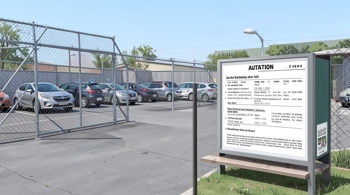
Columbus-related reporting similarly describes that vehicles are sold as-is and most are sold with salvage titles. These details show how title status and mechanical expectations can be managed at the listing level but still leave meaningful unknowns, particularly for electrical systems, drivability, or damage not clearly enumerated in the listing. 3
Removal windows, tow-yard pickup, and the operational friction point after purchase
After purchase, removal deadlines are a core feature of these sales and frequently appear in both local reporting and public notices. In the Columbus June 6, 2026 report, payment was due by 1 p.m. and purchased vehicles had to be removed by noon on June 10. 3 That timeline creates a narrow post-sale window during which towing, storage, and site clearance must be arranged. 3
In the NoticeRegistry summary for Columbus, the removal obligation is described as completion by the Wednesday after the auction. Kansas City terms also include strict compliance around nonpayment and bans, and while the provided Kansas City excerpt focuses on payment, the overall theme across sources is that impound lot dispositions operate on fixed, enforceable schedules. 1 2
Inventory sources and why “police impound” can include more than just municipal tow lots
“Police impound vehicles for sale” can refer to multiple pathways, including municipal tow-yard auctions of abandoned forfeited vehicles, and broader government channels for seized or surplus vehicles. General research context provided with this topic notes that vehicles seized by law enforcement can be sold through government auction channels, and that state and local agencies may require public auction procedures after statutory notice and satisfaction of towing or impound fees. 4
That same research context highlights that auctions often list key details such as VIN and mileage when shown, while condition is frequently sold as-is with limited or unverified inspections and titles that may vary depending on the case and agency process. 4 Federal asset forfeiture contexts also exist as a separate legal pathway that can lead to sale or transfer of seized property under authorized law enforcement and court processes. 5
Risk factors to evaluate: title status, unknown mechanical history, and compliance consequences
The dominant risk in police impound vehicle auctions is not only mechanical uncertainty but also legal and administrative friction tied to titles, eligibility, and enforceable auction terms. One common element is that vehicles are sold as-is or as-is where-is, which appears in Kansas City auction terms stating no warranty and sales finality. 2 Another common element is that payment failures can trigger forfeiture and bans, shown explicitly in the Kansas City tow-lot terms. 2
Another documented risk evaluation step is verifying vehicle history using VIN-based records when impound history is suspected. A VIN-history-focused research note argues that an impound record alone does not automatically invalidate a vehicle, but it can signal hidden title problems, unresolved liens, or neglect-related mechanical damage that can exceed the apparent discount. 6 Although this type of guidance is not a substitute for official auction documentation, it underscores a compliance-aligned approach to risk management. 6
Example compliance checklist drawn from published notices
- Confirm the auction date, gates or registration time, and whether public viewing is scheduled prior to bidding. 3
- Bring valid ID for registration when required by the auction site or public notice. 3
- Verify payment forms and approval requirements, including cash-only rules or bank-letter approval for checks. 1
- Plan removal within the stated pickup window, such as removal by noon on a specified date or by the Wednesday after the auction. 3
Sources
- NoticeRegistry: “Jul 24, 2026 Public Notice: 2700 Impound Lot Rd., Columbus, OH | Ohio | NoticeRegistry” https://www.noticeregistry.com/ohio/notice/other-columbus-307969
- Woolsey Auction / OAI Auctions: “Kansas City Police Tow Lot Auction” https://www.woolseyauction.com/auction/kansas-city-tow-lot-2026-07-21-82589/details
- Columbus Dispatch: “Columbus police hosting auction of about 120 impounded vehicles June 6” https://www.dispatch.com/story/news/local/2026/05/26/columbus-police-hosting-auction-of-about-120-impounded-vehicles-june-6/90198729007/
- GovDeals / GovPlanet / Copart / IAA / Public Surplus and research context entries supplied in the prompt (seized and surplus auction channels and typical listing elements) https://www.govdeals.com/
- U.S. Department of Justice: Asset forfeiture context supplied in the prompt https://www.justice.gov/usao/asset-forfeiture
- CarCheckerVIN: “Impound Vehicle VIN History: Know This | CarCheckerVIN” https://www.carcheckervin.com/blog/impound-vehicle-vin-history
Authored by MyTrendSpot team