Best dark circle eye creams for aging skin: An evidence-led ingredient and formula analysis
Dark circle eye creams for aging skin commonly promise brighter, smoother, firmer, and more hydrated-looking eyes. The products and research supplied for this review show that formulas differ considerably: some emphasize vitamin C or niacinamide for discoloration, while others focus on retinoid alternatives, peptides, caffeine, hydration, or light-reflecting pigments.
What dark circles may indicate
Under-eye darkness is not one uniform condition. Product research distinguishes blue or vascular circles, brown or pigmented circles, and hollow shadows associated with natural aging and structural volume loss. Thin skin can make underlying blood vessels more visible, while sun exposure, irritation, allergies, and genetics may contribute to brown or red discoloration. These differences matter because a brightening ingredient may have limited effect on shadows caused primarily by anatomy or hollowness. 7
- Blue or purple tones are generally approached with circulation-supporting and light-diffusing ingredients.
- Brown tones are more closely associated with pigment-focused ingredients such as vitamin C, viniferine, or niacinamide.
- Hollow shadows may respond visually to hydration or reflective pigments but are not necessarily corrected by cream alone.
Ingredient priorities for mature eye skin
Caffeine is frequently used in eye formulas because it is associated with temporary vessel constriction and a reduction in the appearance of puffiness and darkness. Hydrators such as hyaluronic acid help address dryness and can make fine lines appear less pronounced, while ceramides support moisture retention in a delicate area that becomes thinner and drier with age. These ingredients primarily improve the look and feel of the skin rather than changing every underlying cause of dark circles. 101218
- Look for caffeine when puffiness and tired-looking eyes are prominent.
- Look for hyaluronic acid, glycerin, or barrier-supporting lipids when dryness is visible.
- Consider peptides when firmness and fine lines are central concerns.
Vitamin C and pigment-focused options
Vitamin C is commonly selected for dark circles linked to hyperpigmentation. Murad's Vita-C Eyes Dark Circle Corrector uses a gold-stabilized vitamin C complex and light-reflecting micro-minerals, with the brand stating that its formula targets blue, brown, and red-looking circles and may show results in as little as two weeks. Caudalie's Vinoperfect Brightening Eye Cream uses viniferine and caffeine; its product page reports that 86% of 22 volunteers saw brighter dark circles after 56 days. 32
- Vitamin C derivatives may be preferable when sensitivity is a concern, although individual tolerance still varies.
- Reflective minerals can improve appearance cosmetically without treating the cause of discoloration.
- Clinical percentages supplied by brands are often based on small volunteer groups and satisfaction surveys.
Retinoid and retinoid-alternative approaches
Retinol is widely used for long-term concerns involving texture, fine lines, and collagen support, but the eye area is especially vulnerable to dryness and irritation. RoC's Derm Correxion Eye Repair Dark Circle Cream identifies patented clinical retinol as a key ingredient and reports that 87% of 32 volunteers saw persistent dark circles visibly reduced after eight weeks. Countertime Ultra Renewal Eye Cream instead uses a Retinatural Complex and Persian Silk Tree Extract, while specifically stating that it does not use retinol or retinyl propionate. 4111
- Introduce retinoid-containing products cautiously and avoid applying too close to the lash line.
- Use less frequently if stinging, scaling, or persistent redness develops.
- Retinoid alternatives may appeal to people prioritizing a gentler formulation, but they should not be assumed equivalent to retinol.
Peptides, niacinamide, and barrier support
Peptides are used in premium eye treatments to support the appearance of firmness and fine lines, while niacinamide can help even tone, reduce visible inflammation, and reinforce the skin barrier. MDAiRE's Regenerative ECM Eye Complex combines niacinamide, peptides, caffeine, green tea, licorice, and the N-hydroxysuccinimide and chrysin pair. Noreva's Trio White Mela combines a peptide, a vitamin C derivative, hyaluronic acid, and silk tree extract, reporting a 77% reduction in dark circles in a self-assessment involving 22 volunteers. 861315
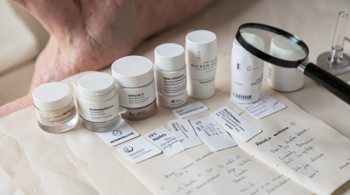
- Niacinamide is relevant when discoloration and barrier weakness occur together.
- Peptide formulas may be useful for people prioritizing fine lines and firmness.
- Ingredient combinations can increase potential benefits but also make it harder to identify the source of irritation.
Formulas with published testing
Brand-reported testing varies in design, duration, and outcome language, so percentages should be interpreted as product-specific evidence rather than universal proof. RoC reports results at one and eight weeks from 32 volunteers, Caudalie reports satisfaction after 56 days among 22 volunteers, and Noreva reports self-assessment outcomes from 22 volunteers. Estée Lauder states that its Advanced Night Repair Eye Gel-Creme made dark circles look brighter in two weeks and uses a proprietary Night Peptide targeting blue, purple, and brown circles. 4265
| Formula | Highlighted approach | Reported timing or measure |
|---|---|---|
| RoC Derm Correxion | Clinical retinol and cooling tip | 87% reported reduced persistent circles at eight weeks |
| Caudalie Vinoperfect | Viniferine, caffeine, ceramic applicator | 86% saw brighter circles after 56 days |
| Noreva Trio White Mela | Peptide, vitamin C derivative, hyaluronic acid | 77% reported reduced circles |
Texture, applicators, and immediate appearance
Application design affects user experience and can influence the short-term appearance of fatigue. Caudalie uses a cooling ceramic applicator intended to reduce puffiness and awaken the eye contour, while RoC describes a cooling precision tip that massages the area. La Mer's Supreme Lift Anti Age Eye Cream includes light-reflecting pigments, hyaluronic acid, bakuchiol, sea silt, algae extracts, shea butter, and olive oil, with a stated focus on normal to dry skin and customers over 50. 24917
- Gel-creams generally emphasize fast absorption and a lighter feel.
- Richer creams may suit dry mature skin but can feel heavy or migrate toward the eyes.
- Reflective pigments offer visual camouflage and should not be confused with pigment correction.
Safety, maintenance, and realistic expectations
Sun protection is a central maintenance step because ultraviolet exposure can worsen hyperpigmentation and accelerate visible aging around the eyes. The American Academy of Dermatology advises consistent sunscreen use, while retinol guidance emphasizes restrained use around delicate skin. Product pages also show that fragrance-free and ophthalmologically tested options exist, but those labels do not guarantee that every individual will tolerate a formula. Persistent swelling, pain, eczema-like irritation, or sudden asymmetry warrants professional assessment rather than continued experimentation. 16112
- Patch testing and gradual introduction reduce, but do not eliminate, irritation risk.
- Daily sun protection helps prevent worsening discoloration.
- Topical products have practical limits when darkness reflects hollowness, prominent vessels, or medical conditions.
How to compare products objectively
A useful comparison begins by identifying the dominant concern, then checking the active ingredients, fragrance status, texture, applicator, and quality of the evidence. A vitamin C or niacinamide formula may be more logically aligned with brown discoloration, whereas caffeine and reflective pigments may better address a tired visual effect. Retinol, peptides, bakuchiol, and barrier-supporting ingredients are more relevant when fine lines, firmness, and dryness are also present. Cost and brand prestige do not establish clinical superiority. 35914
- Match the formula to discoloration type rather than selecting solely by popularity.
- Separate measured clinical outcomes from marketing descriptions and visual effects.
- Allow several weeks of consistent use when assessing long-term texture or pigmentation changes.
Sources
- Counter, Ultra Renewal Eye Cream
- Caudalie, Vinoperfect Brightening Eye Cream
- Murad, Vita-C Eyes Dark Circle Corrector
- RoC, Derm Correxion Eye Repair Dark Circle Cream
- Estée Lauder Advanced Night Repair Eye Gel-Cream
- Noreva, Trio White Mela Eye Contour Care
- Biologique Recherche, Oligo-Protéines Marines
- MDAiRE, Regenerative ECM Eye Complex
- La Mer, Supreme Lift Anti Age Eye Cream
- Healthline, Eye Creams for Dark Circles
- Allure, Eye Creams for Dark Circles
- Vogue, Eye Creams for Dark Circles
- Byrdie, Eye Creams for Dark Circles
- Harper's Bazaar, Eye Creams for Dark Circles
- Elle, Eye Creams for Dark Circles
- American Academy of Dermatology, Under-Eye Circles
- Good Housekeeping, Eye Creams for Dark Circles
- Cosmopolitan, Eye Creams for Dark Circles
- Self, Eye Creams for Dark Circles
Authored by MyTrendSpot team