Top 15 Uterine Fibroid Treatment Centers in the United States: An Analytical Guide to Specialized Care
Identifying the top 15 uterine fibroid treatment centers in the United States requires examining institutional accreditation, specialist credentials, procedural volume, and the breadth of treatment modalities available. Uterine fibroids are benign growths composed of smooth muscle and fibrous tissue that develop in or around the uterus, affecting an estimated 20% to 50% of women of reproductive age, with lifetime prevalence reaching as high as 77% during childbearing years. 1 Despite documented clinical evidence that non-surgical options are effective, hysterectomies and myomectomies still represent more than 96% of fibroid-related procedures performed in the United States. 2
Why Fibroid Treatment Center Selection Matters
The quality of a fibroid treatment center directly influences available options. Institutions carrying Centers of Excellence in Minimally Invasive Gynecology (COEMIG) designation from the AAGL have demonstrated measurable commitments to patient safety and surgical outcomes. 3 Geography also plays a decisive role: patients in urban hospitals are 7.13 times more likely to have access to uterine fibroid embolization (UFE) than those in rural areas, according to the JAMA Network Open study. 2 Treatment selection at top-tier facilities is typically determined by a patient's reproductive goals, fibroid size, number, location, and symptom severity, not a single standardized protocol.
The American College of Obstetricians and Gynecologists (ACOG) provides clinical guidance on uterine leiomyoma management, supporting evidence-based treatment selection that ranges from hormonal medications and intrauterine devices to laparoscopic myomectomy, hysterectomy, UFE, and MRI-guided focused ultrasound. 4 The National Institute of Child Health and Human Development (NICHD) similarly notes that treatment pathways vary substantially based on symptoms, severity, and a patient's circumstances, underscoring that no single center or modality is universally appropriate. 5
The 15 Notable Centers: Institutional Profiles
The following table summarizes 15 recognized uterine fibroid treatment centers across the United States, grouped by institutional type, geographic location, and primary treatment specialization. These profiles are drawn from publicly available institutional data and are presented as a reference framework, not as a ranked endorsement of any facility.
| Center | Location | Key Specialization |
|---|---|---|
| Mayo Clinic | Rochester, MN | Multidisciplinary care; minimally invasive surgery and embolization |
| Cleveland Clinic | Cleveland, OH | Fertility-sparing robotic-assisted laparoscopic myomectomy |
| Johns Hopkins Medicine | Baltimore, MD | Fertility-preserving treatments; advanced imaging diagnostics; serves patients from 49 states |
| Brigham and Women's Hospital Fibroid Center | Boston, MA | MR-guided focused ultrasound (HIFU); minimally invasive gynecologic surgery |
| UCLA Health Fibroid Treatment Center | Los Angeles, CA | Interventional radiology; image-guided UFE |
| Penn Center for Integrated Fibroid Care | Philadelphia, PA | Integrated multidisciplinary model; robotic-assisted myomectomy |
| Northwestern Memorial Hospital Fibroid Center | Chicago, IL | Minimally invasive gynecologic surgery; integrated specialist referral |
| University of Michigan Health Fibroid Program | Ann Arbor, MI | Patient-centered care; access to clinical trials for novel therapies |
| USA Fibroid Centers (multi-site) | NY, NJ, IN, WA and others | Outpatient UFE; AAAHC-accredited locations; 86% patient quality-of-life improvement reported |
| Atlanta Fibroid Center | Atlanta, GA | UFE pioneer since 2005; more than 10,000 women treated without hysterectomy |
| Fibroid Institute Texas | Dallas, TX | UFE; board-certified interventional radiology; over 15,000 procedures by affiliated specialists |
| Maimonides Health | Brooklyn, NY | Brooklyn's only COEMIG-designated center; collaborative gynecology and IR model |
| VIP Fibroid Center | Bay Area, CA | Non-surgical UFE and focused ultrasound; board-certified interventional radiologists |
| Georgia Endovascular (Atlanta Fibroid Clinic) | Atlanta, GA | Outpatient UFE; over 90% symptom relief rate reported; 40,000+ procedures performed |
| Vista Interventional Care Center (VICC) | Knoxville, TN | Outpatient UFE serving East Tennessee; minimally invasive non-surgical care |
Treatment Modalities Available at Leading Centers
Top centers generally offer a spectrum of interventions rather than a single procedure. Hormonal therapies, including birth control pills, IUDs, and hormone injections, are typically the first tier for patients with smaller fibroids or those seeking to avoid procedures entirely. 6 For patients with larger or more complex fibroids, minimally invasive surgical options include laparoscopic myomectomy, robotic-assisted myomectomy using systems such as the Da Vinci platform, and hysteroscopic myomectomy. Estimated costs for these surgical approaches in U.S. facilities range from approximately $10,000 to $50,000 depending on surgical complexity and facility type. 7
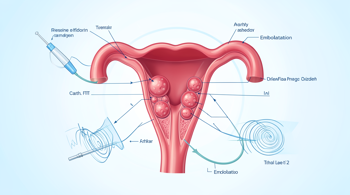
Uterine Fibroid Embolization, the most widely offered non-surgical procedure at the centers profiled here, works by delivering embolic agents through a catheter to block blood supply to fibroids, causing them to shrink over time. The procedure is performed under image guidance, requires no general anesthesia, involves no surgical incision beyond a small catheter entry point, and typically carries a recovery period of 7 to 10 days. 8 MRI-guided focused ultrasound (MRgFUS), approved by the FDA for uterine fibroids since 2004, is a fully non-invasive option available at select centers such as Brigham and Women's Hospital. It uses high-intensity sound waves to heat and destroy fibroid tissue without any incision, with most patients returning to normal activities the following day. 9
Epidemiology, Health Equity, and Access Gaps
Black women are disproportionately affected by uterine fibroids, experiencing higher rates of the condition, earlier onset, more severe symptoms, and higher rates of invasive surgery than white women. Penn Medicine notes that Black women are approximately three times more likely to develop fibroids than white women. 6 Emage Fibroid Centers, which launched a public awareness campaign in July 2026, cited a national figure of 26 million affected women, with the condition described as a condition that disproportionately affects women of color. 10 Maimonides Health further reports that uterine fibroids affect up to 80% of Black women, compared to 25 to 30% of women in the general U.S. population. 3
These disparities are compounded by geographic access barriers. The JAMA Network Open study, which analyzed more than 271,000 patient encounters, found that access to UFE is dramatically concentrated in urban hospital settings. 2 Multi-site networks such as USA Fibroid Centers have cited national expansion as a deliberate strategy to address this inequity, noting that their one-year outpatient UAE study showed an 86% improvement in patient quality of life. 2 NCI-designated centers and ClinicalTrials.gov, the authoritative federal registry for federally and privately supported studies, list ongoing fibroid treatment trials that may provide access to emerging therapies for eligible patients. 11
Cost Benchmarks and Insurance Considerations
Patients evaluating fibroid treatment centers should account for substantial variation in out-of-pocket exposure. Initial consultations with gynecologists in the U.S. typically range from $200 to $300, and pelvic or transvaginal ultrasounds used for fibroid diagnosis carry similar costs. 7 Hysteroscopy ranges from approximately $2,800 to $3,500. Open myomectomy ranges from $17,000 to $30,000, while robotically assisted myomectomy, such as the Da Vinci platform, can reach $30,000 to $50,000. Robotic-assisted hysterectomy carries a comparable cost range. 7 UFE, which is covered by most major insurance plans at accredited outpatient centers such as USA Fibroid Centers and the Fibroid Institute, generally falls below the cost threshold of surgical alternatives, though exact figures depend on facility, region, and insurer.
Patients should request itemized pre-authorization documentation before scheduling any procedure. Insurance coverage for UFE is not universal, and coverage for MRgFUS may be more restricted depending on the insurer and policy type. Academic medical centers and teaching hospitals, including those ranked by U.S. News and World Report for gynecology and fertility-related specialties, may provide access to robotic technologies and highly trained surgical specialists but can involve longer wait times and higher facility fees than outpatient-focused centers. 12
Eligibility Criteria, Risks, and Limitations
Not all patients are candidates for every modality. UFE is generally not recommended for women who are pregnant, plan an immediate pregnancy, or have active pelvic infection. Focused ultrasound suitability depends on fibroid location, size, and the presence of abdominal scarring that could obstruct the sound beam path. Myomectomy preserves the uterus but carries surgical risks including blood loss, scarring, and a chance of fibroid recurrence. Hysterectomy, while definitive, is irreversible and carries the full risks associated with major surgery under general anesthesia.
Centers affiliated with academic medical institutions, such as the University of Michigan Health fibroid program, typically offer access to clinical trials and experimental therapies through ClinicalTrials.gov, which may be appropriate for patients whose fibroids have not responded to standard interventions. 11 Patients with adenomyosis, a related but distinct condition in which the uterine lining grows into the muscular wall, may find that some fibroid-focused outpatient centers, including USA Fibroid Centers locations in Indianapolis and Passaic, also treat this condition. However, adenomyosis may require different or combined treatment strategies, and its management should be discussed with a specialist before selecting a facility.
What to Look for When Comparing Centers
Board certification in interventional radiology or advanced gynecologic surgery is a baseline credential to verify when evaluating any fibroid treatment center. Specialist experience metrics, such as total procedure volume, are meaningful indicators of technical proficiency. For example, Dr. Cathryn Shaw of Fibroid Institute Texas had performed over 15,000 interventional radiology procedures as of 2025, and Georgia Endovascular reports over 40,000 procedures performed at its Atlanta clinic. 13 Multidisciplinary team composition, meaning the availability of gynecologists, interventional radiologists, fertility specialists, and relevant surgical subspecialists within a single coordinated care model, is a structural feature associated with higher-quality fibroid management.
Accreditation status from bodies such as the AAAHC or AAGL COEMIG program signals an independently verified standard of safety. Patients should also assess whether a center provides structured follow-up protocols, since fibroid recurrence rates and long-term symptom monitoring vary by modality and individual patient profile. Research participation, published outcomes data, and transparent communication about procedural risks are additional markers of institutional quality that distinguish the most clinically rigorous centers from general gynecology practices offering a limited range of fibroid services.
Sources
- Seamless Medical Centers - Understanding Uterine Fibroids: theseamlessway.com
- USA Fibroid Centers Press Release, March 2026 - 96% of Women Still Undergo Fibroid Surgery: einpresswire.com
- Maimonides Health - Uterine Fibroids: maimo.org
- American College of Obstetricians and Gynecologists (ACOG) - Uterine Fibroids: acog.org
- NICHD (NIH) - Uterine Fibroids: nichd.nih.gov
- Penn Medicine - Uterine Fibroid Care and Management: pennmedicine.org
- Bookimed - Uterine Fibroids Treatment Costs in the United States: us-uk.bookimed.com
- Metro Fibroid Center at Image Guided Surgery - UFE Treatment: metrofibroidcenter.com
- Focused Ultrasound Foundation - Uterine Fibroids: fusfoundation.org
- Emage Fibroid Centers - Freedom From Fibroids Campaign: einpresswire.com
- ClinicalTrials.gov - Uterine Fibroid Studies: clinicaltrials.gov
- U.S. News and World Report - Best Hospitals Rankings: usnews.com
- Fibroid Institute Texas - Dallas Fibroid Doctor Spotlight: fibroidfree.com
Authored by MyTrendSpot team