What registered nurses make in each state: a U.S. salary comparison: An Analysis of Geographic Earning Trends
The landscape of registered nurse (RN) compensation across the United States is characterized by significant regional variation, with reported annual median salaries diverging by more than $60,000 between the highest and lowest-paying states 8. As of 2026, the national median annual wage for registered nurses is approximately $97,550, though this figure serves primarily as a baseline rather than a reflection of individual local markets 2. Understanding these differences requires evaluating more than just raw salary numbers, as regional cost-of-living adjustments, tax structures, and nursing union presence heavily influence the actual purchasing power of these wages 3, 11.
Geographic Distribution of Compensation
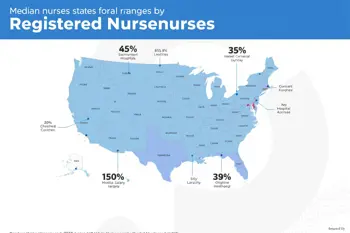
The highest concentration of top-paying states for registered nurses remains firmly anchored on the Pacific Coast and in the Northeast. California consistently leads the national rankings, with reported median salaries reaching $140,270 annually 2. Other states such as Hawaii and Oregon also report median earnings exceeding $120,000 in recent occupational data 7. This Pacific premium is largely attributed to a combination of high living costs, strong labor protections, and aggressive competition among hospital systems to secure specialized nursing staff in high-demand metropolitan areas 4, 12.
Conversely, states in the South and parts of the Midwest often appear at the lower end of the compensation spectrum. Alabama, for instance, has reported median RN salaries in the vicinity of $77,080, illustrating the stark divide in nominal pay across the country 2. While these figures are lower, industry analysts emphasize that these states frequently feature lower regional price parity, meaning that a lower nominal salary may still support a similar or superior standard of living compared to higher-wage coastal regions 4, 11.
The Impact of Cost of Living on Real Purchasing Power
When analyzing registered nurse income, reliance on raw salary data can often be misleading. Financial analysts frequently apply a cost-of-living index to determine the real purchasing power of a nurse's salary in different states 4. For example, while California offers the highest gross compensation, the effective value of that salary is often mitigated by significantly higher expenses related to housing, utilities, and state income taxes 11. After adjusting for these factors, the rankings of states by economic value often shift, with regions like Texas or Georgia occasionally demonstrating higher real-world financial flexibility than their coastal counterparts 13.
| State | Median Annual Salary | Cost of Living Context |
|---|---|---|
| California | $140,270 | Very High |
| Hawaii | $136,320 | Very High |
| Oregon | $129,010 | High |
| Massachusetts | $104,550 | High |
| Alabama | $77,080 | Low |
Workforce Drivers and Salary Growth
Several institutional and structural factors drive the current variations in nurse pay. The nursing profession faces an ongoing national labor shortage, with estimates suggesting a shortfall of approximately 100,000 registered nurses currently affecting the healthcare system 8. This supply-and-demand imbalance compels healthcare providers to adjust base pay and offer competitive packages to attract and retain experienced staff. Furthermore, states with mandated nurse-to-patient ratios often see higher wage growth as hospitals seek to meet compliance requirements while maintaining operational capacity 5, 12.
Experience levels and educational attainment also play a foundational role in salary differentiation within state borders. While the base salary for an entry-level nurse may be consistent across a specific region, long-term earnings potential is frequently tied to specialized certifications and years of clinical experience 6. Advanced roles, such as nurse practitioners or nurse anesthetists, naturally command higher compensation tiers that are often distinct from the median data reported for general staff nurses, creating a tiered career structure within the broader industry 2, 10.
Unionization and Institutional Pay Standards
The prevalence of nursing unions in certain states correlates with higher average pay and standardized benefits. States where collective bargaining is common, such as California, often display higher wage averages compared to non-unionized states 8. These unions frequently negotiate for higher base wages and standardized shift differentials, which directly influence the reported state median salary 12. The presence of these agreements often forces non-unionized facilities in the same region to adjust their pay scales to remain competitive, creating a broad regional upward pressure on nursing wages 12.
Clinical Specialization vs. Geographic Location
While geography remains a primary predictor of nurse salary, specialization is an equally significant variable. The data shows that the gap between a standard staff nurse and an advanced practice role-such as a certified registered nurse anesthetist (CRNA)-can exceed $100,000 per year regardless of the state of practice 2. Consequently, nurses often weigh the decision to relocate to a higher-paying state against the professional investment required to enter higher-paying specialties. This dual-path approach to salary growth is a cornerstone of modern nursing career planning 10.
Regulatory Oversight and Future Projections
Regulatory environments significantly dictate the long-term prospects for registered nurses in each state. States that allow for greater practice authority for advanced nursing roles often see different salary trajectories compared to states with more restrictive scope-of-practice regulations 3. Looking ahead, the Bureau of Labor Statistics projects continued demand for registered nurses, with growth rates outpacing many other sectors through 2034 14. As the population continues to age, the demand for primary care and hospital-based services is expected to remain a critical factor in sustaining nurse compensation levels across all fifty states 14.
Sources
- U.S. Bureau of Labor Statistics (BLS) Occupational Employment and Wage Statistics (OEWS).
- RenewRN, "Registered Nurse Salary by State (2025 BLS Data)."
- Registered Nurse Salary (2026) - All 50 States, "Registered Nurse Salary by State (2026) Trends."
- SmartAsset, "Where It Pays to Be in Nursing - 2026 Study."
- Nurse Salary Data, "Registered Nurse Salary by State 2026."
- Credenza Health, "2025–26 Nurse Salary: How Much Do RNs Make in Each State?"
- World Population Review, "Nursing Pay by State 2026."
- NurseSalaryIntel, "Nurse Salary Data 2026: All 50 States & Specialties."
- Diversity Nursing, "2026 Nurse Salary in the U.S. by State."
- The Nursing Directory, "Nursing Salary & Career Data 2026."
- TakeHomeTax, "Registered Nurse Salary by State After Taxes (2026)."
- NurseZee, "RN Salary by State: Where Nurses Earn the Most."
- GoodNurse, "2026 Nursing Salaries by State: Adjusted for Cost of Living."
- U.S. Bureau of Labor Statistics, "Occupational Outlook Handbook: Registered Nurses."
Authored by MyTrendSpot team