Understand meniscus tear treatment options: Evidence-based guidance on rehabilitation and surgery
What a meniscus tear means
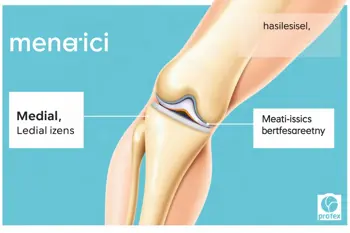
Understanding meniscus tear treatment options begins with the structure involved. Each knee contains a medial meniscus on the inner side and a lateral meniscus on the outer side. These crescent-shaped cartilage structures sit between the femur and tibia, helping absorb impact, distribute load, and contribute to stability. Tears may occur suddenly after twisting during football or basketball, or gradually through age-related wear and tear. Symptoms can include pain, swelling, clicking, catching, instability, and difficulty fully bending or straightening the knee. 1
Treatment cannot be selected from an MRI description alone. Clinicians consider the tear pattern, size, location, healing potential, age, activity level, existing arthritis, associated ligament damage, and the specific symptoms affecting daily function. A traumatic tear in a younger, active person may be approached differently from a degenerative tear in an older adult. Persistent locking or mechanical blockage is more concerning than pain alone and warrants orthopedic assessment. 2
Initial nonsurgical treatment
Many meniscus tears are initially managed without an operation. Early care may include protecting the knee, reducing aggravating activities, applying ice, using compression and elevation, and taking appropriate pain relief. A structured physiotherapy program can then address range of motion, quadriceps and hamstring strength, coordination, stability, and a gradual return to normal loading. The precise program depends on symptoms and examination findings rather than on the MRI label by itself. 3
Activity modification does not necessarily mean complete inactivity. Movements that provoke sharp pain, repeated twisting, deep squatting, or impact may need to be reduced while rehabilitation progresses. Physiotherapy is particularly important for degenerative tears, where symptoms may coexist with osteoarthritis and reduced muscle strength. Improvement is assessed through pain, swelling, movement, stability, walking tolerance, and function, with treatment adjusted if symptoms persist or worsen. 4
How diagnosis guides the decision
A clinical examination usually forms the starting point, including assessment of tenderness, swelling, movement, stability, and provocative maneuvers. MRI can show the menisci as well as ligaments, cartilage, tendons, and other soft tissues, making it useful when the diagnosis is uncertain or associated injuries are suspected. Plain X-rays do not directly display meniscal tissue, but they can identify fractures, bone abnormalities, or arthritis-related changes that influence treatment planning. 8
Imaging findings need to be interpreted alongside symptoms. A tear visible on MRI may not be the only source of knee pain, particularly when degenerative joint changes are present. Conversely, a displaced fragment that blocks movement may require more rapid specialist review. The important clinical questions are whether the knee is repeatedly locking, whether instability is present, whether function remains limited after rehabilitation, and whether the tear appears suitable for preservation. 3
Meniscus repair
Meniscus repair aims to preserve and restore the torn cartilage rather than remove it. It is considered when the tear has characteristics that may allow healing, including a suitable location and pattern, adequate tissue quality, and a patient profile in which preserving shock-absorbing tissue is important. Tears nearer the outer meniscal region generally have better blood supply than inner tears, which can affect healing potential. Repair may also be considered when a traumatic tear is associated with other knee injuries. 7
Repair has a preservation advantage, but rehabilitation is usually more demanding than after partial meniscectomy. Early protocols may restrict weight-bearing or knee movement, followed by gradual restoration of range of motion, strength, and load tolerance. Recovery requirements vary substantially according to the repair and any concurrent procedure. The longer rehabilitation period is an important practical consideration for people whose work, sport, or daily responsibilities require kneeling, pivoting, or impact. 9
Partial meniscectomy
Partial meniscectomy removes only the damaged portion of the meniscus that cannot be repaired, usually through arthroscopy using small incisions. The objective is to reduce symptoms caused by an unstable fragment while retaining as much functional meniscal tissue as possible. Recovery is often less restrictive than after repair, although the timeline still depends on the extent of tissue removed, symptoms, strength, and any additional knee damage. 6
Removing meniscal tissue can reduce mechanical symptoms, but it also leaves less shock-absorbing cartilage and may increase stress on the remaining joint surfaces. For this reason, tissue preservation is generally considered when repair is realistic. Surgery is not automatically preferred for degenerative tears, particularly when osteoarthritis is also present. The potential for faster symptom relief must be balanced against surgical risks, rehabilitation demands, and the longer-term condition of the knee. 7
What research says about physiotherapy and surgery
Evidence from randomized research has challenged the assumption that arthroscopic partial meniscectomy is routinely superior to rehabilitation for adults with a meniscal tear and knee osteoarthritis. In a New England Journal of Medicine trial, arthroscopic partial meniscectomy combined with physiotherapy was not significantly better than physiotherapy alone for improving function in many such patients. This supports a rehabilitation-first discussion when there is no persistent mechanical blockage. 5
A recent narrative review similarly reported that exercise therapy can be as effective as arthroscopic partial meniscectomy for degenerative tears in the short and long term, although surgery may provide faster symptom relief in selected cases. The evidence for additional treatments such as platelet-rich plasma, hyaluronic acid, corticosteroid injections, and extracorporeal shockwave therapy remains mixed. These options should therefore be discussed as uncertain adjuncts, not established replacements for rehabilitation or indicated surgery. 11
When surgery or specialist review becomes more relevant
Surgery may be considered when symptoms remain limiting after an appropriate rehabilitation period, when repeated catching or locking indicates a displaced fragment, or when a traumatic tear appears repairable. A persistently locked knee is especially important because a displaced tear can mechanically block movement. Associated anterior cruciate ligament or other structural injuries may also change the treatment plan. The decision should match the mechanical problem, tissue-preservation goals, general health, and functional expectations. 2
Meniscus transplantation is an uncommon option for carefully selected patients who have lost substantial meniscal tissue and continue to experience symptoms, provided advanced arthritis is not present. It is not a routine treatment for a newly diagnosed tear. In every pathway, rehabilitation remains central, including gradual strengthening, restored movement, load management, and monitoring for recurrent swelling or instability. Medical review is appropriate when pain worsens, movement becomes blocked, or progress stops. 104
Sources
- Bupa UK, Meniscus tear: Symptoms, causes and treatment
- Merck Manual Professional Edition, Knee Sprains and Meniscal Injuries
- Mayo Clinic, Torn meniscus: Diagnosis and treatment
- American Academy of Orthopaedic Surgeons, Meniscus Tears
- New England Journal of Medicine, Surgery versus Physical Therapy for a Meniscal Tear and Osteoarthritis
- Penn Medicine, Meniscus Repair Surgery
- Hospital for Special Surgery, Meniscus Tears
- RadiologyInfo.org, Knee MRI
- Mass General Brigham, Meniscus Tears Rehabilitation
- American Orthopaedic Society for Sports Medicine, Meniscus Transplantation
- Contemporary Management of Meniscal Tears: From Diagnosis and Surgery to Rehabilitation Strategies
Authored by MyTrendSpot team