Niacinamide body lotion for dark spots and scars: An evidence-based consumer analysis
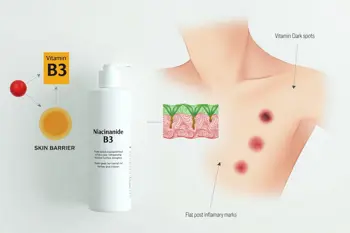
The phrase “niacinamide body lotion for dark spots and scars” generally refers to leave-on body moisturizers formulated with vitamin B3 to improve uneven tone while supporting hydration. Available product information and clinical research indicate that niacinamide is more directly relevant to discoloration and post-inflammatory marks than to permanent, raised, indented, or textural scars.1
How niacinamide addresses uneven tone
Niacinamide is used in body care because it may reduce the transfer of melanosomes, the pigment-containing structures that move into epidermal cells. This mechanism can gradually reduce the appearance of hyperpigmentation rather than physically removing pigment from the skin. Clinical research cited in the supplied data reported a significant reduction in hyperpigmentation after eight weeks of topical use, while broader skincare guidance identifies niacinamide as an ingredient for tone, barrier support, and visible spots.9
The ingredient also supports ceramide production and the epidermal barrier, which can help reduce moisture loss and calm irritation. That barrier function matters when discoloration follows acne, shaving, friction, or inflammation, because ongoing irritation can maintain uneven tone. Niacinamide is generally described as a gentler brightening option than hydroquinone or strong retinoids, although gentleness depends on concentration, the rest of the formula, and individual sensitivity.10
Dark spots and scars are different concerns
Dark marks left after a blemish, cut, bruise, or shaving irritation are usually pigment changes rather than scars in the structural sense. A body lotion may help the color appear more even over time, but it cannot be assumed to rebuild depressions, flatten raised scar tissue, or erase long-standing changes in texture. One 10% niacinamide body-lotion description specifically states that the product is not a spot treatment and is unsuitable for scars, fades, or long-standing hyperpigmentation.2
This distinction affects expectations and evaluation. A flat brown or gray mark may respond to pigment-focused care, whereas a firm, raised, indented, or unusually thick area requires a different clinical assessment. Product descriptions for body brightening lotions often use terms such as “scar healing” or “scar appearance,” but ingredient databases describe those benefits as cosmetic improvements in appearance, hydration, or texture rather than proof of scar removal.11
Concentration and formula design
Supplied research information identifies 2% to 5% as commonly studied concentrations for discoloration, while available body lotions include examples labeled 1%, 5%, and 10%. Vaseline Radiant X Even Tone Nourishing Body Lotion is described as containing 1% niacinamide and claiming visibly reduced dark spots and a more even tone in 14 days. Minimalist lists 5% niacinamide with glycerin and shea butter, while Be Bodywise lists 10% niacinamide and recommends regular use for three to four months.1
A higher percentage does not automatically establish better performance or better tolerance. Formula structure is equally relevant: humectants such as glycerin attract water, emollients soften the surface, and occlusive ingredients reduce water loss. The Minimalist formulation identifies 20% glycerin, shea butter, a fragrance-free profile, and a pH of 5.0 to 6.0, illustrating how niacinamide can be combined with barrier-supporting ingredients rather than used alone.6
Combination ingredients and target areas
Some formulations pair niacinamide with additional tone-focused ingredients. An APLB body lotion described in the supplied data combines niacinamide with tranexamic acid in a stated 16% Tranex Niac Cen complex, alongside centella, hyaluronic acid, squalane, and beta-glucan. A Neoretin sensitive-area lotion lists niacinamide, azelaic acid, tranexamic acid, lactobionic acid, and RetinSphere technology for areas such as underarms, the bikini line, elbows, and knees.3
Combination formulas may create more opportunities for irritation, particularly on recently shaved skin, skin affected by friction, or delicate body zones. The Neoretin description emphasizes fragrance-free care and high tolerability for sensitive areas, but a product description is not the same as an individualized medical assessment. Exfoliating acids, retinoid-related technologies, botanical extracts, and fragrance components should be evaluated together rather than judged only by the niacinamide percentage.4
Use, timelines, and sun exposure
Product directions in the supplied data commonly describe daily application after showering, with consistent use emphasized for meaningful results. The Be Bodywise information recommends everyday use and states that noticeable change may require three to four months, while the clinical source cited in the research summary reports improvement over eight weeks. These timelines are not interchangeable guarantees because study conditions, baseline pigmentation, body site, adherence, and formulation differ.2
Daytime broad-spectrum sunscreen is specifically recommended in the supplied body-lotion guidance to reduce additional sun damage. This is important because ultraviolet exposure can deepen discoloration and make progress harder to judge. Exposed areas such as shoulders, arms, legs, and the upper chest require more attention than covered zones. A lotion used without protection may still moisturize, but the tone-evening objective can be undermined by continued environmental exposure.2
Safety checks and realistic selection criteria
Patch testing is recommended in the supplied product information: a small amount can be applied to the arm or elbow bend, kept dry, and observed for 12 to 24 hours. This procedure cannot predict every delayed or cumulative reaction, but it can identify some immediate intolerance before broader application. Burning, persistent redness, swelling, or worsening irritation are reasons to stop use and seek professional advice, particularly when the affected area is sensitive or inflamed.2
Selection should focus on the stated concern, concentration, supporting ingredients, fragrance profile, and directions rather than the word “brightening” alone. Fixderma’s Dewrav description emphasizes Cybright G, white mulberry extract, hyaluronic acid, and ceramides, while iota describes niacinamide with active ferments, vitamin C-rich botanicals, prebiotics, and postbiotics. These examples show the range of formulation approaches, but marketing claims and ingredient presence do not independently establish equal clinical effectiveness.5
What the evidence can and cannot establish
The strongest conclusion supported by the supplied information is that topical niacinamide can help improve the appearance of uneven tone, mild post-inflammatory marks, and dullness while contributing to barrier maintenance. The cited clinical evidence concerns hyperpigmentation, not the complete removal of body scars. Results are therefore more plausible for flat discoloration than for changes involving collagen structure, scar elevation, or indentation.9
Several practical limitations remain. Product pages use different testing standards, claim periods, and ingredient combinations, so a 14-day visible-improvement statement cannot be directly compared with a three-to-four-month recommendation. Persistent, spreading, painful, rapidly changing, or unexplained pigmentation falls outside ordinary cosmetic self-care and warrants dermatological evaluation. Ongoing friction, acne, shaving irritation, and sun exposure may also continue generating new marks even when an existing lotion is well tolerated.12
Sources
- Vaseline, “Radiant X Body Lotion for Even Skin Tone”
- Be Bodywise, “10% Niacinamide Body Lotion”
- KBeautyForYou, “APLB Tranexamic Acid Niacinamide Body Lotion”
- Lyskin, “Neoretin Discrom Control Sensitive Areas Body Lotion”
- Fixderma, “Dewrav Brightening Body Lotion”
- Minimalist, “Niacinamide 5% Body Lotion”
- iota, “Brightening Body Lotion+”
- Healthline, “Niacinamide”
- PubMed, clinical research on niacinamide and hyperpigmentation
- Cleveland Clinic, “Niacinamide”
- SkinSort, ingredient analysis of body lotions
Authored by MyTrendSpot team