Police auction utility trucks for sale: A 2026 guide to auctions, inspections and ownership costs
Key facts
- Government auction vehicles are commonly sold as-is, with no returns or warranty protection under posted sale terms 1.
- Published auction guidance describes payment deadlines of three to five days and pickup windows commonly lasting five to fifteen days 1.
- Fleet vehicles may be rotated out after roughly 80,000 to 120,000 miles, although mileage alone does not establish mechanical condition 2.
- Utility trucks require separate inspection of the chassis, hydraulics, lifting equipment, records, title documents and roadworthiness systems.
“Police auction utility trucks for sale” describes a broad category rather than a single national inventory. The phrase can refer to retired municipal work trucks, law-enforcement fleet vehicles, seized property, or specialized equipment sold through public or contracted auction channels. The practical questions are whether the sale is open to the public, what the truck was used for, how it is documented, and whether the total ownership cost remains sensible after transport and repairs.
What the term police auction usually means
Police auctions are not limited to patrol vehicles. A police department may dispose of an unclaimed or seized vehicle, while a city fleet department may rotate out pickups, vans and service-body trucks. County public works departments, transportation agencies and other government offices also sell surplus equipment. Seized property follows a different legal path from ordinary fleet surplus, and its storage history may be less predictable 3 4.
Sales may be conducted online, in person, or through a contracted auction operator. Registration rules, inspection appointments, buyer fees, payment deadlines and collection periods vary by jurisdiction. One 2026 auction guide reports buyer premiums ranging from zero to 16.5 percent across platforms, payment deadlines of three to five days, and collection generally within five to fifteen days 1. The controlling document is always the specific auction’s published terms, not a general description of government sales.
Which utility trucks appear most often
Utility trucks occupy several distinct classes. A service-body pickup has lockable compartments for tools and parts. A bucket truck adds an aerial lift and hydraulic system. Digger derricks, line trucks, dump trucks and generator trucks carry heavier equipment and impose different inspection requirements. Cargo vans and standard pickups may be easier to operate privately, while specialized bodies can require trained operators, certification and commercial-use compliance.
Government fleet summaries identify Ford F-150, F-250 and F-350 pickups, Chevrolet Silverado models, and RAM 2500 trucks among common fleet types. They also mention Ford Transit, Chevrolet Express and Mercedes Sprinter vans, plus specialty vehicles such as bucket trucks, ambulances and fire equipment 2. Model name alone is not enough for comparison. Cab configuration, payload rating, axle ratio, four-wheel drive, body manufacturer, engine hours and the condition of attached equipment can change the vehicle’s practical value substantially.
Condition, mileage and maintenance risks
Fleet vehicles can receive scheduled servicing yet still experience demanding use. Utility work brings repeated stops, idling, heavy payloads, rough roads and hydraulic loading. A published surplus-vehicle guide says agencies often cycle vehicles at approximately 80,000 to 120,000 miles, but also cautions that a government-owned vehicle may have been worked hard, stored for months, or removed from service because repairs were no longer practical 2 5.
Inspection should cover cold starting, oil pressure, transmission engagement, four-wheel-drive operation, brakes, steering, frame corrosion, suspension, tires, battery condition and warning lights. Specialized trucks need additional checks for hydraulic leaks, outriggers, boom controls, cylinders, winches, PTO systems, electrical wiring and body mounts. Utility-fleet maintenance guidance emphasizes that aerial devices and digger derricks have inspection and certification cycles separate from ordinary chassis maintenance 6 7.
How bidding and collection typically work
The normal sequence is registration, identity or eligibility verification where required, review of the lot description, inspection if offered, bidding, payment and collection. Some auctions disclose mileage, keys, known defects and service records; others provide only limited information. “As-is” language generally means the purchaser accepts the vehicle’s condition without a warranty or return right. A winning bid therefore represents only one part of the expected cost.
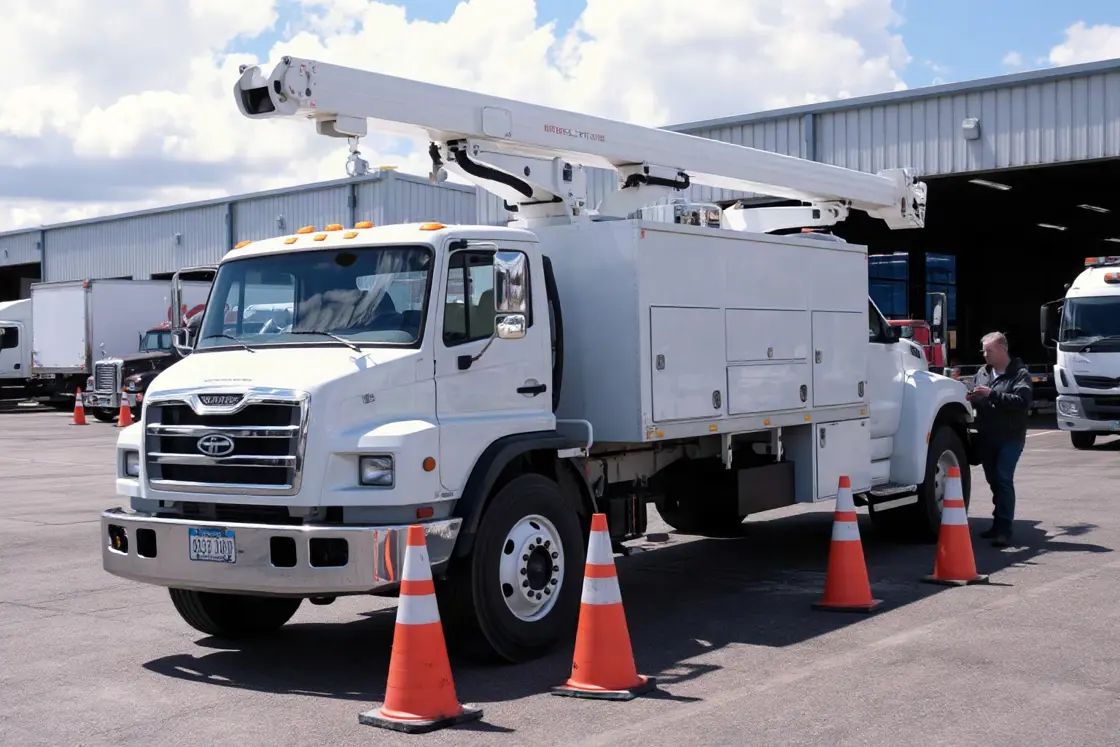
Collection planning is especially important for utility trucks. A non-running chassis, disabled hydraulic system or oversized body may require a commercial tow vehicle, a lowboy trailer, special loading equipment or a storage appointment. Auction guidance states that the buyer normally arranges collection from the agency location and must meet the stated pickup window 1. Missed deadlines can create storage charges or administrative complications, depending on the sale terms.
Budgeting beyond the winning bid
A realistic ownership worksheet should separate the bid from every mandatory and probable expense. Buyer premiums, sales or use tax, title processing, registration, transportation, storage, inspection and immediate maintenance can materially alter the final total. A truck that needs tires, batteries, fluids, brakes or hydraulic repairs may require substantial work before it can safely perform commercial duties.
| Cost area | What to investigate | Why it matters |
|---|---|---|
| Auction charges | Buyer premium, taxes and administrative fees | These are added to the accepted bid under the sale terms |
| Transport | Towing, loading, distance and storage | Non-running or specialized trucks may need dedicated equipment |
| Mechanical work | Fluids, tires, brakes, batteries, suspension and engine repairs | Deferred maintenance can appear immediately after collection |
| Special equipment | Hydraulic, boom, winch, PTO and certification inspections | Failure can make the body unsafe or unsuitable for service |
| Ownership | Registration, commercial compliance, fuel and maintenance | Operating costs continue after the auction transaction |
Insurance costs are also shaped by vehicle weight, use, driver requirements, location, claims history and whether the truck carries specialized equipment. Maintenance costs depend on age, engine type, parts access and body complexity. Depreciation may be slower for a well-maintained standard pickup than for a highly specialized body with limited private demand, so resale assumptions should be conservative.
Titles, registration and comparison with ordinary used trucks
Title paperwork can differ between seized property and surplus fleet vehicles. Federal surplus transactions may use a Certificate of Release of a Motor Vehicle rather than a state-issued title, and state motor-vehicle offices may require additional review before registration 8. The buyer should verify whether the documents identify the vehicle by VIN, whether liens or salvage branding appear, and whether the intended state accepts the document for road registration.
Compared with a conventional used commercial truck, an auction vehicle may offer a clearer government maintenance trail, but it usually provides less consumer protection and less opportunity for a comprehensive pre-purchase inspection. A dealer or commercial-equipment seller may provide more documentation, preparation and support, while an auction can expose the buyer to unknown idle hours, storage damage, incomplete keys or specialized repairs. The appropriate comparison is total cost, condition, legal usability and intended workload, not the bid alone.
A practical inspection and decision checklist
Before bidding, confirm the auction’s public-access rules, viewing schedule, payment method, pickup deadline, buyer fees and title procedure. Match the VIN on the truck to the auction record and inspect the body for collision repairs, corrosion, missing panels and altered wiring. Review engine hours where available, because high idle time can indicate substantial wear even when odometer mileage appears moderate.
- Arrange an independent mechanic or qualified equipment technician when the rules permit.
- Test the chassis separately from the utility body and its hydraulic or electrical systems.
- Confirm payload, axle ratings, dimensions and licensing requirements for the planned use.
- Obtain a written transport estimate before placing a bid.
- Reserve funds for immediate fluids, tires, brakes and safety repairs.
- Check title, VIN, odometer, tax and registration requirements with the relevant state office.
The central risk is treating an auction truck as a ready-to-work vehicle because it once belonged to a public agency. Government ownership can indicate scheduled fleet care, but it does not guarantee low wear, complete records, current certification or road readiness. A disciplined assessment weighs the truck’s service history, inspection results, paperwork, transport and projected maintenance against comparable used commercial vehicles.
Sources
- How Government Auctions Work in 2026 (No Dealer License Needed) | BidProwl: https://bidprowl.com/guides/how-government-auctions-work
- How to Buy a Government Surplus Vehicle (2026): Pricing, Inspection & Bidding | GovAuctions.app: https://govauctions.app/guides/how-to-buy-government-surplus-vehicle
- How Government Auctions Work Before You Bid – Government Auctions Blog: https://www.governmentauctions.org/blog/2026/09/18/how-government-auctions-work/
- Government Seized Auto Auctions: How to Find and Bid - LegalClarity: https://legalclarity.org/government-seized-auto-auctions-how-to-find-and-bid/
- How Federal Surplus Property Auctions Work – Government Auctions Blog: https://www.governmentauctions.org/blog/2026/08/08/federal-surplus-property-auctions/
- Maintenance for Utility and Field Service Fleets: https://oxmaint.com/industries/fleet-management/utility-field-service-fleet-maintenance-guide-2026
- Utility Fleet Maintenance: Trucks, Vans and Specialized Vehicles: https://oxmaint.com/industries/fleet-management/utility-fleet-maintenance-trucks-vans-and-specialized-vehicles
- Government Surplus Vehicle Guide: Ex-Police & SF-97 Fix: https://0taxtags.com/government-surplus-vehicle-buying-guide-ex-police-cars-gsa-fleet-auctions-and-the-sf-97-title-trap/
Authored by MyTrendSpot team