Early signs of eczema vs psoriasis flare up: A Clinical Comparison of Early Changes
Early signs of eczema vs psoriasis flare up can be difficult to distinguish because both conditions may begin with dry, inflamed, uncomfortable skin. Eczema more often develops as intense itching and poorly defined irritation, while psoriasis tends to form persistent, sharply bordered plaques that become thicker and scaly. 1
How an eczema flare-up may begin
An eczema flare-up commonly starts with increasing dryness, sensitivity, and intense itching before the rash becomes obvious. The skin may look red on lighter skin tones and dark brown, purple, or gray on darker skin tones. Early patches often have indistinct edges and may swell, crack, ooze clear fluid, or later form crusts. Scratching can intensify inflammation, creating an itch-scratch cycle that raises the risk of skin damage and secondary infection. 2
Atopic eczema is commonly associated with a weakened skin barrier and an over-sensitive immune response. Early changes frequently appear in the folds of the skin, including the insides of the elbows and backs of the knees, but the face, hands, wrists, and neck can also be affected. Symptoms often begin in childhood, although eczema can continue into adulthood or appear later. A history of asthma or hay fever can provide useful context, but it does not establish a diagnosis. 3
How a psoriasis flare-up may begin
Psoriasis often begins as a clearly defined area of redness or discoloration that gradually develops raised, thicker texture. White or silvery scale may build over the surface as skin cells accumulate faster than they normally shed. Itching can occur, although psoriasis may also feel sore or burning rather than predominantly itchy. Cracks that bleed, persistent plaques, and lesions that remain sharply outlined are features that merit clinical review. 4
The earliest psoriasis changes commonly occur on the scalp, elbows, knees, or lower back, particularly on the outer surfaces of joints rather than inside their creases. Scalp psoriasis may extend beyond the hairline. Nail pitting or other nail changes can support suspicion of psoriasis, and joint pain may indicate associated psoriatic arthritis. In children, scalp and elbow or knee involvement can be especially informative, sometimes following a recent streptococcal infection. 5
Appearance, borders, and body location
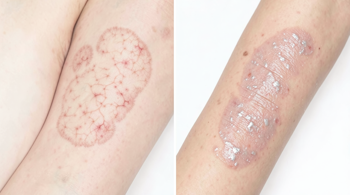
Border definition is one of the most useful visual contrasts, although it is not definitive. Eczema patches generally have less sharply demarcated edges and may look dry, swollen, leathery, or weeping. Psoriasis plaques are usually more sharply outlined, raised, and covered by dry scale. Overlap remains possible: either condition can affect many body areas, and scratching can thicken eczema enough to make it resemble psoriasis. 1
Location can add context to the appearance. Eczema is commonly found in flexural areas such as the inner elbows and behind the knees, while psoriasis more often affects the outer elbows and knees, scalp, and lower back. Skin-fold psoriasis may appear shiny or moist with peeling rather than showing typical silvery scale. These patterns help clinicians form an assessment, but they cannot replace examination because infections, irritation, and other rashes can also produce dry scaling. 6
Triggers and the meaning of a flare
Both eczema and psoriasis can worsen after stress, weather changes, or irritation, so a trigger alone cannot identify the condition. Eczema is often aggravated by allergens, irritants, dry conditions, and changes that further weaken the skin barrier. Psoriasis flare-ups may reflect immune activation and can appear after skin injury or irritation through the Koebner phenomenon, in which new lesions develop at previously damaged sites. 7
A practical early-flare record should note when symptoms began, whether itching or thickness appeared first, the exact body location, recent skin injury, illness, product exposure, weather changes, and whether nails or joints are involved. Repeated observations can show whether patches settle and recur or remain persistent. However, the same trigger may worsen different inflammatory skin conditions, and an apparent response to one cream does not reliably confirm the underlying diagnosis. 4
Risks of confusing eczema with psoriasis
Confusing the two conditions can lead to unsuitable self-treatment because their mechanisms and management approaches differ. Eczema management generally emphasizes restoring moisture and protecting the skin barrier, while psoriasis may require anti-inflammatory or immune-modulating treatment, topical therapy, phototherapy, or systemic treatment depending on severity. A rash that repeatedly returns, spreads, cracks, or fails to improve with an established care plan warrants assessment rather than repeated experimentation. 8
Potential complications also differ in emphasis. Severe itching and scratching in eczema can produce open skin and secondary infection, particularly where the rash is weeping or crusted. Psoriasis can cause painful fissures and may be associated with nail disease or joint symptoms. Rapidly worsening redness, marked pain, warmth, pus, extensive blistering, or fever should be treated as reasons for prompt medical evaluation, while new joint pain in someone with psoriasis-like plaques should be reported to a clinician. 2
When professional assessment is important
Professional diagnosis is particularly important when a rash is new, widespread, recurrent, or located near the eyes, because eczema, psoriasis, fungal infection, contact dermatitis, and other conditions can look alike. Clinicians generally consider the rash's border, scale, thickness, distribution, duration, symptoms, medical history, and nail or joint findings. There is no single appearance that identifies every case, and some people have overlapping or atypical patterns. 9
Until the cause is clarified, observation should focus on changes rather than assumptions: photograph the same area under similar lighting, record symptoms and possible exposures, and avoid scratching or irritating the skin. Existing prescribed treatment should be used only according to the clinician's instructions, because treatment choices differ between eczema and psoriasis. A dermatologist or primary-care clinician can determine whether the early changes represent a flare and whether infection, allergy, or another condition needs consideration. 10
Sources
- Health.com, Eczema vs. Psoriasis: Key Differences Explained
- AccessGP, Psoriasis and Dry Scaly Rashes
- WebMD, Conditions That Can Look Like Psoriasis but Aren't
- DermNet, Psoriasis Clinical Overview: Signs, Diagnosis, and Classification
- Contemporary Pediatrics, Differentiating Pediatric Atopic Dermatitis, Psoriasis, and Seborrheic Dermatitis
- National Psoriasis Foundation, Is It Psoriasis or Eczema?
- DermNet, Psoriasis Clinical Overview: Koebner Phenomenon
- Johns Hopkins Medicine, Eczema
- Clearview Dermatology, How to Tell the Difference Between Eczema, Psoriasis, and Rosacea
- Mayo Clinic, Psoriasis or Eczema
Authored by MyTrendSpot team