Dental hygienist salary comparison by state: A 2026 Analytical Review of Occupational Earnings
The landscape for dental hygienist compensation in the United States reflects a complex intersection of localized labor demand, cost-of-living variances, and specific state-level licensing requirements 1. As of 2026, the national median annual salary for dental hygienists has reached an estimated $102,946, a figure that continues to trend upward from the $98,100 benchmark recorded in 2025 1. Understanding these salary differences requires looking beyond headline numbers, as regional economic conditions and the prevalence of group practice models significantly influence the take-home pay of registered dental hygienists (RDHs) 1, 6.
National Compensation Trends and Growth Metrics
The dental hygiene profession has exhibited consistent salary growth over the past six years, driven by a projected 7% employment expansion through 2034 1, 7. Between 2020 and 2026, the median annual wage rose from $77,090 to an estimated $102,946, reflecting an annual growth trend supported by sustained demand for preventive dental services 1. This trajectory is underscored by the 10th percentile of earners, which represents the typical starting pay for new graduates, currently estimated at approximately $78,579 per year 8.
Because the role is licensed on a state-by-state basis without an interstate compact, professionals must navigate re-credentialing when relocating, which often impacts salary negotiation flexibility 4, 7. The market is predominantly structured around hourly rates and scheduled work days rather than fixed annual salaries, meaning that an RDH's total annual income is directly tied to the number of days they are clinically active 4. This structure makes consistency in employment settings a primary determinant of annual earnings variability across different states 4.
Regional Disparities in Dental Hygienist Pay
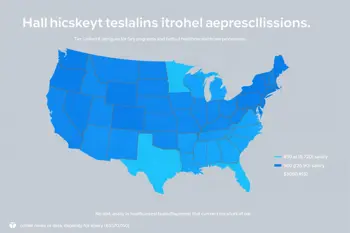
Data consistently indicates that the highest-paying regions for dental hygienists include the Pacific Northwest and California, though these areas also correlate with elevated costs of living 2, 6. For instance, Alaska, California, and Washington frequently report some of the highest nominal salaries, with average annual wages often exceeding $100,000 2, 3. In contrast, Southern and certain Midwestern states often report lower mean salaries, which is partially attributed to variations in local healthcare service demand and differences in practice management styles 2, 5.
| State | Average Annual Salary | Median Annual Salary |
|---|---|---|
| Washington | $131,530 | $131,160 |
| California | $128,110 | $124,930 |
| Colorado | $110,030 | $109,580 |
| Virginia | $105,120 | $102,950 |
| New York | $103,640 | $106,130 |
The Role of Cost of Living and Economic Adjustments
When evaluating state-by-state salary figures, it is essential to adjust for Regional Price Parity (RPP) to determine actual purchasing power 6. A high nominal salary in a high-cost urban center may provide less disposable income than a lower nominal salary in a state with a lower cost of living 6. For example, states like Arizona and Texas often perform well when salaries are adjusted for local expenses, as they combine competitive hourly wages with moderate housing and tax environments 6.
Economists and market researchers suggest that the absence of state income tax in certain jurisdictions can provide a significant boost to a professional's effective take-home pay, even if the gross salary appears lower compared to states with high income tax rates 6. Therefore, evaluating a compensation offer requires a comprehensive assessment that includes tax liabilities, housing costs, and the specific regulatory environment of the state in question 6.
Impact of Practice Setting on Earnings
The specific environment in which a dental hygienist practices is a primary driver of compensation variances regardless of geography 5. Private general dental offices typically provide a different pay structure compared to corporate dental support organizations (DSOs) or public health clinics 5. Specialists, particularly those with additional certifications such as local anesthesia or expanded-function permits, are positioned to command rates toward the 75th or 90th percentiles of the pay scale 4.
- Specialty dental offices: Generally offer competitive pay for specific advanced skills.
- Corporate/DSO practices: Often feature high-volume scheduling, affecting hourly availability.
- Public health/FQHC settings: Often prioritize steady employment but may offer lower base hourly rates.
- Per diem/Temping: Provides significant hourly flexibility, with rates currently ranging from $45 to $60 per hour 5.
Licensure and Professional Requirements
Entry into the field requires an associate degree from a Commission on Dental Accreditation (CODA) accredited program, followed by successful completion of the National Board Dental Hygiene Examination (NBDHE) and a state-administered clinical exam 7. These rigorous requirements create a standardized baseline for the profession, but the variation in state-specific clinical exams acts as a barrier to labor mobility 4. Consequently, the salary premium observed in certain states can be partially explained by the scarcity of locally licensed professionals, which drives up competitive bidding for available talent 6.
As of 2026, the ongoing maturation of the dental labor market suggests that prospective and current dental hygienists should monitor local state board regulations, as these rules determine the scope of practice and the ability to leverage specialized certifications for higher wages 1, 4. With approximately 15,300 annual projected job openings, the profession remains stable, though individuals must remain cognizant of the regional and setting-specific nuances that dictate long-term earning potential 7.
Methodology and Data Integrity
Salary figures presented in this review are derived from Bureau of Labor Statistics Occupational Employment and Wage Statistics (OEWS) data, supplemented by projections utilizing historical compound annual growth rates (CAGR) of 4.94% 1. It is important to note that BLS data is retrospective, and current estimations are necessary to reflect the rapid shifts in local labor markets 1, 4. The distinction between entry-level P10 figures and the P90 figures for top earners illustrates the necessity of evaluating career stage alongside geographic location when analyzing earnings potential 4.
Readers should also be aware that reported compensation can vary significantly depending on the source of the data, as some platforms rely on self-reported employee information while others utilize payroll-linked datasets 3. Utilizing government-validated labor surveys remains the most reliable method for understanding macroeconomic pay trends, while local market research is required for evaluating the nuances of specific dental practice offers 1, 5.
Sources
- Dental Hygienist Pay: Salary by State (2026)
- World Population Review: Dental Hygienists Salary by State 2026
- Rippling: Dental hygienist salary in the US (2026)
- GlobalCybers: Dental Hygienist Salary 2026, By State, Metro & Level
- Wealthvieu: Dental Hygienist Salary by State (2026)
- Dental Hygienist Pay: Cost-of-Living Adjusted Pay
- GlobalCybers: Dental Hygienist Career Guide 2026
- Dental Hygienist Pay: Entry Level Dental Hygienist Salary (2026)
Authored by MyTrendSpot team