A Guide to Identifying Reproductive Health Issues: Clinical Warning Signs and Evaluation
Identifying reproductive health issues begins with recognizing changes that may otherwise be dismissed as normal, including irregular periods, persistent pelvic pain, unusual discharge, painful sex, or difficulty becoming pregnant. This guide distinguishes common warning patterns from emergency symptoms and explains when clinical evaluation, testing, or routine screening may be appropriate. 1
What Reproductive Health Includes
Reproductive health covers the uterus, ovaries, fallopian tubes, cervix, vagina, breasts, related hormones, menstrual function, fertility, contraception, pregnancy, and sexual health. Problems may be structural, hormonal, infectious, or chronic, and they can occur during adolescence, reproductive years, pregnancy, or menopause. Because several conditions share symptoms such as bleeding, pain, bloating, or cycle changes, a symptom alone cannot establish a diagnosis. 2
Awareness is useful because some disorders develop gradually and begin with subtle changes. Tracking cycle timing, bleeding intensity, pain location, discharge, urinary symptoms, sexual discomfort, and pregnancy history can give a clinician a clearer pattern. A new or persistent change is more informative than one isolated variation, particularly when it interferes with sleep, work, sexual activity, or daily function. 3
Menstrual Changes That Merit Attention
Occasional cycle variation can occur during puberty, periods of stress, lifestyle changes, or hormonal transitions. Persistent irregularity, missed periods, unusually long or short cycles, or a substantial change in bleeding can be associated with PCOS, thyroid disorders, or other hormonal conditions. Heavy bleeding, especially when it repeatedly affects daily life, should also be discussed with a healthcare professional rather than automatically accepted as normal. 4
PCOS may involve irregular periods, acne, increased facial or body hair, and difficulty with ovulation or pregnancy. These features do not confirm PCOS because other conditions can produce similar symptoms. A clinical assessment may consider menstrual history, physical findings, laboratory testing, and imaging where indicated. Bleeding after menopause is a separate warning pattern that requires medical assessment. 5
Pain, Discharge, and Sexual Symptoms
Mild menstrual cramping may occur without an underlying disorder, but persistent pelvic pain, pain outside menstruation, painful intercourse, painful urination, or pain that progressively limits activities warrants evaluation. Endometriosis is one possible cause and can involve painful periods, chronic pelvic pain, pain during or after sex, painful bowel movements or urination during menstruation, and difficulty becoming pregnant. 6
Unusual vaginal discharge, genital sores, burning with urination, lower abdominal pain, fever, or pain during intercourse may indicate an infection, including a sexually transmitted infection or pelvic inflammatory disease. Many sexually transmitted infections cause no symptoms, so testing may be relevant after a potential exposure even when a person feels well. Symptoms should not be used to rule out infection. 7
Fertility and Pregnancy-Related Concerns
Infertility generally means that pregnancy has not occurred after at least 12 months of regular, unprotected intercourse. Evaluation is commonly considered after six months when the woman is age 35 or older, while earlier assessment may be appropriate with absent or very irregular periods, known fertility problems, endometriosis, pelvic inflammatory disease, repeated miscarriages, or previous chemotherapy or radiation. 8
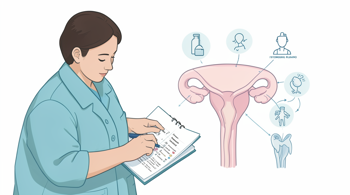
Fertility concerns may involve the female reproductive system, the male reproductive system, both partners, or no identifiable cause. Assessment can include reproductive and medical histories, physical examination, ovulation evaluation, semen analysis, pregnancy testing, laboratory work, and imaging of the reproductive tract. A fertility concern should therefore be evaluated as a shared medical issue rather than automatically attributed to one partner. 9
Emergency Warning Signs
Sudden, severe, or one-sided pelvic or abdominal pain can signal an urgent condition, particularly when accompanied by nausea, vomiting, fainting, fever, or heavy vaginal bleeding. In a person who could be pregnant, severe pain or bleeding may require prompt assessment for ectopic pregnancy. Ovarian torsion is another urgent possibility because blood flow to an ovary can be affected. 10
Sudden severe testicular pain also requires emergency assessment because testicular torsion can block blood flow to the testicle. Other concerning combinations include severe pain with fever, vomiting, fainting, or heavy bleeding. These patterns are different from routine monitoring of mild, familiar symptoms and should be assessed through emergency medical services or an emergency department according to local arrangements. 11
Testing, Screening, and Clinical Evaluation
A reproductive health visit may include questions about symptoms, menstrual timing, sexual exposure, contraception, pregnancy possibility, medications, previous infections, surgeries, and fertility history. Depending on the presentation, evaluation may include a physical examination, pregnancy test, STI testing, hormone or other laboratory tests, and imaging. Because symptoms overlap, the appropriate combination depends on age, medical history, examination findings, and the pattern of symptoms. 12
Cervical cancer screening uses HPV testing, cervical cytology, commonly called a Pap test, or both, with the recommended approach determined by age and previous screening history. Screening is preventive and differs from diagnostic evaluation of symptoms such as abnormal bleeding or pelvic pain. Keeping an accurate record of cycle changes, pain, discharge, and test results can support more precise conversations about follow-up and treatment. 13
Practical Interpretation of Symptoms
No single symptom identifies one disease. Heavy bleeding may occur with fibroids, hormonal disorders, or other conditions; pelvic pain may relate to endometriosis, infection, ovarian problems, or non-reproductive causes; and irregular cycles may reflect PCOS, thyroid disease, stress, or life-stage changes. The most useful distinction is whether a symptom is persistent, worsening, recurrent, associated with other warning signs, or disruptive to ordinary activities. 2
Seeking evaluation does not mean that a serious disease is present, but delaying assessment can allow treatable problems to continue or complications to develop. Particular attention is warranted for persistent pain, unusual bleeding, genital sores, abnormal discharge, painful urination, fertility concerns, or symptoms after a possible infection exposure. Emergency care is appropriate for sudden severe pain, fainting, vomiting, fever, or heavy bleeding. 3
Sources
- Kokilaben Hospital, Female Reproductive Health Issues Guide
- VidaBeacon, Gynecologic Health: The Complete Guide
- Women’s Healthcare UK, Important Signs of Reproductive Health Problems
- Your Health Magazine, Common Reproductive Health Concerns
- Office on Women’s Health, Polycystic Ovary Syndrome
- Cleveland Clinic, Endometriosis
- Centers for Disease Control and Prevention, Sexually Transmitted Infections and Pelvic Inflammatory Disease
- Mayo Clinic, Infertility Symptoms and Causes
- American Society for Reproductive Medicine, Infertility Evaluation
- American College of Obstetricians and Gynecologists, Ectopic Pregnancy
- National Health Service, Testicular Torsion
- American Society for Reproductive Medicine, Infertility Evaluation
- National Cancer Institute and U.S. Preventive Services Task Force, Cervical Cancer Screening
Authored by MyTrendSpot team