Public auction listings for seized fleet vehicles: A Reporter's Guide to How These Sales Work
Public auction listings for seized fleet vehicles circulate through dozens of official channels each month, spanning federal platforms like GSA Auctions to county sheriff notices published in local newspapers. The government auctions thousands of motor vehicles each year, with some units retired directly from active agency fleets and others forfeited or impounded through law enforcement proceedings. 1 Understanding the distinctions between these categories is foundational to navigating the market accurately.
The Institutional Sources Behind Seized and Surplus Fleet Vehicle Auctions
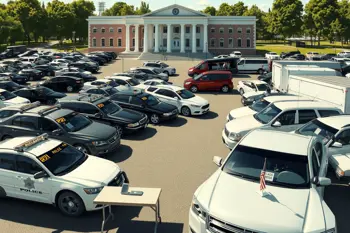
Fleet vehicles reach public auction through two distinct legal pathways. The first involves routine surplus disposal: federal agencies retire vehicles after a set service period, typically around seven years, with scheduled maintenance documentation accompanying each unit. 2 The federal government operates one of the largest civilian fleets in the world, estimated at roughly 650,000 vehicles, and turns over a significant portion annually. 3 The second pathway is law enforcement seizure, where vehicles are confiscated as evidence, forfeited under civil or criminal proceedings, or abandoned at impound facilities and never reclaimed.
Local and county agencies generate substantial seized vehicle volume independently. The Kimble County Sheriff's Office in Texas, for example, held a public auction of abandoned and seized motor vehicles with a minimum bid of $250 per unit, and state law requires sale proceeds to be held for 90 days so original owners or lienholders can file claims. 4 The Columbus Division of Police scheduled an August 2026 auction of approximately 110 impounded vehicles at its city impound lot, with all units sold as-is carrying salvage titles. 5 These local events occur on a recurring basis, with some jurisdictions like Kansas City operating bi-weekly impound lot auctions throughout the calendar year. 6
Major Platforms Where Public Auction Listings Are Published
Several distinct platforms aggregate or host these listings, and buyers typically need to monitor multiple sources simultaneously. The primary federal portal is GSAFleet.gov, which since January 2026 routes federal fleet vehicle sales through weekly nationwide auctions operated by IAA (Insurance Auto Auctions). Roughly 30,000 to 40,000 federal fleet vehicles reach the public through this channel each year, and participation requires both a free IAA account and a GSA bidder number obtained through pre-registration. 2 A separate platform, GSAauctions.gov, continues to list non-vehicle federal surplus and occasional rolling stock from individual agencies. 7
For state and local agency vehicles, GovDeals functions as the largest centralized marketplace, listing fleet vehicles from cities, counties, school districts, and utilities. 3 PropertyRoom.com partners with law enforcement agencies specifically to auction seized, abandoned, and surplus vehicles. 8 Public Surplus serves municipalities and school districts disposing of retired fleet equipment. 9 U.S. Marshals Service seized asset auctions handle vehicles forfeited through Department of Justice proceedings, while U.S. Treasury auctions cover property forfeited for tax evasion or violations of Treasury law. 1 Individual jurisdictions also contract with regional auctioneers: the Norfolk Police Department runs monthly auctions through Auction757, with the August 2026 sale expected to include 87 or more cars, trucks, vans, and motorcycles spanning makes from Toyota and BMW to Cadillac and Mercedes. 10
Typical Vehicle Types and Realistic Price Bands
The composition of inventory varies significantly by source. Federal fleet sales predominantly feature sedans, SUVs, and light trucks used by civilian agency employees, with most units three to five years old and carrying 60,000 to 120,000 miles. 3 Police and impound auctions present a wider range, from late-model confiscated vehicles to high-mileage, non-running units missing keys. Specialty auctions sometimes introduce unusual inventory: the collapse of Bollinger Motors led to 19 of the company's B4 electric evaluation fleet trucks appearing at auction in Ortonville, Michigan, as creditors sought to recover losses. 11
Published price guidance from industry observers places government vehicle auction outcomes in the following general bands based on historical market averages:
| Vehicle Category | Typical Auction Range (Historical Average) |
|---|---|
| Fleet Sedans | $2,000 - $8,000 |
| SUVs | $5,000 - $18,000 |
| Pickup Trucks | $4,000 - $20,000 |
| Police Cruisers | $3,000 - $12,000 |
These figures represent historical auction outcomes across multiple platforms and should not be interpreted as guaranteed pricing. Heavily damaged, non-running, or salvage-titled units commonly sell below the lower bounds of these ranges, while low-mileage fleet units in documented good condition may approach or exceed the upper bounds. 3
Registration, Bidding Procedures, and Payment Requirements
Participation requirements differ by agency and auction format, but several procedures appear consistently across public listings. Registration with a valid government-issued ID is universally required, and many platforms mandate pre-registration before the auction date rather than at the facility. The Orange County Sheriff's Office auction held at Royal Auction Group in Zephyrhills, Florida required online pre-registration and set age minimums: attendees must be at least 16 years old, and bidders must be 18 or older. 12 The Pasadena, Texas city auction requires all purchasers to obtain a bidder's number by presenting identification and submitting their name, address, and phone number. 13
Payment methods and timelines are strictly enforced. The Columbus impound auction accepted cash only, with checks requiring prior approval and a bank validation letter. 5 The Kansas City tow lot auction charged a $25 per lot administrative fee plus a 10% buyer's premium on all sales, and required a $300 deposit starting in March 2026 to register. 6 Non-payment at that auction results in a permanent ban from future sales. Vehicle removal deadlines are equally rigid: Kansas City buyers had until the Saturday following the auction, with a $30 per day storage fee for late pickups. The San Antonio Police Department's asset seizure auctions require payment by cash or credit card on the day of the sale, with all property removed the same day. 14
Inspection Windows, Title Conditions, and As-Is Sale Terms
Inspection access is one of the most important variables separating informed bids from uninformed ones. Most public listings provide limited preview windows before bidding closes. The Norfolk Police auction offered a two-hour inspection window on the Tuesday before a Thursday sale. 10 The Orange County Sheriff's Florida auction allowed viewing on the two days prior to sale dates between 9:00 AM and 4:00 PM, plus a compressed window from 7:30 to 9:00 AM on sale mornings. 12 However, many impound auctions provide no guarantee that a vehicle will start or run, and most do not include keys. The Kansas City tow lot auction terms state explicitly that most vehicles will not be in running condition and most lack keys, with all sales final and no warranty of any kind. 6
Title status presents an additional complexity buyers must evaluate before bidding. Salvage titles are common at impound and law enforcement auctions, as seen with the Columbus Division of Police sale where all approximately 110 units carried salvage titles. 5 Federal fleet vehicles sold through GSA channels are generally non-salvage units, but GSA's terms specify all vehicles are sold as-is with no warranty and SF-114C amendments govern the terms of each sale. 15 Third-party vehicle history reports such as CARFAX or AutoCheck are recommended by some auction operators, though these services are not affiliated with the auctioning agencies and carry their own fees. 10
Risks, Regulatory Oversight, and Market Friction Points
Several structural risk factors are inherent to seized fleet vehicle auctions that prospective participants should weigh carefully. First, the as-is condition means undisclosed mechanical failures, frame damage, odometer discrepancies, and incomplete service histories are all possible. Unlike private dealer transactions, there is no consumer protection remedy if a vehicle proves unusable after purchase. Second, the title chain can be complex: seized vehicles may carry liens that the auction does not discharge, and buyers are responsible for clearing title through the appropriate county tax or DMV office. The Kimble County example notes that purchasers must apply at the county tax office to receive a clear title free of all liens after the sale. 4
Regulatory oversight varies by jurisdiction. Federal auctions through GSA are governed by standardized federal property disposal regulations. State and county auctions operate under individual state surplus property laws, and notice publication requirements differ significantly. Some auctions are announced only through agency websites, local newspapers, or agency social media pages, creating information asymmetry between frequent participants and first-time buyers. Forfeiture law itself is subject to ongoing legal challenge in multiple states, meaning that title conveyance for certain seized vehicles can occasionally be delayed or reversed by court order after a sale. Buyers operating in commercial fleet replacement contexts should account for additional costs including towing, mechanical inspection, title processing fees, and potentially extended timelines before a purchased unit reaches operational status. 16
Sources
- USAGov - Government vehicle auctions (usa.gov/car-auctions)
- GovAuctions.app - Government Car Auctions Near Me, How to Find and Buy 2026 (govauctions.app)
- BidProwl - Government Vehicle Auctions $2k-$20k 2026 (bidprowl.com)
- Yahoo News / Concho Valley Homepage - Kimble County Sheriff's Office to hold auction for abandoned, seized vehicles (yahoo.com)
- NoticeRegistry - Public Notice 2700 Impound Lot Rd., Columbus, OH, July 24, 2026 (noticeregistry.com)
- Woolsey Auction / OAI Auctions - Bi-Weekly Kansas City Police Impound Auction July 2026 (woolseyauction.com)
- GSA Auctions - Auctions Home (gsaauctions.gov)
- PropertyRoom.com (propertyroom.com)
- Public Surplus (publicsurplus.com)
- Auction757 - Norfolk Police Auction August 13, 2026 (auction757.com)
- Car-Revz-Daily - Seized Bollinger Trucks Hit The Auction Block To Pay Off Debts, January 2026 (car-revz-daily.com)
- NoticeRegistry - Equipment and Vehicle Procurement, Orange County Sheriff's Office, Zephyrhills FL, July 2026 (noticeregistry.com)
- City of Pasadena TX - City Auctions (pasadenatx.gov)
- City of San Antonio SAPD - Seized Property and Auctions (sa.gov)
- Metro Auto Auction Phoenix - GSA Federal Fleet Sale (metroaa.com)
- GovernmentAuctions.org Blog - How Government Truck Auctions Work for Buyers, July 31, 2026 (governmentauctions.org)
Authored by MyTrendSpot team