Police auction SUVs on sale: A Comprehensive Guide to Municipal and Federal Surplus Fleet Liquidation
The Mechanics of Public Vehicle Liquidation
For individuals researching the availability of police auction SUVs on sale, understanding the administrative structure of government surplus liquidations is essential. Across the United States, municipal police departments, county sheriffs, and state agencies routinely retire fleet vehicles and auction seized assets to the public. These public sales are organized systematically, transitioning municipal utility vehicles from active service to civilian ownership. Rather than utilizing traditional dealership networks, government entities partner with specialized auction houses or manage their own local auto pounds to execute these public liquidations.
Local and county liquidations occur on strict schedules, handling varying volumes of vehicles. For example, the Houston Police Department schedules regular public auctions at contracted storage lots to process unclaimed vehicles 1. Similarly, the Norfolk Police Department schedules recurring auctions to liquidate cars, trucks, and utility platforms 2. These events serve as the primary legal mechanism for municipalities to clear their storage facilities and generate revenue from retired public assets.
Registration, Bidding Rules, and Deposit Requirements
Participating in public vehicle auctions requires strict adherence to regional administrative regulations. Most auction structures mandate that all bidders register beforehand with a valid state-issued identification card, driver's license, or accepted international identification 4. Financial commitments also vary by municipality; for instance, certain municipal tow lot auctions, such as the Kansas City Tow Lot, require a $300 security deposit to establish bidding eligibility 3. This step ensures that all active participants are financially vetted before bidding on retired assets.
Payment and fee structures are similarly rigid across different municipal venues, as outlined in the comparative table below:
| Auction Location | Payment Requirements | Administrative Fees | Removal Deadlines |
|---|---|---|---|
| Kansas City Tow Lot 3 | Cash or wire transfer due day after close | $25 admin fee plus 10% buyer's premium | Saturday following the sale |
| Dallas Auto Pound 4 | Full payment within one hour of final sale | Standard municipal fees apply | 11:59 PM the day following auction |
| Columbus Police Impound 5 | Cash only (or pre-approved bank check) | Varies by vehicle salvage status | Wednesday after the auction |
Fleet Standard Models and Vehicle Profiles
The standard inventory available at these public sales features heavy-duty utility vehicles manufactured to meet demanding operational requirements. Among the most common models are Ford Explorer Police Interceptor vehicles, which are frequently retired from municipal patrol duty. Municipalities like Galesburg, Illinois, have held auctions featuring several retired 2020 Ford Explorer utility models 6. Other departments, such as the Elmira Police Department, coordinate periodic online sales that list multiple utility and patrol platforms alongside specialized municipal gear 7.
In addition to mid-sized interceptor platforms, larger utility options like the Chevrolet Tahoe Police Package and Ford Expedition are frequently liquidated. These vehicles often present higher mileage figures due to extended operational use. For example, a retired 2018 Chevrolet Tahoe auctioned in Jim Wells County, Texas, showed an odometer reading of 230,266 miles 8, while a 2022 Chevrolet Tahoe LS in Manitoba showed 268,715 kilometers 9. Buyers must anticipate these heavy usage profiles when analyzing the market for retired fleet assets.
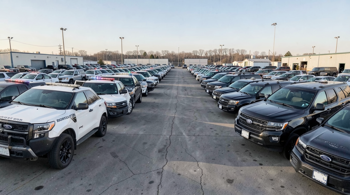
Vehicle Conditions, Disclaimers, and the 'As-Is' Reality
A critical consideration for any prospective buyer is the vehicle's mechanical condition and functional history. All assets are sold strictly on an as-is basis, with no express or implied warranties. Many vehicles may possess serious mechanical or structural damage from past operational accidents. For example, a 2022 Ford Explorer Police Interceptor auctioned by the Chemung County Sheriff in New York was listed in poor condition with heavy rear-end damage, rendering it suitable primarily for spare parts 10. Buyers must perform extensive research to assess whether a vehicle is functional or salvage-grade.
Furthermore, decommissioned municipal vehicles are stripped of active law enforcement equipment prior to public release. This process includes the removal of light bars, sirens, computer mounts, and official city decals, which can leave cosmetic holes in the bodywork or interior panels 11. Buyers must legally ensure that any remaining emergency signaling instruments are completely decommissioned before operating the vehicle on public roads 12. Failure to do so can result in serious legal penalties under local vehicle codes.
Logistical Realities and Post-Sale Compliance
Logistical planning is another crucial phase of purchasing retired municipal vehicles. Due to liability regulations, many impound lots and municipal storage yards do not allow purchased vehicles to be driven directly from the facility. The Dallas Auto Pound, for example, mandates that all purchased vehicles be removed via a licensed wrecker service 4. Additionally, buyers face strict removal deadlines; failure to transport the vehicle within the specified timeframe can result in steep storage fees, which can accumulate at rates like $30 per day 3.
The administrative process of securing a title also introduces unique challenges. Depending on the vehicle's history, condition, and jurisdiction, it may be issued with a salvage title, a municipal title, or a simple bill of sale 11. In certain regions, such as Kimble County, Texas, the purchaser is only issued a clear title after submitting the appropriate paperwork to the local county tax office 13. Navigating these title transfers is a mandatory administrative step before the vehicle can be registered for civilian use.
National and Federal Auction Channels
For buyers looking beyond local municipal tow lots, federal and national platforms offer structured alternatives. The federal government auctions thousands of vehicles annually through centralized programs, including GSA Fleet Vehicle Sales and GSA Auctions 14. These sales feature vehicles retired from federal agencies, which are often well-maintained and in road-ready condition. Additionally, agencies like the U.S. Marshals Service and the U.S. Treasury host regular public auctions to liquidate assets seized during federal law enforcement actions 14.
Commercial vehicle liquidation platforms also provide broad access to repossessed and impounded fleets. Platforms like Copart host twice-weekly wholesale auctions featuring bank-owned and impound vehicles from reputable institutional sellers 15. While these platforms offer detailed condition reports and optional arbitration protections, buyers must still register, pay buyer premiums, and arrange professional vehicle transport 15. This multi-layered ecosystem requires buyers to be thoroughly prepared before bidding on any surplus utility asset.
Sources
- Houston Police Department Auto Dealers Detail
- Norfolk Police Department Auction757
- Kansas City Police Department Tow Lot Auction
- Dallas Police Department Auto Pound Unit
- NoticeRegistry Columbus Division of Police Public Notice
- WGIL Galesburg City Vehicle Auction News
- MyTwinTiers Elmira Police Department Auction News
- Global Auction Guide Jim Wells County Sheriff
- Global Auction Guide McDougall Auction Manitoba
- Global Auction Guide Chemung County Sheriff
- Central Auction Group Inventory
- Global Auction Guide City of Gloversville
- Concho Valley Homepage Kimble County Sheriff Auction News
- Government Vehicle Auctions via USAGov
- Copart Repo and Impound Sales
Authored by MyTrendSpot team